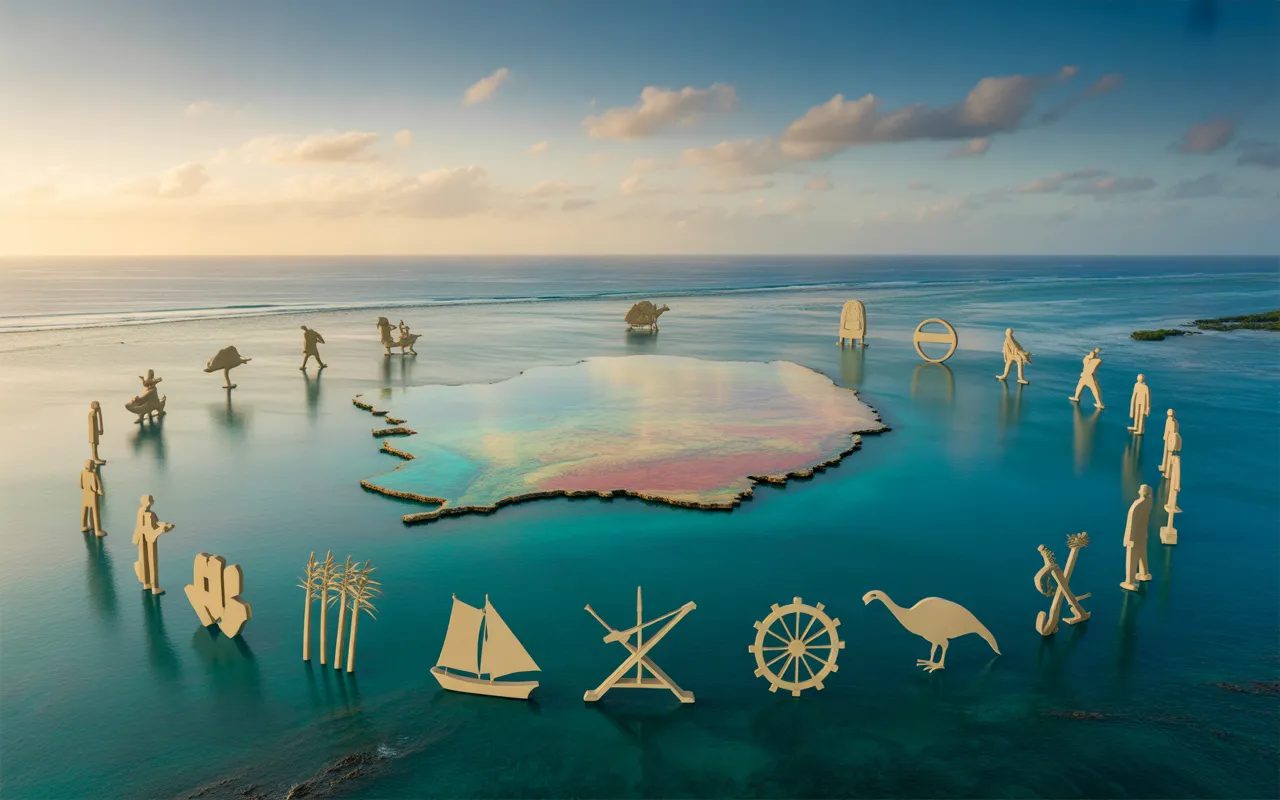
One island, twelve dates, and a whole identity.
If you are looking for a clear summary of the history of Mauritius, These timelines provide a reliable overview: successive colonizations (Dutch, French, British), the abolition of slavery, the arrival of indentured laborers, economic developments, and then independence and the Republic. In just a few minutes, you will understand why Mauritius is today a nation multicultural, multilingual and facing the Indian Ocean.
To learn more about daily life, procedures and settling in, you can also consult the expatriation guides from Expat Mauritius.
Summary
- 12 dates to remember (with context)
- Summary table: the timeline at a glance
- What these landmarks reveal about Mauritian society today
- FAQ about Mauritian history
The 12 key dates in Mauritian history
1598 – The Dutch land and give the name «Mauritius»
At the end of the 16the century, Dutch navigators took possession of the island and named it Mauritius (referring to Prince Maurice of Nassau). This moment is a true starting point: it establishes a name that will endure through the centuries and paves the way for a more structured European presence. To understand what follows, it's important to remember that the island was then uninhabited (but probably known to Arab sailors much earlier), which explains the logic of maritime stopovers in the Indian Ocean.
Useful source: Britannica – History of Mauritius.
1638 – First Dutch colony (permanent settlement)
The Dutch were no longer content with simply passing through; they settled. This period was marked by the exploitation of resources (notably ebony), the introduction of crops and animals, and the first colonial organization. It was also a phase in which the ecological footprint accelerated (deforestation, introduced species), an issue that still resonates today in the attention paid to Mauritian ecosystems.
To establish the colonial context: Britannica – History of Mauritius.
1710 – Dutch abandonment: the island once again becomes a coveted stopover
After costly and largely unsuccessful attempts, the Dutch left the island. This withdrawal had a direct consequence: Mauritius once again became a strategic territory "to be seized," situated on a major maritime route between Europe, Africa, and Asia. This liminal space paved the way for the French arrival and the subsequent military importance of the island at the beginning of the 19th century.e century.
Key reference confirmed by: Britannica – History of Mauritius.
1721 – Beginning of the French occupation: «Isle de France»
The French East India Company occupies the island and renames it Isle de France. The population gradually intensified, and the French administration permanently structured the territory. A very visible legacy remains: the law, certain institutions, and a strong presence of the French language in culture and daily life, including after the British period.
Reference source: Britannica – History of Mauritius.
1736 – Port Louis becomes an administrative center (and major supply port)
Under French administration, Port Louis Port Louis stands out as the administrative heart and strategic port of the island. Its relatively sheltered geography and location on maritime routes make it a major logistical hub between Europe and Asia. Even today, Port Louis is home to institutions, historical sites (museums, historic buildings), and a large part of the economic activity.
For a date reference (1736): Port Louis – historical.
1810 – Mauritius Campaign: Battle of Grand Port (August) and surrender (December)
The year 1810 was decisive: the naval battle of Grand Port (August 1810) is famous as a rare British defeat at sea during the Napoleonic Wars. But the French victory was short-lived: a large British force then landed, and the island capitulated in December 1810. Mauritius then fell into the British sphere of influence, while retaining a strong French cultural continuity.
Detailed and quantified account: Britannica – Battle of Grand Port.
A striking feature of Mauritian history is this continuity: even under British sovereignty, many customs, laws and cultural references of French origin remain structuring.
November 2, 1834 – Arrival of the first Indian indentured laborers (beginning of a major migration)
After the abolition of slavery in the British Empire, Mauritius became a testing ground for the use of indentured labor: "indentured servitude." A frequently cited symbolic marker is the arrival of 36 workers hired THE November 2, 1834, aboard the Atlas, at the very beginning of this system. On the scale of the 19the century, this movement will permanently transform the demography, languages, religions and culture of the island.
Source : Britannica – Aapravasi Ghat.
1er February 1835 – Abolition of slavery in Mauritius
Slavery was abolished in Mauritius in 1835 (commemorated the 1er FEBRUARYThis date still shapes national memory: it explains some of the social, land-related, and cultural legacies, and it also sheds light on the emergence of the indentured labor system. To understand this turning point without oversimplifying, it is important to remember that the post-abolition period did not instantly erase inequalities: rather, it ushered in a period of transitions and restructuring.
Sources: Britannica – History of Mauritius ; UNESCO – Slave Trade and Slavery Records in Mauritius (1721–1892).
1849 – Construction of the Aapravasi Ghat Immigration Depot
The immigration office of’Aapravasi Ghat, in Port Louis, is built in 1849 to receive and register indentured workers. The site is central to understanding Mauritian social history: according to UNESCO, almost half a million committed workers arrive between 1834 and 1920, Aapravasi Ghat is associated with the emergence of a modern diaspora of contract laborers. The site is now a major memorial site.
Sources: UNESCO – Aapravasi Ghat (official record) ; Britannica – Aapravasi Ghat.
1869 – Opening of the Suez Canal: Port Louis loses part of its maritime role
The opening of Suez Canal In 1869, the events profoundly altered trade routes between Europe and Asia. For Mauritius, the consequence was clear: stopovers in the Indian Ocean changed, and Port-Louis is seeing its port activity decline compared to the time when rounding the Cape was the norm. This example shows how geopolitical and technical decisions made far from the island can reshape its economy.
Source : Britannica – History of Mauritius.
March 9, 1959 – First elections by universal adult suffrage (key figure)
The path to independence lies in broadening political participation. March 9, 1959, General elections are held with, for the first time, the adult universal suffrage. One figure illustrates the magnitude of the shift: the number of voters then rose to 208 684. This step makes the emergence of modern democratic institutions, now at the heart of Mauritian political stability, more legible.
Source : Government of Mauritius – Explore Mauritius.
March 12, 1968 – Independence of Mauritius
THE March 12, 1968, Mauritius became an independent state within the Commonwealth. This date is a fundamental landmark: it marks the shift towards full political sovereignty and a fully developed nation-building process. In the following decades, the country underwent major economic transformations (diversification beyond sugar, industrialization, and then the rise of the service sector), which contributes to Mauritius's current image: a small island state, but one that is very well connected to international trade.
Sources: Britannica – Independence of Mauritius ; Government of Mauritius – institutional landmarks.
March 12, 1992 – Mauritius becomes a Republic
THE March 12, 1992, Maurice becomes a Republic within the Commonwealth. The country transitioned from a constitutional monarchy (with the British monarch as head of state) to a system with a president as head of state, while retaining a parliamentary system. This institutional evolution consolidated a distinct political identity, in continuity with the independence achieved 24 years earlier.
Sources: Britannica – Mauritius becomes a republic ; Government of Mauritius – March 12, 1992.
Summary table: the history of Mauritius in 12 dates
Summary timeline (date, event, impact)
| Date | Event | Why it's a landmark |
|---|---|---|
| 1598 | Dutch takeover, name "Mauritius"« | The name sticks and the island becomes a maritime prize |
| 1638 | First Dutch colony | Beginning of a sustainable occupation and an ecological impact |
| 1710 | Departure of the Dutch | The island was once again coveted, marking the transition to the French era. |
| 1721 | French occupation (East India Company), "Isle de France"« | Strong administrative structure and Francophone heritage |
| 1736 | Port Louis becomes an administrative center | Strategic port, still central today |
| 1810 | Battle of Grand Port and British conquest | Transition to British administration |
| 02/11/1834 | First Indian indentured laborers (symbolic beginning) | The beginning of a major demographic transformation |
| 01/02/1835 | Abolition of slavery | Decisive social and economic turning point |
| 1849 | Construction of Aapravasi Ghat | A key location in the history of indentured labor and the diaspora |
| 1869 | Opening of the Suez Canal | Reconfiguration of shipping routes and the role of Port Louis |
| 09/03/1959 | Adult universal suffrage elections (208,684 voters) | A major step towards political autonomy |
| 12/03/1968 | Independence | Birth of the sovereign Mauritian state |
| 12/03/1992 | Proclamation of the Republic | Modern institutional consolidation |
What these landmarks reveal about Mauritius today
A multicultural society born from several historical waves
The periods of slavery and then indentured servitude, combined with European influences (France/Great Britain) and regional migrations (Africa, India, China, Madagascar), explain the current diversity of Mauritius: cuisines, festivals, religions, languages, surnames, and neighborhoods. The example of’Aapravasi Ghat is telling: UNESCO recalls the arrival of almost half a million of workers engaged between 1834 and 1920, a determining factor in contemporary demographic composition.
Read this: UNESCO – Aapravasi Ghat.
A "mixed" legal and linguistic culture«
British colonization (from 1810 onwards) did not erase the French influence: elements of language, culture, and administrative traditions remain visible. The result is a country where one naturally navigates between several linguistic and cultural registers, which is often part of the "positive culture shock" experienced upon arrival.
Summary reference: Britannica – History of Mauritius.
A small but strategic territory (yesterday as today)
From maritime routes to contemporary geopolitics, Mauritius's location in the Indian Ocean matters. A simple historical example: the opening of the Suez Canal in 1869 changed trade flows and reduced the relative importance of port calls, demonstrating how sensitive the island's economy is to major trade corridors.
FAQ – Frequently asked questions about the history of Mauritius
Why has Mauritius had several names (Mauritius, Isle de France, Mauritius)?
The island's names reflect the powers that have administered it. "Mauritius" appears with the Dutch takeover (late 16th century).e century). Under French occupation, the island was renamed "Isle de France" (early 18th century).eAfter the British conquest (1810), the name "Mauritius" was reinstated. This back-and-forth is useful for reading historical documents (maps, archives, buildings) and understanding why French influence remained strong despite the British period.
What is the difference between slavery and indentured servitude in Mauritius?
Slavery was based on the forced ownership of people, abolished in Mauritius in 1835 (commemorated on the 1ster February). Indentured labor was a system of contract work, later developed on a large scale, particularly with arrivals from India. UNESCO emphasizes that this movement (1834–1920) involved almost half a million indentured laborers arriving via Port Louis, and that Aapravasi Ghat is a major site of this history. Both systems shaped Mauritian society, but with distinct statuses and timeframes.
Why is March 12th so important in Mauritius?
March 12th embodies two institutional landmarks: independence (March 12, 1968) and the proclamation of the Republic (March 12, 1992). This dual symbolism makes it a powerful marker of national civic identity, often celebrated as a time of unity. Understanding this choice also helps to grasp political continuity: Mauritius is evolving towards greater sovereignty without a sudden break from the parliamentary system. It is a date that features prominently in commemorations, official speeches, and popular culture.
What sites should I visit to "see" Mauritian history firsthand?
To connect the chronology to concrete locations, Aapravasi Ghat (Port Louis) is essential: UNESCO designates it as a key site in the history of indentured labor and the migration of contract workers. In Port Louis, the colonial legacy can also be seen in the architecture and urban planning. For those interested in the Napoleonic era, the Grand Port area evokes the 1810 campaign. Finally, numerous museums and historical buildings help to understand the social evolution of the island, particularly in relation to slavery and its aftermath.
And now ?
Understanding the history of Mauritius also means better understanding its cultural codes, festivals, diversity, and way of life. If you are preparing a relocation project (visa/permit, housing, schooling, starting a business), you can discover the support offered by Expat Mauritius (Living in Mauritius: turnkey expatriation and real estate) and request a free evaluation via the contact channels indicated on the website.