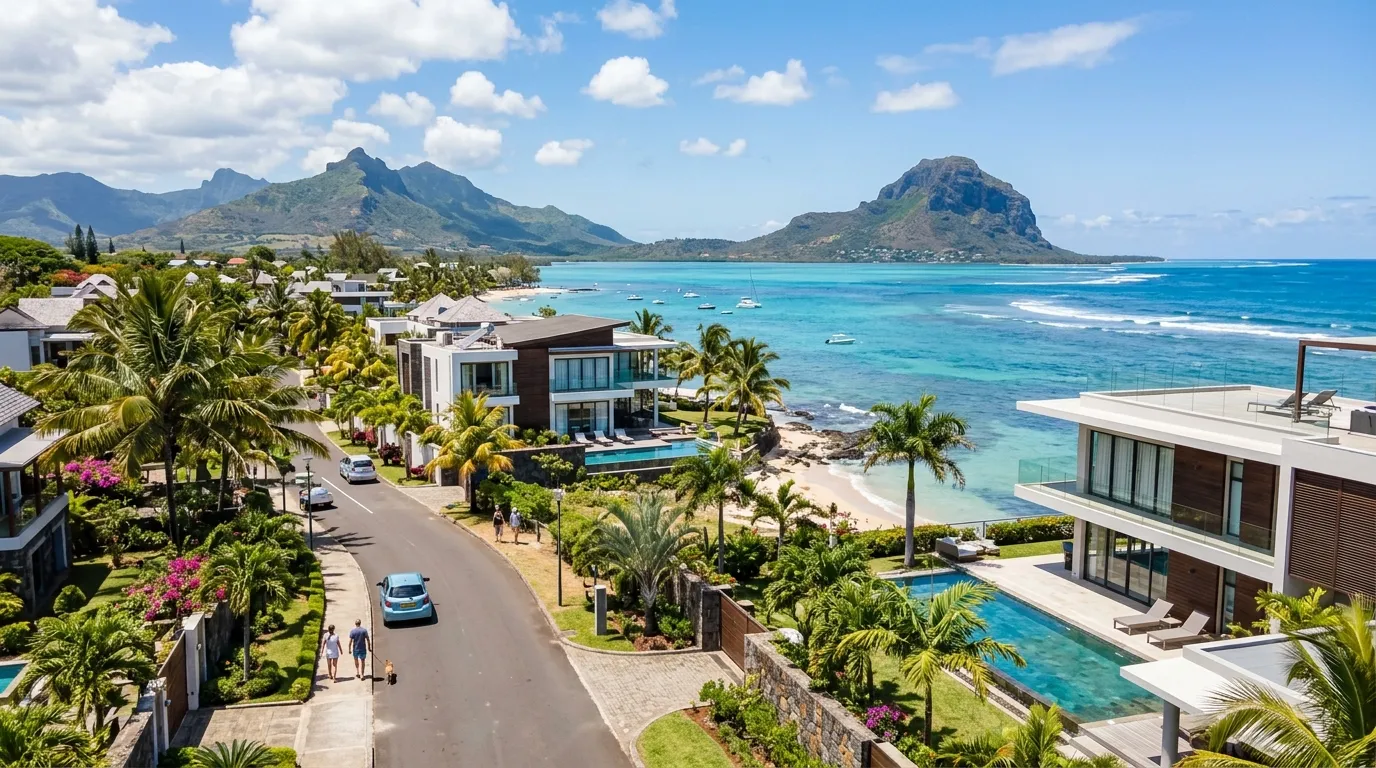
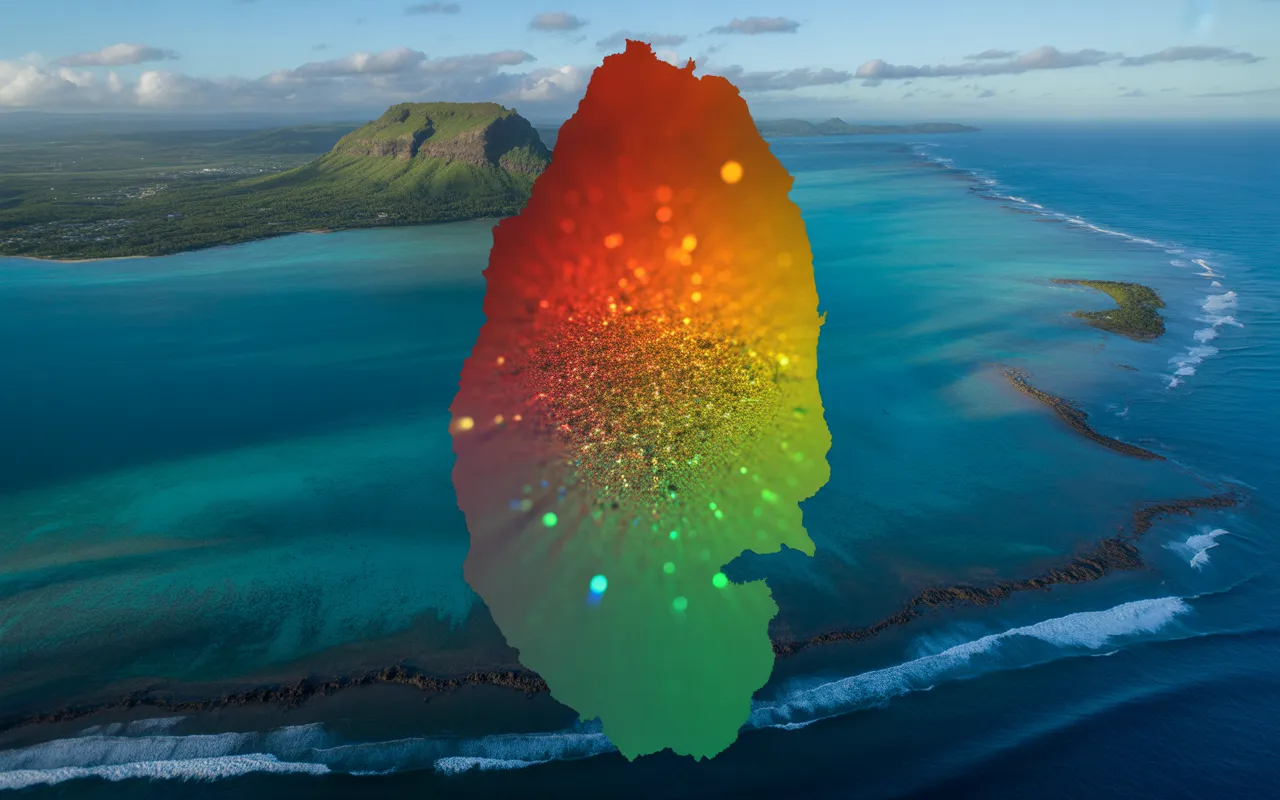
Mauritius is small, but very densely populated.
If you are looking for reliable benchmarks on the population of Mauritius (number of inhabitants, density, most populated areas), here is the essential information: as of December 31, 2024, the main island had 1,199,834 inhabitants and a density of approximately 642 inhabitants/km², while the Republic of Mauritius (including Rodrigues and Agalega) reached 1,244,477 inhabitants for a density of approximately 620 inhabitants/km² (official estimates). These figures explain in concrete terms why some areas are more fluid (or more saturated), why property prices vary greatly, and how to choose a place to live that is consistent with your expatriation project.
To learn more about settling in (visas/permits, housing, schools, banking, insurance, real estate, starting a business), you can consult the page Live in Mauritius with Expat Mauritius or browse the practical resources in the Expatriation guides.
Recent figures: population and density in Mauritius (2024–2025)
The data most commonly used in practice comes from Statistics Mauritius, the official body. They exist under several “reference dates” (end of year, mid-year), which can create modest differences depending on the source consulted.
- As of December 31, 2024 Republic of Mauritius 1 244 477 inhabitants; Mauritius 1 199 834 ; Rodrigues 44 313. (Source : Population and Vital Statistics – Year 2024 (PDF, Statistics Mauritius))
- Density as of December 31, 2024 Republic 620 inhabitants/km² ; MAURITIUS 642 inhabitants/km². (Same source)
- As of July 1, 2025 (Mid-year estimate, provisional): Republic 1 243 741 ; MAURITIUS 1 198 812 ; Rodrigues 44 599. (Source : Population and Vital Statistics – Jan–Jun 2025 (PDF, Statistics Mauritius))
Key points to remember: The average density is high in Mauritius, but the pressure is not uniform. It is concentrated mainly in the urban corridor and employment areas, while some coastal or rural areas remain more open—which changes everything for travel, access to services and real estate strategy.
How is population density calculated (and why is it important)?
There population density corresponds to number of inhabitants per km². In Mauritius, it is structurally high for a simple reason: a large population in a limited area (approximately 2,007 km² for the whole of the Republic according to Statistics Mauritius).
In concrete terms, density has a direct impact on:
- mobility (traffic jams during peak hours, commute time); ;
- the housing market (rental tension in certain areas, trade-off between surface area and price); ;
- access to services (schools, health, administrations, businesses); ;
- business opportunities (catchment areas, employment pools).
Population distribution of Mauritius: where do the inhabitants live?
When we talk about distribution, We must distinguish between two things: where people live And where they work. In Mauritius, these two realities do not always overlap, which explains the significant daily flows towards certain centers.
1) The urban center and main thoroughfares (Port Louis and the central plateau)
The historic and administrative urban core remains Port Louis, with a high concentration of activities (administration, services, commerce). Statistics Mauritius also points out that Port Louis remains the district receiving the most daily commuters in 2022, in front Plaines Wilhems (source : 2022 Population Census – Main Results (Highlights)).
Around this center, the central tray and the associated urbanized areas (notably the Plaines Wilhems area, with several towns) concentrate a large part of the population and jobs. This is often where you find:
- denser infrastructure (schools, health, administrations); ;
- a varied housing offer (apartments, houses, residences); ;
- travel times are more sensitive during peak hours.
2) The northern coastline: residential appeal and economic dynamism
THE North (and more broadly certain coastal areas) attracts people for very concrete reasons: quality of life, beaches, services, restaurants, and real estate development. In reality, this translates into greater pressure on:
- rents (depending on the exact location, supply and season); ;
- traffic during rush hour and peak tourist periods; ;
- the availability of certain services (nurseries/schools, health, etc.).
For an expatriation project, it is often a "favorite" area... but you have to weigh it against travel constraints if your activity is centered elsewhere.
3) The West: Between economic activity and quality of life
L'’West It combines sought-after residential areas and economic sectors linked in particular to services and tourism. The distribution of the population is contrasting: some coastal areas are becoming denser, while other areas remain more “breathable”.
4) The east and south: often more moderate population densities, but real local hubs
L'’East and the South These areas are sometimes perceived as “less populated,” but they are not empty: they contain key towns, business parks, and a well-established daily life. The population density is often more moderate than in the city center, which may appeal if you are looking for:
- more space and quiet; ;
- a potentially more flexible housing budget depending on the area; ;
- a lifestyle less dependent on major centres (or remote work).
5) Rodrigues and the outlying islands: another scale
Rodrigues represents a smaller share of the total population, with a lower density than Mauritius (approximately 402 inhabitants/km² end of 2024, and 405 inhabitants/km²
Recent developments: a slightly decreasing population
Recent figures show a slight decrease of the total population. For example :
- Between December 31, 2023 And December 31, 2024, the population of the Republic goes from 1 260 379 à 1 244 477 according to official publications (estimated data, see Statistics Mauritius PDFs). (Sources: Year 2023 (PDF) And Year 2024 (PDF))
- À mid-2025, The preliminary estimate is 1 243 741 (source : Jan–Jun 2025 (PDF)).
This decrease is explained by the combination of the natural dynamics (births – deaths) and migrations (inputs/outputs). Statistics Mauritius details these mechanisms in its publications “Population and Vital Statistics”.
Aging, households, needs: what the data says
Beyond the number of inhabitants, the population structure of Mauritius is extremely important in understanding the demand for housing, schools or health.
- THE 2022 census indicates a resident population of 1 235 260 (Republic) and a median age which increases (source: 2022 Population Census – Main Results).
- At the end of 2024, Statistics Mauritius highlights the progression in the share of 65 years and older in the population, a sign of aging (source: Year 2024 (PDF)).
Comparative table: population and density per island (end of 2023 vs end of 2024)
| Period (reference date) | Mauritius (population) | Rodrigues (inhabitant) | Agalega & St Brandon (hab.) | Republic (inhabitant) | Population density in Mauritius (inhabitants/km²) | Population density of the Republic (inhabitants/km²) |
|---|---|---|---|---|---|---|
| December 31, 2023 | 1 214 997 | 45 108 | 274 | 1 260 379 | 650 | 628 |
| December 31, 2024 | 1 199 834 | 44 313 | 330 | 1 244 477 | 642 | 620 |
Sources: Statistics Mauritius, “Population and Vital Statistics” Year 2023 & Year 2024 (official PDFs).
How population distribution affects your expatriation
Understanding the population of Mauritius It's not just about "having a number": it's a very concrete tool for decision-making where to live, where to school, where to invest And where to set up a business.
Choosing where to live: commute time vs. living environment
The denser an area is (or the more attractive it is), the more you have to make decisions:
- proximity to schools and services (often better in/near urbanized areas); ;
- quality of life (calm, open spaces, proximity to the sea); ;
- mobility (the roads leading to employment hubs may be congested).
Real estate: a "on-the-ground" reading of density
In areas of high demand (often linked to employment, services, or coastal appeal), density frequently translates into:
- a more competitive rental market; ;
- shorter search times for "well-located" properties; ;
- significant price differences even within a few kilometers.
Conversely, in less densely populated areas, you can sometimes get more space—but with other constraints (commuting, school provision, specialized services).
Starting a business: targeting population centers (or niche markets)
If you are starting a business, the distribution of the population helps to reason in terms of:
- catchment area (where are your customers?); ;
- access to the workforce (where do the assets reside, what are the home-to-work flows?); ;
- visibility (busy roads, commercial areas, business districts).
Reliable sources (to be consulted for verification and updates)
- Statistics Mauritius – Population and Vital Statistics, Year 2024 (PDF)
- Statistics Mauritius – Population and Vital Statistics, Jan–Jun 2025 (PDF)
- Statistics Mauritius – 2022 Population Census (Main Results – Highlights)
- United Nations – World Population Prospects (methodology, to understand the estimates and projections)
- United Nations – World Urbanization Prospects 2025 (benchmarks on urbanization)
FAQ — Frequently asked questions about the population of Mauritius
What is the current population of Mauritius?
According to official estimates from Statistics Mauritius, the’MAURITIUS count 1,199,834 inhabitants as of December 31, 2024. For a "mid-year" reading, the estimate as of July 1, 2025 is 1,198,812 inhabitants (Provisional data). The two figures are consistent: they describe a generally stable population, with a slight downward trend in the recent period. For international comparison, some databases (UN/World Bank) publish "mid-year" estimates that may differ slightly.
Why are there different figures depending on the source?
Because publications don't always use the same reference date (end of year vs mid-year), nor exactly the same estimation method (Post-census adjustments, migration assumptions, etc.). In Mauritius, Statistics Mauritius publishes clear series at the end of the year and at mid-year. International platforms (UN, World Bank, etc.) often rely on harmonized mid-year estimates. The best approach is therefore to compare figures that refer to the same date and the same geographical area (Mauritius vs. the Republic of the Republic).
What is the population density in Mauritius?
The density depends on the chosen perimeter. For the’MAURITIUS, Statistics Mauritius indicates a density of approximately 642 inhabitants/km² (end of 2024 and also mid-2025). For the whole of the Republic of Mauritius (including Rodrigues and Agalega), the density is approximately 620 inhabitants/km² (end of 2024 and mid-2025). This high density explains the concentration of services and traffic flows around major urban and economic centers.
Where is the population concentrated in Mauritius?
On a local level, the population is concentrated mainly around the urban centers and employment areas: Port-Louis and the large urbanized areas of the central plateau, as well as several attractive coastal sectors. Data from the 2022 census highlights significant commuter flows to Port-Louis and Plaines Wilhems, indicating economic centrality. For those considering relocating, this translates into a strategic choice: living near employment hubs to reduce commuting, or moving further away to prioritize quality of life.
And now ?
Are you looking to settle in Mauritius (or develop a project there), taking into account the realities of population density, commuting, and services? Expat Mauritius can provide comprehensive support (visas/permits, relocation, real estate, business creation) with local expertise and quick responses. Start with a free evaluation via the page Expat Mauritius, then explore the guides to prepare for your next steps.