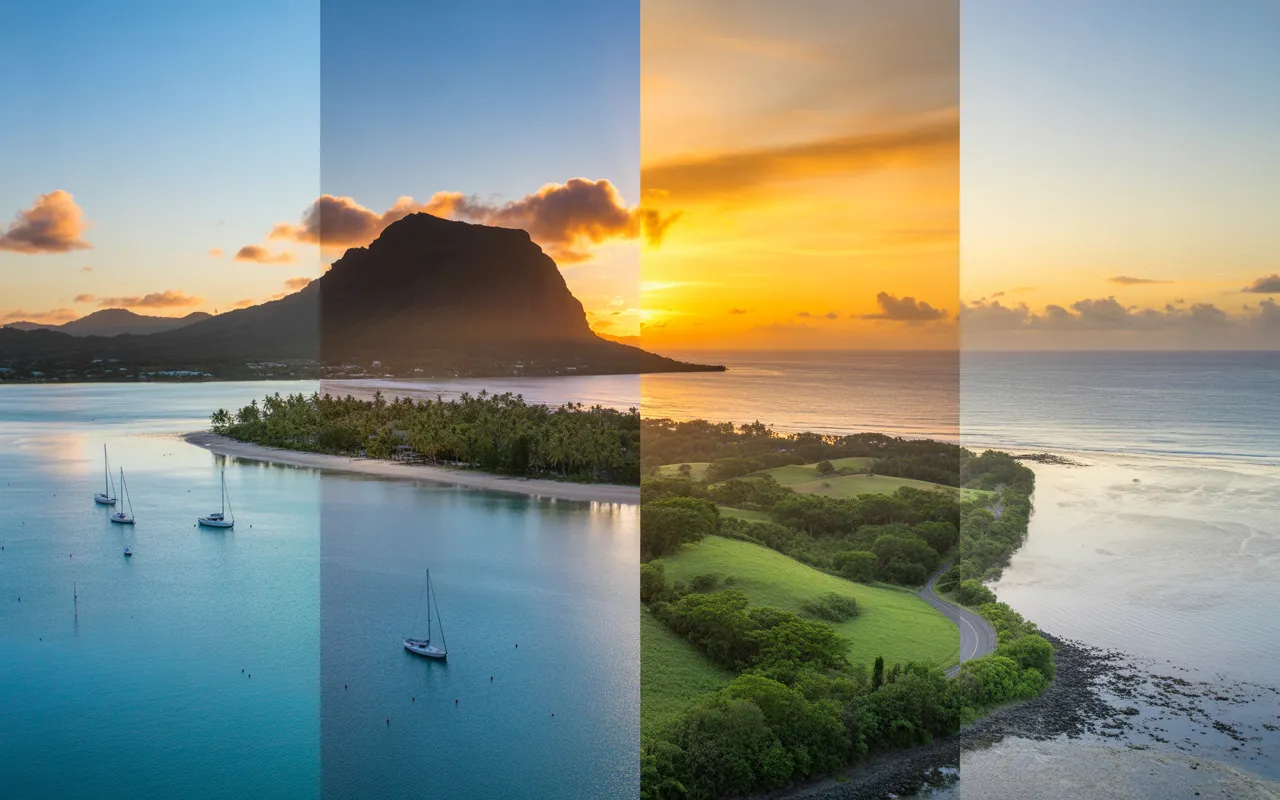
Choosing your region in Mauritius changes everything.
The North, West, East, and Central regions offer very different lifestyles (beaches, wind, commutes, schools, services, budget). This comparative guide provides a clear and actionable overview to help you decide where to settle—whether you're coming as a couple, a family, or to start a business—with on-the-ground information and information on available support. EXPAT MAURITIUS.
- You want a life where everything is "within reach"“ (restaurants, supermarkets, outings, expat communities): look first the North And the West.
- Are you looking for peace and quiet and a picture-postcard atmosphere?“ explore ballast.
- You prioritize school, work (Port Louis / Ebene) and a cooler climate : THE Center is often the best compromise.
How to choose the right region (without making a mistake)
Before falling in love with a beach, base your decision on concrete criteria. In Mauritius, distance is measured less in kilometers than in travel time (and in everyday comfort).
The 7 criteria that really make a difference
- Your lifestyle : outings and entertainment (North/West) vs tranquility (East) vs city/plateau (Central).
- Your workplace : Port-Louis, Ébène, business zones, or teleworking.
- Your sensitivity to the climate : wind on the East coast, more “drier” heat in the West, coolness on the central plateau.
- Your housing budget : highly sought-after areas on the coast quickly rise in price (especially in the most “expat” hubs).
- Schools & children's activities : access, travel, sports and extracurricular activities.
- Everyday services : health, businesses, infrastructure, fiber/Internet quality.
- Your long-term project : rental, purchase, investment, business creation (and associated administrative constraints).
Useful reference point: in 2022, Mauritius had 411,700 housing units and internet access has reached 75,0% households (compared to 31.7% in 2011), which greatly facilitates remote work—but the actual experience still depends on the neighborhood and housing. (Sources: Statistics Mauritius, Housing Census 2022).statsmauritius.govmu.org)
Quick comparison: North vs West vs East vs Central
Comparative table (profile, atmosphere, climate, points of attention)
| Region | Frequently sought-after sectors | Strengths | Points to consider | Climate (trend + annual rainfall LTM) | Ideal for… |
|---|---|---|---|---|---|
| North | Grand Baie, Pereybère, Mont Choisy, Trou aux Biches | Practical information, outings, shops, expat communities, water sports | Areas requested (budget), traffic at certain times | Drier than the East; representative station Grapefruits ≈ 1,349 mm/year (LTM 1971–2000, sum of monthly averages) (metservice.mu) | Couples, first-time expats, entrepreneurs, social life |
| West | Flic en Flac, Tamarin, Rivière Noire | Sunsets, lagoon, outdoor atmosphere, often sunnier climate | High demand at certain spots, premium prices on the coast | One of the driest areas; station Medina ≈ 781 mm/year (LTM 1971–2000, sum of monthly averages) (metservice.mu) | Remote workers, athletes, families, seaside living |
| East | Belle Mare, Trou d'Eau Douce, Roches Noires / Azuri | Peaceful setting, beautiful beaches, resorts, a more “natural” atmosphere” | More exposed to the trade winds (wind sensation), services sometimes more dispersed | More humid/windy; station Fuel ≈ 1,962 mm/year (LTM 1971–2000, sum of monthly averages) (metservice.mu) | Seeking tranquility, extended stay, "slow" lifestyle“ |
| Center | Moka, Ébène (nearby), Quatre Bornes, Curepipe, Vacoas | Proximity to employment hubs, cooler climate, road access to several coastlines | Less "postcard-perfect" on a daily basis (less immediate lagoon view) | Cooler, often more humid; resort Vacoas ≈ 1,996 mm/year (LTM 1971–2000, sum of monthly averages) (metservice.mu) | Families (schools/activities), employees, mobile entrepreneurs |
Method note: The “mm/year” values above are taken from the regional climate sheets of Mauritius Meteorological Services (LTM period 1971–2000) and correspond to the sum Monthly averages from the representative station (North: Pamplemousses, West: Médine, East: Fuel, Central: Vacoas). (metservice.mu)
Living in the North: the “easy” choice for many expats
The North is often the first choice for newcomers: it offers a high concentration of services, an active social life and easy access to beaches.
The most sought-after areas
- Grand Baie : convenient, lively, lots of shops and restaurants.
- Pereybère : beach atmosphere, often appreciated for a calmer daily life while remaining close.
- Mont Choisy / Trou aux Biches Residential, sea access, good compromise for families.
Why the North is (really) appealing
- Simple daily life Shopping, leisure, activities, services… often within a short distance.
- Social network : easier to meet people (expats and Mauritians), which accelerates integration.
- Good “landing” : ideal for a first temporary accommodation while getting to know the island.
Points to consider (and how to manage them)
- Housing budget Some areas are premium. Tip: extending your visit by 10–20 minutes can significantly change the value for money (to be confirmed during site visits).
- Traffic : depending on your schedule, anticipate the exit/entry routes.
Living in the West: sun, lagoon and “outdoor” lifestyle”
The West is known for its more stable weather and superb evenings. It is also a highly sought-after area for remote workers and those with a sport & nature background.
The most sought-after areas
- Flic en Flac : beach life, practical, a good base for “living by the sea” on a daily basis.
- Tamarind residential, popular for surfing, sports, and a more premium lifestyle.
- Black River : between sea and nature, close to water sports and wilder areas.
A very telling climate indicator
On the climate sheets of Mauritius Meteorological Services, the representative station Medina (West) springs with approximately 781 mm/year (LTM 1971–2000), significantly below the East/Central stations close to ~2000 mm/year. This does not “guarantee” the daily weather, but it clearly illustrates the microclimate from the West. (metservice.mu)
Points to consider
- Tight market For properties in good locations (sea view, close to the beach, beautiful residences): you need to be responsive and clearly define your specifications.
- Budget : the West concentrates a part of the “high-end” demand.
Living in the East: calm, wind, and a “slow living” spirit”
The East attracts those who want to breathe: less hustle and bustle, a more natural atmosphere, and magnificent beaches (often bordered by hotel zones).
The most sought-after areas
- Belle Mare Iconic beaches, very pleasant setting.
- Freshwater Hole : starting point towards Île aux Cerfs, coastal atmosphere.
- Black Rocks / Azure : residential, sought after for a “village” setting and a more relaxed lifestyle.
Things to know about the wind and rain
The trade winds (often from the East/Southeast) make the East coast more ventilated. In the regional climate data, the station Fuel (East) is located around 1,962 mm/year (LTM 1971–2000), compared to ~781 mm/year on the western side (Médine station). (metservice.mu)
When the East is an excellent choice
- You work remotely and you prioritize quality of life, peace and quiet, and a more “natural” environment.
- Do you love the sea? but not necessarily crowds (depending on the area and the season).
Living in the Centre: convenient, cooler, strategic for working
The Centre (central plateau and urban areas) is often underestimated by newcomers. Yet, it ticks many boxes: schools, access to services, proximity to business hubs, and a generally cooler climate.
The most sought-after areas
- Mocha : highly sought after, modern, often perceived as a “premium” compromise without being by the sea.
- Four Milestones : central, convenient, lots of shops.
- Curepipe / Vacoas : cooler, residential, access to several directions.
Climate: cooler, often more humid
Mauritius has a generally mild climate, with a hot/humid season (November to April) and a cooler/dryer season (June to September). However, the weather varies considerably depending on altitude and exposure. (metservice.mu)
At the station Vacoas (Centre), the annual rainfall is approximately 1,996 mm/year (LTM 1971–2000), consistent with the idea of a plateau with more rainfall than some coastal areas, and lower average temperatures than on the coasts. (metservice.mu)
Understanding Mauritian microclimates (to avoid surprises)
Mauritius doesn't have "one" weather: it has several microclimates. Mauritius Meteorological Services reminds users of the seasonal pattern (hot/humid summer, cooler/dry winter) and publishes weather reports by region (North/West/East/Central). (metservice.mu)
Reliable orders of magnitude
- The normal “average” rainfall on the island (reference 1991–2020) is indicated around 2,019 mm/year on the monthly climatology page. (metservice.mu)
- Spatial variability can be very high: a FAO summary cites a variation ranging from approximately 700 mm/year on the western coastal area at 4,000 mm/year on the highest parts of the central plateau.fao.org)
Field advice: If you are hesitating between two regions, test them at different times (morning/evening, rainy day, windy day) and check the actual ventilation of the accommodation (orientation, openings, mosquito nets, humidity).
Family: schools, calendar and daily organization
For families, the region is often chosen based on the three key factors school – journey – activities. Regarding the calendar, the Ministry of Education publishes the official dates: for example, for 2026, THE 1st quarter is indicated from January 12, 2026 At April 3, 2026, THE 2nd quarter of April 20, 2026 At July 17, 2026, and the 3rd quarter of August 17, 2026 At October 30, 2026. (education.govmu.org)
What this changes by region (in concrete terms)
- North / West : very pleasant for lifestyle, but anticipate school-work journeys if you have to go to Port-Louis/Ébène.
- Center : often simpler to get around (work + schools + access to several coasts), with cooler weather.
- East : beautiful setting, but plan ahead (services are more spaced out depending on the area).
Housing market: what you need to understand before renting or buying
It is tempting to compare only rents "seen online". However, in Mauritius, the price depends heavily on qualitative criteria: residence (security, swimming pool, gym), proximity to the sea, view, parking, generator, actual condition of the property, and quality of management.
Two macro-level reference points can help to provide context:
- The population of the Republic of Mauritius was 1 244 477 END 2024 (Statistics Mauritius), in a limited area—which mechanically increases the pressure on certain high-demand areas.statsmauritius.govmu.org)
- Tourism has reached 1,382,177 arrivals in 2024 (compared to 1,295,410 in 2023), which can influence certain coastal areas through seasonal rentals and property turnover.statsmauritius.govmu.org)
Why get support (and what EXPAT MAURITIUS does)
Choosing a region also means securing an overall project: visa/permit, housing strategy, settling-in procedures (bank, insurance, schools), and sometimes business creation. EXPAT MAURITIUS supports individuals and entrepreneurs with local expertise and personalized follow-up, from Azuri Village.
- For an overview of expatriation and real estate services: Living in Mauritius: turnkey expatriation
- For more information on the procedures and checklists: Expat Mauritius Expatriation Guides
- To learn more about the company and request initial guidance: official EXPAT MAURITIUS website
FAQ – Regions and Settlement with EXPAT MAURITIUS
What is the best region to settle in in Mauritius when arriving for the first time?
For a first landing, the North and the’West The simplest advantages are often: plenty of services, a variety of housing options, and an active social life. The right choice depends primarily on your work (Port Louis/Ébène or remote work) and your tolerance for traffic. The most effective approach is to rent temporary accommodation for 1–3 months, then refine your search based on your actual routine. EXPAT MAURITIUS can help you structure this phase to avoid making hasty decisions.
Where to live in Mauritius with a family (schools + transport)?
For many families, the Center (Moka, Quatre Bornes, Curepipe/Vacoas) offers an excellent compromise: more direct access to activity hubs, a cooler climate, and often simpler daily logistics. The North and West remain very attractive, but you must carefully plan your home-school-work commute. Official school dates (published by the Ministry) must also be factored into your annual planning, especially if you travel.education.govmu.org)
Which region should I choose for remote work in Mauritius?
If you work remotely, you can prioritize lifestyle:’West for a sporty atmosphere and often a drier climate, the’East for calm and a slower pace, or the North for easy access to services. In all cases, check the internet quality of the dwelling (and not just the neighborhood). Nationwide, internet access has increased significantly (75.01% of households in 2022), but performance varies depending on the buildings and equipment.statsmauritius.govmu.org)
Does the climate really change from one coast to the other in Mauritius?
Yes: Mauritius is small, but its microclimates are influenced by exposure to the trade winds, the topography, and altitude. Regional climate data shows significant differences between representative stations: the West (Médine) receives considerably less rainfall than the East (Fuel) and the Central region (Vacoas). The Mauritian meteorological services publish weather reports for each region (North/West/East/Central), useful for anticipating wind, rain, and temperatures based on your lifestyle (daily beach outings, hiking, children, etc.). (metservice.mu)
Can EXPAT MAURITIUS help me choose the region and secure my move?
Yes, the benefit of support is to connect your geographical choice to your overall project: status (visa/permit), travel constraints, budget, schools, and housing strategy (long-term rental, purchase, real estate investment). EXPAT MAURITIUS positions itself as a comprehensive partner with local expertise and quick responses, and can guide you toward solutions tailored to your situation. You can start by consulting their services and guides pages, then request a free assessment to define your priorities.
And now ?
If you're hesitating between North, West, East, and Central Mauritius, the most effective approach is to transform your criteria into an action plan (temporary accommodation, areas to visit, a realistic budget, and a visa/settling-in timeline). EXPAT MAURITIUS can support you every step of the way—from permits and real estate to practical matters—with a personalized approach. To get started, consult the resources and contact us through the official website to request a free assessment and move forward with peace of mind.