Importing personal belongings to Mauritius is not something to be done on a whim.
Between potential duty and tax exemptions, customs documents, prohibited or permit-required items, and logistical costs (transport, handling, storage, delivery), an international move requires methodical planning. This guide provides a clear approach, checklists, and practical tips to help you avoid delays and stay within your budget.
For a complete relocation (visa/permit, housing, schooling, banking, insurance, business creation), you can also rely on EXPAT MAURITIUS, based in Azuri Village, with personalized support and a free assessment.
1) Personal effects and Mauritian customs: what the rule really says
Definition: What does Mauritian customs call “household & personal effects”?
The Mauritius Revenue Authority (MRA) typically includes household goods such as furniture, bedding, linens, dishes, appliances, and devices like TVs/radios, musical instruments, etc., in “household and personal effects.”mra.mu)
In practice, the idea is simple: goods intended for your personal and family use, consistent with a setup (and not an import for commercial purposes).
Exemption from duties and taxes: who is eligible (and under what conditions)?
According to the MRA, personal and household effects can be not subject to duties and taxes if you are eligible for the exemption (e.g., first arrival for permanent residence, Mauritian returning after at least one year abroad, or non-citizen coming to work in Mauritius with an Occupation Permit/Work Permit to present).mra.mu)
Important conditions to anticipate:
- Goods purchased abroad And not intended for sale nor to the transfer.mra.mu)
- Import time : the effects must be imported within 6 months following your arrival (with the possibility of extension if the MRA considers there to be a reasonable cause).mra.mu)
- Long-term commitment : if you wish to sell/transfer/otherwise use the assets before age 4 From the date of exemption, you must notify in writing the MRA.mra.mu)
Summary table: Customs exemption for personal effects (Mauritius)
| Key point | Key takeaways | Consequences if not respected |
|---|---|---|
| Eligibility | Eligible profile (permanent settlement, return to the country, or arrival to work with a valid permit) | Risk of duties/taxes payable or of being held up pending receipt of supporting documents |
| Import time | Import into the 6 months based on arrival (unless an extension has been accepted) | Risk of losing the exemption |
| Nature of the goods | Household goods, purchased abroad, not for sale | Reclassification as a “commercial” import (increased controls, taxes, procedures) |
| Resale/transfer | Written notification if sold/transferred before age 4 | Risk of regularization (duties/taxes) and additional formalities |
| Packing list | A detailed list is strongly recommended to facilitate customs clearance. | Potentially longer procedure (provisional declaration, inventory to be completed) |
This summary is directly based on the guidelines published by the MRA.mra.mu)
2) Customs clearance documents and procedures: the “stress-free” checklist”
Documents generally requested by customs (MRA)
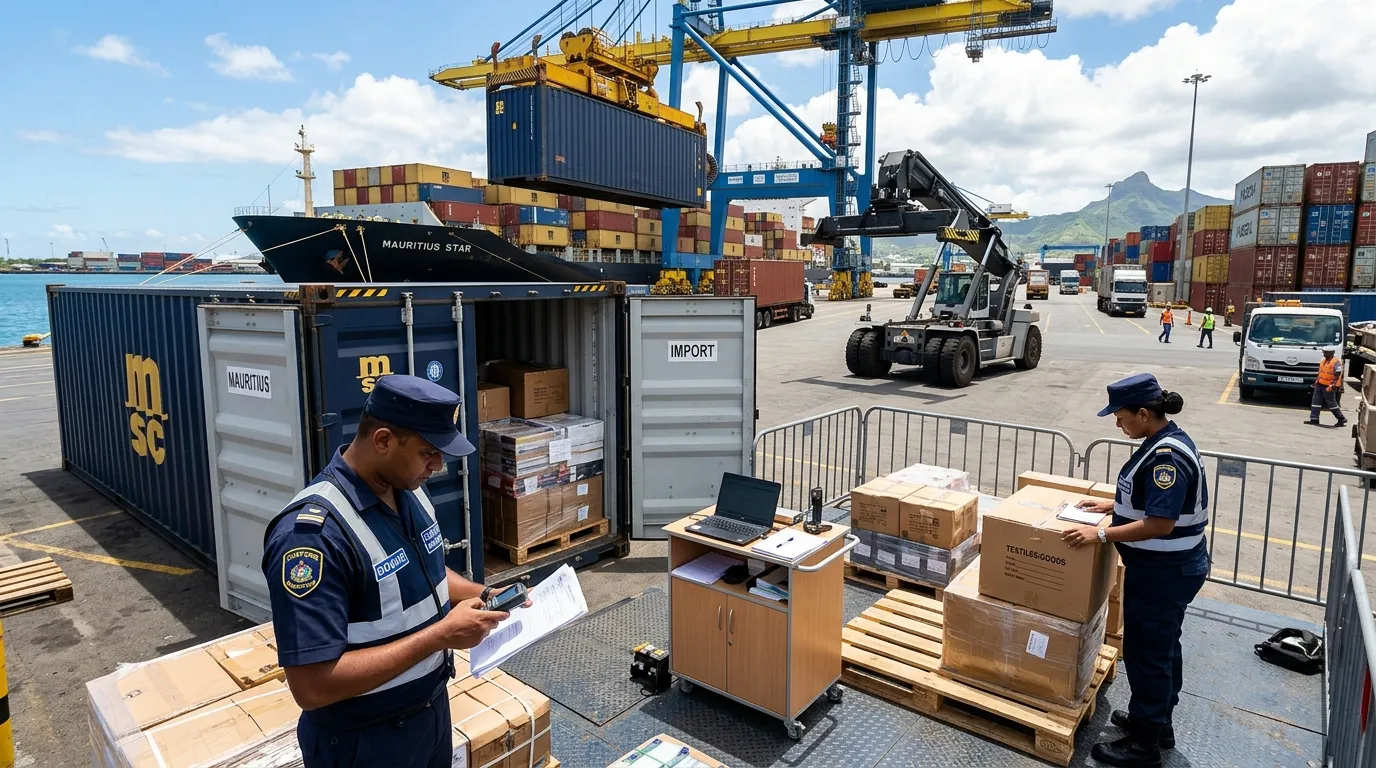
For customs clearance of personal and household effects, the MRA specifies the following documents: passport, Passport Memo (to be collected from the Passport and Immigration Office), inventory of the shipment, and shipping arrival papers (Arrival documents provided by the carrier / shipping company / airline).mra.mu)
Packing list: the number one tool for avoiding delays
The MRA recommends submitting a detailed list (packing list). Without this list, a provisional statement may be necessary to list all imported items.mra.mu)
Good packing list practices (very effective in quality control):
- One line per carton: carton number, room (kitchen/living room), description, quantity.
- Clearly indicate the “sensitive” items: electronics, alcohol, tools, valuables.
- Avoid vague labels (“misc.”, “various”) on too many lines: it often triggers checks.
Special cases: when authorizations are required
The MRA reminds us that some products require permits of competent authorities (e.g., agricultural products: relevant ministry; pharmaceuticals/foodstuffs: Ministry of Health; weapons/ammunition: Police).mra.mu)
Field advice: If you have the slightest doubt about an item (plants, food, medicine, weapons, "regulated" items), it's best to identify it. Before shipping. A single blocking item can delay the release of the entire shipment.
3) Prohibited, restricted and risky products (items frequently “forgotten”)
Prohibitions and restrictions: where to check (official sources)
Before filling a container or air shipment, check your goods against:
- lists of prohibited products (e.g., spearfishing equipment, certain specific products/items) via the Mauritius Trade Easy portal.mauritiustrade.mu)
- product categories prohibited/restricted (e.g., protected species, certain used vehicles, goods that violate public morals, etc.) as summarized in the US Department of Commerce country guide.trade.gov)
- Traveler reminders (e.g., prohibitions on drugs, weapons, certain equipment) published by foreign authorities (useful as a guide, to be cross-referenced with local regulations).adoption.state.gov)
Focus: plants, seeds, wood, furniture… pay attention to phytosanitary requirements
Plant-related products (plants, seeds, wood products, certain furniture, etc.) may require phytosanitary formalities. The Mauritian SPS portal (GovMU) specifies, for example, that many products (fruits, vegetables, seeds, wood and wood products, etc.) may require a Plant Import Permit depending on the circumstances.sps.govmu.org)
Furthermore, the international standard ISPM 15 (IPPC/FAO) describes measures to reduce the risk of introducing harmful organisms via wooden packaging (pallets, crates, dunnage).ippc.int)
In practical terms: if your mover uses wooden crates/pallets, ask for compliant packaging (treated and marked), and avoid any “contaminated” furniture (soil, organic residues).
Public health focus: e-cigarettes / related products
Mauritian tobacco control regulations have been strengthened in recent years. The WHO notes that the Mauritian regulatory framework (Public Health Regulations) includes restrictions targeting newer products, including e-cigarettes, with a significant milestone in May 31, 2023 (reinforced measures).afro.who.int)
Without going into the specific cases of "travellers" (which often vary depending on the regulations), the best approach for moving house is: avoid shipping any product whose importation/possession may be contested or prohibited, in order to avoid holding up your shipment.
4) Choose your international moving method: air, LCL sea freight, container…
Maritime: LCL (less than container load) vs FCL (full container load)
- LCL (Less than Container Load) : you pay by volume (m³). Interesting if you have few items, but more handling (grouping/degrouping) and sometimes more "upon arrival" fees to monitor.
- FCL (Full Container Load) : a dedicated container. Often simpler to manage above a certain volume, with better control over loading/unloading.
Volume benchmarks: how much does a container "fit"?
To determine the size of your shipment, CMA CGM's specifications (nominal capacity) provide useful guidelines: approximately 33.2 m³ for a standard 20' and 67.8 m³ for a standard 40' (and ~76.4 m³ for a 40' High Cube).cma-cgm.com)
Airborne: useful for an “arrival kit”
If you need to start living there before the sea freight arrives (linens, clothes, computer, work equipment), targeted air freight may be a good option. However, be aware of security/transport restrictions (batteries, flammable products, etc.) and the airline's specific rules.my.airmauritius.com)
5) Costs: How to budget for a move to Mauritius without unpleasant surprises
Cost items to anticipate (even if your assets are tax-exempt)
Even when customs exemptions apply, an international move generates logistical costs. The most common are:
- Preparing for departure : packaging, crating, handling, transport to the port/airport, export formalities.
- International freight : maritime (LCL/FCL) or air, to which surcharges may be added (fuel, season, congestion, etc.).
- Arrival in Mauritius : terminal/handling fees, arrival documents, any representation/file fees, transport to your accommodation, any unpacking.
- Storage : if you do not remove your container/parcel promptly.
Concrete example (variable costs): surcharges related to port congestion
Shipping costs can change rapidly. For example, the PIL shipping company announced a congestion overload towards Port Louis published on November 22, 2024, with effect from December 22, 2024, indicating amounts (e.g., USD 250 for 20' dry, USD 500 for 40' dry) ’until further notice’.pilship.com)
Key takeaway: always ask for quotes that clearly detail the costs. what is included (and what is not) on the starting side and on the finishing side.
Terminal storage: "free" time is limited
At the Port Louis container terminal, the Cargo Handling Corporation Ltd (CHCL) publishes storage rules indicating, among other things, that no storage fees are charged for the import containers for 5 days (excluding Sundays and public holidays) after the ship has been unloaded.chcl.mu)
Budgetary consequence: the more your documents are ready and your delivery organized, the less you risk additional costs (storage, immobilization, re-delivery).
Table: “Where the budget goes” and how to secure it
| Cost item | When he appears | How to master it |
|---|---|---|
| Packaging / Crating | Before departure | Accurate inventory, sorting (sell/donate), avoiding "overflow"“ |
| Freight (air/sea) + surcharges | Departure & transit | Compare LCL vs FCL, request details of surcharges, choose shipping window |
| Fees upon arrival (terminal, processing, etc.) | Upon arrival in Mauritius | Get a clear "door-to-door" or "port-to-door" quote and check what's included. |
| Storage | If withdrawal is delayed | Prepare the documents in advance, organize delivery as soon as the arrival notification is received. |
| Risk of blockage (products subject to permits) | Customs control | Identify “sensitive” goods and obtain permits/clearances before shipment. |
6) Action plan: the simple 10-step method
- Sort : only keep what is worth the cost/volume to be shipped.
- Choose the mode (air for “arrival kit”, sea for the rest).
- Estimate the volume (m³) to arbitrate LCL vs full container (reference points 20'/40'). (cma-cgm.com)
- Check for prohibitions/restrictions and remove any potentially hazardous items.mauritiustrade.mu)
- Anticipating the use of plant protection products (plants/wood): permits, certificates if necessary.sps.govmu.org)
- Compile the inventory + detailed packing list.mra.mu)
- Prepare the MRA documents (passport, Passport Memo, arrival papers). (mra.mu)
- Organize the arrival (delivery, truck access, parking space, temporary storage if needed).
- Remove quickly to avoid storage fees (e.g., CHCL rules).chcl.mu)
- Keep evidence (quotes, BL/AWB, inventories, exchanges): useful in case of control or dispute.
7) How EXPAT MAURITIUS can help you (beyond packing)
Importing your belongings is just one piece of the puzzle: true comfort comes when everything is coordinated (status, housing, schools, banking, insurance, etc.). That's precisely where... EXPAT MAURITIUS, with local expertise and comprehensive support to help you settle in more smoothly.
To prepare your expatriation as a whole, you can consult the page Living in Mauritius: turnkey expatriation and real estate, then structure your project step by step.
FAQ – Importing your personal belongings and settling in with EXPAT MAURITIUS
What documents are needed to clear personal effects through customs in Mauritius?
For Mauritian customs, always bring your passport, the Passport Memo (obtained from the Passport and Immigration Office), a detailed inventory/packing list, and the arrival papers provided by the carrier. The Mauritius Revenue Authority also specifies that authorizations from other agencies may be required depending on the nature of the goods (agricultural, pharmaceutical, weapons, etc.). Ideally, everything should be gathered before the ship/flight arrives to avoid storage and delays.
Do I have a time window to import my belongings after arriving in Mauritius?
Yes. For those eligible for the exemption on household and personal effects, the MRA indicates an import into the 6 months Following arrival, with the possibility of an extension if the authority deems there to be a reasonable cause (for example, circumstances preventing shipment). This rule is crucial: it influences your departure schedule, lease signing, and your "arrival kit" strategy for air travel. Good reverse planning also minimizes storage fees at the terminal.
What items might cause a move to be blocked (even if they are “personal belongings”)?
Blockages often stem from items requiring permits (plants, seeds, agricultural products, certain foods/medicines) or clearly prohibited items. The Mauritius Trade Easy portal publishes a list of prohibited products, and other official sources also indicate sensitive categories (weapons, drugs, protected species, etc.). The best approach is to create a "red list" before packing: anything regulated should either be removed or documented (permits/certificates) before shipment.
How to estimate the cost of an international move to Mauritius without making a mistake?
Avoid focusing solely on freight cost. A reliable budget includes: initial packaging/handling, inland transport, freight (with potential surcharges), arrival fees (terminal, documentation), final delivery, and any necessary storage. Logistical events can also impact the price (e.g., congestion surcharge announcements published by shipping companies during certain periods). Request detailed quotes, compare LCL vs. FCL based on your volume, and especially verify the "arrival" fees, which are often underestimated.
Does EXPAT MAURITIUS also take care of my relocation (accommodation, procedures, etc.)?
Yes, EXPAT MAURITIUS specializes in assisting with expatriation to Mauritius: visas and permits, real estate investment, settling in (housing, schools, banking, insurance), and business creation, with local expertise and personalized support. Importing your personal belongings is integrated into this process: timeline, documents, arrival organization, and coordination of all stages. To get started, you can begin by consulting their resources and guides, then request a free assessment tailored to your specific situation.
And now? Move from logistics… to a successful installation
Once your personal belongings are settled, the most important thing is to organize everything else: legal status, housing, schooling, banking, insurance, and potentially a real estate project or starting a business. To move forward in a structured way, consult the expatriation guides from EXPAT MAURITIUS, then contact their team for personalized support and a free assessment.