Moving to Mauritius requires preparation.
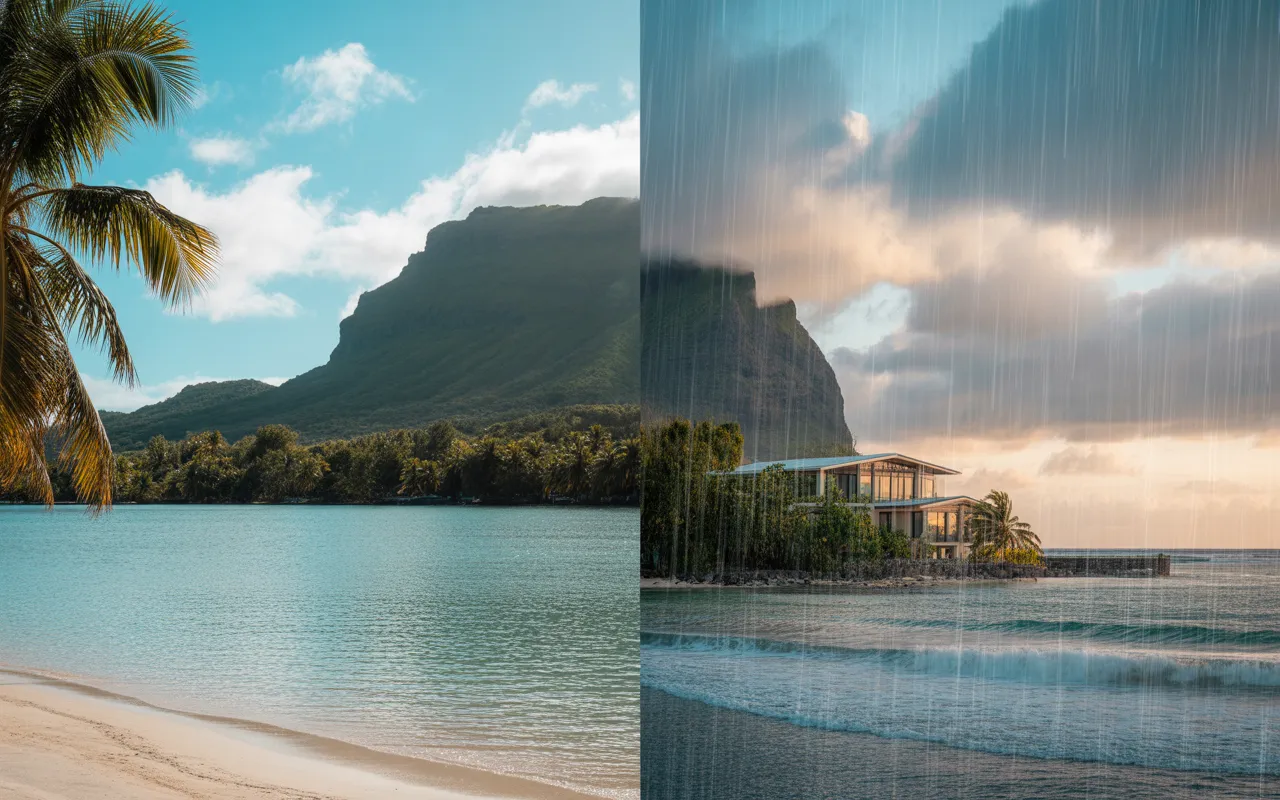
If you are considering living in Mauritius all year round, The good news is that the climate is generally pleasant and stable… provided you understand the seasons, microclimates (North/West vs East/South vs Central Plateau) and especially the cyclone season. In this guide, EXPAT MAURITIUS helps you choose When arrive, Or you settle in and how anticipate weather events (heavy rain, swell, alerts).
Understanding the Mauritian climate (without getting the "seasons" wrong)
Two seasons + two months of transition
Maurice has a tropical maritime climate with :
- A hot and humid summer of November to April,
- A cooler and drier winters of June to September,
- And may + october considered as transition month (often very appreciated upon arrival). (metservice.mu)
Temperatures: "bearable" heat, but humidity needs monitoring
According to the Mauritius Meteorological Services (MMS), the average temperature is approximately 24.7 °C in summer And 20.4 °C in winter (moderate seasonal variation). The hottest months are January–February (maximum means around 29.2 °C) and the fresher are July–August (average nighttime lows around 16.4 °C(metservice.mu)
In practice: it's not just the temperature that changes your comfort, but humidity (more pronounced in summer) and the wind (more present on certain coasts in winter).
Rain: no “monsoon”, but a truly wetter season
At the national level (normals 1991–2020), the MMS indicates a annual rainfall approximately 2019 mm, with a typical distribution:
- summer (Nov.–Apr.) : approximately 1352 mm,
- winter : approximately 668 mm.
The wettest months are generally January to March (e.g., normal:) January 280 mm, February 322 mm, March 294 mm), And october is among the driest (normal) 75 mm(metservice.mu)
Microclimates: the “right” place depends on your lifestyle
One point often underestimated by newcomers: The weather is not exactly the same everywhere on the island, even just a few kilometers away.
North & West: drier, sunnier
The regions North and above all West are often sought after for a drier and brighter daily life. As an indication, over the period 1971–2000, the representative station in the West (Medine) recorded monthly totals of approximately 781 mm/year (calculated from monthly averages). (metservice.mu)
East & South: more exposed to the trade winds, more humid
L'’East and the South are more exposed to wind and often receive more precipitation. For example, over 1971–2000, the representative station for the East (Fuel) totaled approximately 1962 mm/year (sum of monthly averages), and that of the South (Plaisance) approximately 1723 mm/year. (metservice.mu)
Central plateau: cooler… and significantly more watered
THE center (Altitude) is often cooler, with more clouds and rain. Over 1971–2000, the Vacoas station recorded approximately 1996 mm/year (sum of monthly averages), with very wet months in summer (e.g., February). (metservice.mu)
Key points to remember: If you are hesitating between several regions (proximity to school, offices, beach, activities), the local climate can be a real deciding factor—and good on-site support saves time.
Cyclones in Mauritius: calendar, actual risks and alert level
When is cyclone season? (Official dates to know)
MMS reminds us that’austral summer extends from November 1st to April 30th, and that the official cyclone season for the Republic of Mauritius is of November 1st to May 15th (even though systems can form outside of them).metservice.intnet.mu)
What “cyclone” means in everyday life (even without direct impact)
A cyclone does not necessarily have to make landfall to impact daily life: swell, heavy rains, gusts And localized outages can occur if the system passes "offshore". The MMS also highlights the possibility of associated extreme events (severe thunderstorms, intense short-duration rainfall, flash floods, etc.).metservice.intnet.mu)
Cyclone warning system: understanding classes I to IV
The official MMS system structures the alert by classes. The regulations specify, in particular, that:
- there Class I is issued 36 to 48 hours before the likely occurrence of gusts of 120 km/h,
- there Class II aims to leave, as much as possible, 12 hours of daylight before these gusts,
- there Class III aims 6 hours of daylight,
- there Class IV is emitted when gusts of 120 km/h are observed in certain places and are expected to persist.
MMS also publishes safety bulletins and termination notices when the risk decreases.metservice.intnet.mu)
Field advice: If you live in Mauritius year-round, don't just look at "cyclone or no cyclone". Also follow the weather reports. heavy rains and swell, because they are the ones who most often disrupt exits, the road and certain coastal areas.
2025–2026 Season: Anticipated Trends (Concrete Example)
For summer 2025–2026, the MMS published a seasonal outlook indicating, across the Southwest Indian Ocean basin, a probable total of 11 to 13 named storms.metservice.intnet.mu)
For its part, Météo-France La Réunion estimated activity to be close to or above normal, with 10 to 14 storms And 5 to 8 which can reach the stage of a tropical cyclone.meteofrance.re)
Why is this useful? Because it helps to plan an arrival (accommodation, schooling, insurance, storage, car) with an appropriate level of caution, without dramatizing.
The best times to move to Mauritius (according to your profile)
There is no single best time, but there are often more comfortable periods:
- may And october (transition): Good compromise for weather, and often practical for organizing the installation. (metservice.mu)
- June to September : drier and cooler, ideal for errands, visits, and getting your bearings without excessive humidity. (metservice.mu)
- November to April Perfectly livable, but more humid and statistically more exposed to cyclones/heavy rainfall. (metservice.mu)
Practical information: weather + installation (table)
| Period | Dominant feeling | Rain (trend) | Cyclone risk | Why now is (or isn't) a good time to move in |
|---|---|---|---|---|
| November–April | Hot, humid | Higher (summer = ~1352 mm on the 1991–2020 averages) | Higher (official season 1 Nov.–15 May) | Arrival possible, but allow for flexibility (visits, transport, schools) and check insurance and accommodation (shutters, drainage, exposure). |
| May | Transition | Often declining | A decline (but vigilance still necessary) | Excellent timing to settle in: more stable weather, easier pace for finding accommodation, buying a car, and setting up bank/insurance accounts. |
| June–September | Cooler, less humid | Lower (winter = ~668 mm on the 1991–2020 average) | Weaker | Ideal for setting up a weather-free campsite. Note: trade winds blow from the East/South, and evenings can be cool in the higher elevations. |
| October | Transition | Rather low (October is on average one of the driest months) | Raise gradually | A very good compromise: you arrive before the peak of summer, with time to secure accommodation and routines. |
Contextual data: Transition seasons and months (MMS), official cyclone season (MMS), 1991–2020 rainfall normals (MMS). (metservice.mu)
Families: aiming for alignment with the start of the school year
If you are traveling with school-aged children, the school calendar may affect your arrival date. For 2026, the start of the school year is indicated on the Monday, January 12, 2026, and the first quarter extends until Friday, April 3, 2026 (Official calendar of the Ministry of Education – Mauritius).education.govmu.org)
Common strategy: to arrive in October/November (to prepare for the start of the academic year + accommodation) or in the southern spring (April/May) if you prefer a drier climate to start with.
Entrepreneurs & active workers: prioritize operational clarity
To start a business, launch an activity, and schedule appointments and visits, many expatriates choose May to September : fewer weather uncertainties, more reliable travel, a more comfortable pace.
And if your schedule requires you to spend the summer (November–April), the right thing to do is to secure everything in advance: suitable accommodation, insurance, and a buffer on the schedule (signing the lease, moving, deliveries).
Practical advice for living in Mauritius year-round (climate + accommodation + routines)
Accommodation: think “rain and wind”, not just “sea view”
- Drainage : check the drainage of water (courtyard, parking lot, access), especially in areas prone to heavy rain.
- Exposure to wind : in the East/South, the trade winds can be pleasant… but also tiring on a daily basis (noise, sea spray, feeling of coolness).
- Equipment : shutters, closures, roof maintenance, protection of bay windows, and condition of gutters.
Preparing for the cyclone season: a simple “kit”, a clear organization
- Record official sources (weather reports, heavy rain alerts, swell).
- Plan to have a short supply of supplies (water, lamps, batteries, first aid kit, document protectors).
- Identify the safest room in the home and put away anything that could fly (terrace, garden).
- Check your home insurance and what is covered (strong winds, water damage, contents).
Rainfall: understanding the variability from year to year (numerical example)
Rainfall varies from year to year. For example, data from the World Bank/CCKP indicate 1992.54 mm of precipitation in 2024 against 2374.53 mm in 2023. (tradingeconomics.com)
Conclusion: it is better to reason in seasonal trends and in area selection (microclimate), rather than “perfect weather” all year round.
How EXPAT MAURITIUS helps you settle at the right time (and in the right place)
EXPAT MAURITIUS is an expatriation support company based in Azuri Village, with a practical approach: local expertise, quick responses, personalized follow-up, and comprehensive support (individuals and entrepreneurs).
- Visas and permits : help to structure the file and secure the process.
- Real estate / investment : support for buying and settling in with peace of mind.
- Installation : housing, schools, banking, insurance (coordination and referrals according to your situation).
- Starting a business : support for entrepreneurs who wish to launch or structure their business in Mauritius.
To get started, you can discover the approach and services on the official website EXPAT MAURITIUS.
And if you want an overview of “expatriation + real estate”, see the page Living in Mauritius: turnkey expatriation and real estate, as well as the expatriation guides.
Useful official resources (to keep handy)
- Mauritius Meteorological Services – Climate of Mauritius (seasons, indicators). (metservice.mu)
- MMS – Monthly Rainfall Climatology (1991–2020) (rainfall averages). (metservice.mu)
- MMS – Seasonal Climate Forecast (seasonal trends, cyclones). (metservice.intnet.mu)
- Météo-France La Réunion – Cyclone Seasonal Trend 2025–2026. (meteofrance.re)
- Ministry of Education (Mauritius) – School Calendar (Useful for families).education.govmu.org)
FAQ – Climate, cyclones and settling in with EXPAT MAURITIUS
What is the best time to move to Mauritius to avoid cyclones?
To reduce exposure to cyclone hazards, many expatriates prefer to arrive between May and September, a generally drier and less exposed period. The months of may And october are also highly valued because they are transition month You often enjoy a good balance before and after the wet summer. The official cyclone season extends from November 1st to May 15th : it is therefore possible to settle at this time, but with more preparation (accommodation, insurance, planning margin).
West, North, East or Central Plateau: how to choose your region according to the climate?
The choice depends on your tolerance for humidity, wind, and rain. In summary: West/North are often sought after for drier and sunnier daily life, while the’East/South are more exposed to the trade winds and can be more humid. Central plateau is generally cooler, with more rainfall. EXPAT MAURITIUS can help you make informed decisions based on your priorities (schools, commutes, budget, lifestyle), to avoid a "good choice on paper" that is uncomfortable in everyday life.
What exactly happens when Mauritius goes on cyclone alert?
The MMS issues cyclone alerts in classes (I to IV) depending on the system's development. The regulations specify, in particular, that the Class I may be announced 36 to 48 hours before gusts likely to reach 120 km/h, Then, the alert levels increase as the risk becomes more specific. In practice, this mainly involves anticipating: securing your home, avoiding unnecessary outings, following official bulletins, and preparing for disruptions (road conditions, rough seas, rain). The important thing is to adopt a routine of vigilance, without panicking.
Is it possible to live in Mauritius all year round without experiencing continuous rain?
Yes, because even if the summer is wetter, it doesn't rain "all the time". The 1991–2020 averages show a wetter season of November to April and a drier period in winter. Furthermore, the weather varies considerably depending on the area: some parts of the west are significantly drier than areas of the central plateau. The best approach is to choose a place to live that suits your lifestyle (work, leisure activities, children) and to plan the year: water sports, hiking, travel periods, etc.
How can EXPAT MAURITIUS help me plan my move according to the seasons?
EXPAT MAURITIUS acts as conductor Your expatriation: we'll outline the steps, provide practical advice, and coordinate key aspects (permits/visas, settling in, housing, schooling, banking, insurance, real estate, and starting a business). The goal is to avoid timing errors (arriving in the middle of the rainy season without a buffer, signing for unsuitable accommodation, or underestimating the impact of wind or rain on a particular area). You'll gain clarity, security, and speed up your progress with a local contact.
And now ?
If you want to settle in Mauritius with a simple strategy (good timing, good region, suitable accommodation, well-sequenced procedures), EXPAT MAURITIUS can support you from start to finish: permits/visas, real estate, facility And business creation. The team proposes a free evaluation and can be contacted by phone, WhatsApp, email or via an online form (from the official website).