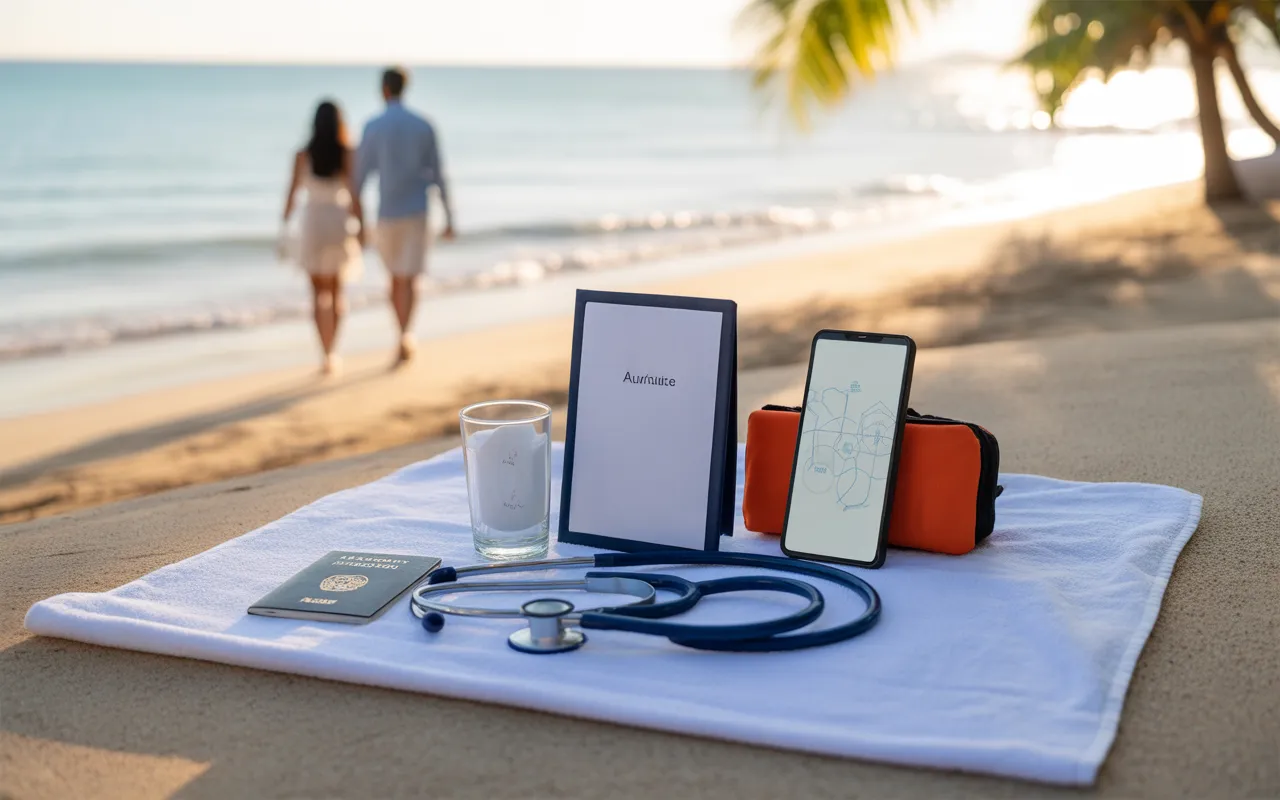
Having good insurance in Mauritius means avoiding unpleasant medical and financial surprises.
When you move to Mauritius, you quickly discover that the healthcare system combines public sector And private clinics, with practices (upfront costs, ceilings, networks, evacuation) that can be confusing. This guide helps you choose a expatriate health insurance consistent with your profile (solo, family, entrepreneur, retiree), your status (tourist, Premium Visa, residence permit…), and your budget — with a clear, concrete and actionable approach.
And if you would like assistance with your move (housing, schools, banking, insurance, administrative procedures), EXPAT MAURITIUS can guide and structure your project, from the initial planning stages to the formalities, through a local and personalized approach. To learn more, you can start from the Expat Mauritius homepage.
Understanding the healthcare system in Mauritius (and what this means for expatriates)
Public vs. private: two logics, two experiences
The Mauritian Ministry of Health indicates that public services aim for universal health coverage, and that The public system is used by approximately 731,300 of the population., with a structured organization (community centers, regional hospitals, specialized establishments, etc.).
In practice, many expatriates prefer private healthcare for certain specialties, availability, or comfort. Foreign official sources also reiterate a crucial point: foreigners often have to pay upfront and some serious situations may require a medical evacuation out of Mauritius.
Useful information: public hospitals and emergency numbers
The official Mauritian government portal lists several public institutions (for example, Dr. AG Jeetoo, SSRN, Victoria, Jawaharlal Nehru, Flacq…), and mentions the SAMU (emergency) can be reached at 114.
Why is this important from an insurance perspective? Because your contract must be consistent with your actual reflexes: will you consult in a private clinic? do you want quick access to certain specialists? do you want to be covered in case of serious hospitalization and/or evacuation?
Some figures (to give an idea of the orders of magnitude)
According to data from the World Bank (reported by TheGlobalEconomy), the health spending in Mauritius was 5.82% of GDP in 2022, and the health expenditure per capita approximately $590.94 USD in 2022.
Another key indicator: the share of spending paid directly by households (out-of-pocketFor Maurice, the’out-of-pocket represented 44,01% of current health expenditure in 2022 (World Bank/WHO series).
Simple reading: The higher the out-of-pocket expenses, the more common it is to pay a portion of the costs directly. A well-designed insurance plan aims to limit these out-of-pocket expenses, particularly during costly hospitalizations and examinations.
Health insurance in Mauritius: what exactly are we talking about?
The 3 large cover formats
- Travel insurance (short stay) Useful for initial assessment, a few weeks/months, or a transition. Often suitable for emergencies, but limited for long-term follow-up.
- International health insurance for “expatriates” : designed for living outside one's country, with hospitalization, routine care, maternity, dental/optical depending on options, sometimes evacuation.
- Local coverage (Mauritian insurer) : may be interesting if you live permanently in Mauritius and mainly use healthcare services there (to be compared according to ceilings, exclusions, networks, etc.).
Concepts to master before comparing quotes
- Annual ceiling : maximum amount reimbursable per year (and sometimes per item).
- Franchise / deductible : portion remaining your responsibility before reimbursement.
- Co-payment : percentage remaining to be paid even after reimbursement.
- healthcare network : partner establishments (third-party payment/direct billing more frequent).
- Waiting periods : period without coverage for certain services (maternity, dental…).
- Exclusions : pre-existing conditions, sports, diving, scooters, etc. to be checked according to your lifestyle.
Special cases: visas and residence permits (when insurance becomes essential)
Premium Visa: insurance required (at least for the initial period)
In its dedicated publication, the Economic Development Board (EDB) specifies that, in order to be eligible for Premium Visa, The applicant must provide proof of their long-term stay plans and a travel and health insurance for the initial period of stay.
Practical tip: Your certificate must be legible, dated, and detail the coverage (hospitalization, emergency, repatriation/evacuation if required). Plan ahead: insurers can take several days to issue a compliant certificate.
Occupation Permit / Residence: no single rule is posted, but there is a very real financial risk.
The official page describing the’Occupation Permit The permit is presented as a combined residence and employment document, with several categories (investor, professional, young professional, self-employed), and provides links to the required documents. Insurance requirements may vary depending on individual circumstances and administrative changes.
Recommended approach: Even if your status doesn't explicitly "make" insurance mandatory, it's often essential in practice (upfront costs, hospitalization, follow-up care, unforeseen events). This is typically a point that EXPAT MAURITIUS helps to frame in a realistic installation plan (timeline, budget, documents, priorities).
How to choose health insurance that suits your expatriate profile
Step 1 — Assess your real needs (not your “wants”)
- Length of stay 3 months, 12 months, long term?
- Household composition : single, couple, school-aged children.
- Age and medical history ongoing treatments, chronic conditions.
- Lifestyle : water sports, hiking, scootering, diving (often subject to exclusions).
- Medical habits : regular follow-up (dermatology, dental, physiotherapy), planned maternity, etc.
Step 2 — Define your “security level” (limits, deductibles, evacuation)
For the majority of expatriates, the decision hinges on three key factors:
- Hospitalization : this is the item that can generate the heaviest bills, especially in the private sector.
- Routine care : consultations, analyses, imaging, medications (and rate of consumption).
- Evacuation / Repatriation : some serious cases may require treatment outside the country, which foreign authorities mention as a possible scenario.
Step 3 — Choose the geographical coverage area
- Mauritius only : often more affordable, but less flexible.
- Mauritius + regional : useful if you are travelling (business/personal) in the region.
- World (excluding USA / including USA) : the version “with USA” is generally much more expensive.
Step 4 — Check the “payment process” (third-party payment vs. reimbursement)
The US State Department points out that many providers are waiting for payment (in Mauritian rupees) and that US Medicare-type insurance does not apply abroad.
In your contract, explicitly look for:
- Direct billing / third-party payment (and the list of partner institutions).
- Prior agreement procedure (hospitalization, imaging, surgery).
- Refund deadlines and required documents (detailed invoices, medical reports, possible translations).
Step 5 — Read the exclusions “that matter” in Mauritius
- Pre-existences Covered, excluded, or covered after a deadline?
- Maternity Waiting period, ceilings, pregnancy monitoring.
- Dental/Optical : often limited, sometimes optional.
- High-risk activities Water sports, diving, two-wheeler rental.
- Mental health : highly variable depending on contracts.
Comparison: Which health insurance plan should you choose when moving to Mauritius?
Comparative table of the most common options
| Option | Perfect for | Strengths | Limits / vigilance |
|---|---|---|---|
| Travel insurance | Arrival “test”, reconnaissance, short stay | Easy to subscribe to, effective for emergencies/accidents | Limited long-term monitoring, sometimes low ceilings, exclusions for sports/two-wheelers |
| International expatriate health insurance | Sustainable installation, families, entrepreneurs | Hospitalization + routine care, maternity/dental options, sometimes evacuation | Variable cost, careful reading of pre-existing conditions and waiting periods |
| Mauritian local insurance | Residents who primarily consume healthcare in Mauritius | Often well aligned with the local network, with appropriate labels | International coverage is sometimes limited; limits should be compared. |
| “Mixed” coverage (e.g., basic + supplementary) | Profiles wanting to control budget and out-of-pocket expenses | Optimization: base + reinforcement for hospitalization/evacuation | More complex management (2 contracts), coordination of reimbursements |
Concrete examples: 3 expatriate scenarios and the insurance coverage that “holds up”
1) Entrepreneur / self-employed: unforeseen events + business continuity
You need robust hospital coverage (and ideally an evacuation option), as immobilization or a high bill can directly impact your personal cash flow and your business. Priorities: hospitalization, imaging, network / third-party payment, annual ceiling, and expedited prior agreement procedures.
2) Families with children: pediatrics, emergencies, dental care, schooling
With children, the frequency of consultations and emergencies often increases (ENT, gastroenterology, minor trauma). An effective formula is one that provides good coverage for routine care and offers a third-party payment or smooth reimbursements. Also consider assistance guarantees (transport, accompaniment) if a parent has to deal with an emergency alongside school life.
3) Retired: chronic condition, regular monitoring, risk of hospitalization
Priority to long-term monitoring (specialists, examinations) and good hospital care. Check in particular: pre-existing conditions, waiting periods, caps on chronic illnesses, and renewal terms (some contracts change with age).
Choosing the right insurer: regulations, reliability, and key points to check
Verify the existence and regulatory status
In Mauritius, the Financial Services Commission (FSC) is the integrated regulator for non-bank financial services, including insurance, and publishes a register of licensed entities. Before signing, it is good practice to check that the actor (insurer/intermediary) appears in the register where relevant.
Quick checklist before signing
- Annual ceiling and ceilings per position (hospitalization, imaging, maternity).
- Exclusions (pre-existing conditions, sports, 2 wheels, diving…).
- Waiting periods (maternity in particular).
- Network and third-party payment (written list, not just “on request”).
- Emergency procedure : numbers, application, direct support.
- Documents : invoices, reports, accepted language, deadlines.
And what about the "France" cover in all of this? (useful if you are French)
Expatriation: the logic changes compared to a tourist stay
For French citizens, the Health Insurance system reminds them that when living abroad, they are no longer covered by the French system as they would be in France, and that they must plan ahead; it is also indicated that it is possible, under certain conditions, to join the French Nationals Abroad Social Security Fund (CFE) to maintain basic coverage.
Depending on your needs in Mauritius, the CFE (French Health Insurance Fund for French Nationals Abroad) can be a basic component (depending on the situation) but does not necessarily replace comprehensive expatriate insurance (particularly regarding evacuation/assistance). For official documents and forms related to healthcare abroad, the CFE publishes dedicated resources.
The role of EXPAT MAURITIUS in your choice of health insurance
Choosing insurance isn't just about "taking the cheapest one": you have to align Status (visa/permit), lifestyle, place of residence, schools, And budgets. That is precisely what EXPAT MAURITIUS helps to structure an expatriation: clarify priorities, avoid blind spots, and move forward with a realistic roadmap.
You can also consult:
- Living in Mauritius: turnkey expatriation and real estate (settling-in overview)
- Expat guides – Expat Mauritius (practical resources)
FAQ – Health insurance & expatriation in Mauritius with EXPAT MAURITIUS
Can EXPAT MAURITIUS help me choose health insurance in Mauritius?
Yes, as part of our relocation support services, EXPAT MAURITIUS can help you clarify your requirements (status, length of stay, family, budget, healthcare habits), identify essential coverage (hospitalization, routine care, evacuation/assistance), and avoid common mistakes (exclusions, gaps, inadequate coverage limits). The goal isn't to "choose insurance at random," but to integrate health insurance into a comprehensive plan (housing, schools, administrative procedures, timeline) for a smoother expatriation.
What insurance is required for a Premium Visa in Mauritius?
For the Premium Visa, the Economic Development Board (EDB) indicates that the applicant must have proof of a long-stay project and a travel and health insurance For the initial period of your stay, prioritize a contract with a clear policy (name, dates, territory, coverage). Also, check for 24/7 assistance and, if possible, comprehensive hospitalization coverage. Finally, keep a digital copy accessible offline: this document often saves time during the paperwork.
Is health insurance required for an Occupation Permit (OP) in Mauritius?
Official documentation presents the Occupation Permit as a permit combining residence and work, and refers to the criteria and documents required by category (investor, professional, self-employed, etc.). The exact requirements may vary depending on your situation and are subject to change. In all cases, even when insurance is not explicitly listed as "mandatory," it remains strongly recommended: upfront costs, unforeseen expenses, hospitalization, and potential evacuation are major financial risks. The safest approach is to determine the appropriate coverage before your actual arrival.
How to limit upfront costs in private clinics in Mauritius?
The key point is to choose an insurance policy that offers third-party payment (Direct billing) via a local network, or a simple prior authorization procedure for hospitalization and imaging. Before subscribing, ask for a list of partner facilities, emergency procedures, and the documents required for coverage. Without direct billing, plan for a cash reserve: official sources remind us that many providers expect to be paid, and that some national coverages do not apply abroad.
What health insurance coverage should I choose if I come to Mauritius with children?
With children, the frequency of routine care (pediatrics, ENT, emergencies) is often higher. A well-balanced plan should include: consultations and examinations, medications, emergency care, and robust hospitalization coverage. Also consider practical services: telehealth, assistance, ease of reimbursement, and ideally, direct billing. Finally, align your insurance with your place of residence and school: if you live far from major medical centers, assistance/transportation coverage can become a crucial factor. EXPAT MAURITIUS can help you integrate this choice into your overall family plan.
And now? Moving from comparison to a calm decision.
Good health insurance in Mauritius means a contract tailored to your specific situation: residency status, budget, medical habits, and desired level of coverage. If you want to save time, avoid mistakes, and integrate insurance into your overall setup (visa/permits, accommodation, schools, banking, etc.), you can contact EXPAT MAURITIUS via the official website to benefit from personalized guidance and comprehensive support.