
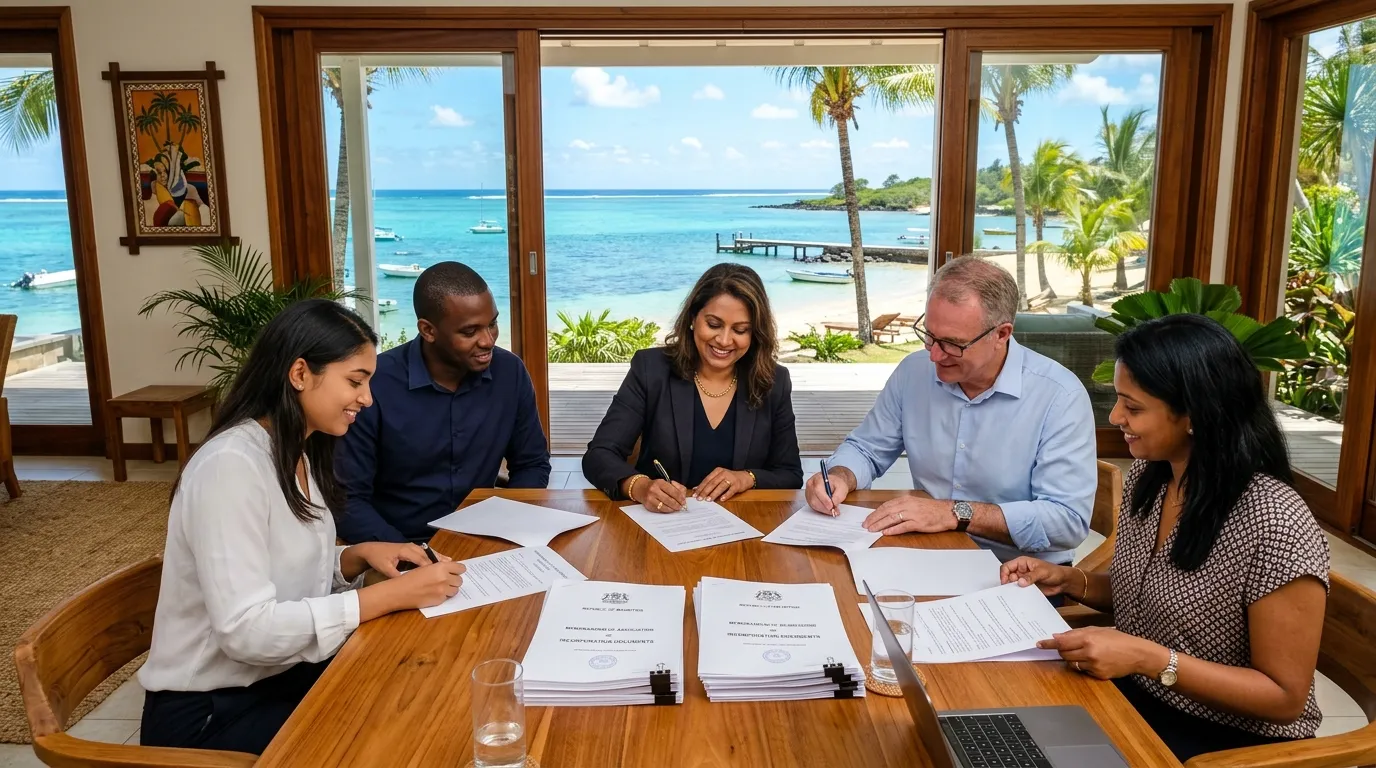
Setting up a company in Mauritius can be very quick… provided you choose the right legal status and anticipate recurring costs.
In this guide, you will find the main legal statuses (sole proprietorship, Ltd company, LLP, Global Business structures), registration procedures (online or at the counter) and costs to be expected, with a focus on the incorporation fees, THE annual fees and the trade fees.
Key points to remember (2026)
- A company can be typically incorporated into the half-day if the file is complete.admin.theiguides.org)
- THE annual registration fees (registration fees) vary depending on the revenue (e.g., 500 MUR if turnover ≤ 30 M for a small private company, within the deadlines). (rra.govmu.org)
- There VAT becomes mandatory beyond 3 WALLS of annual taxable turnover since the October 1, 2025. (mra.mu)
1) Possible legal structures for starting a business in Mauritius
In Mauritius, the “good” status depends mainly on 4 criteria: your level of risk (liability), the number of partners, your banking/client needs, and your expatriate status (right to work and reside).
Sole proprietorship (Business Registration / BRN)
If you are starting out on your own, the’sole proprietorship may be the simplest way: you get a Business Registration Number (BRN) and one Business Registration Card. The process is advertised as quick (often “within half a day”).admin.theiguides.org)
Regarding official expenses, the CBRD guide indicates a table based on the declared workforce (e.g. 125 WALL if “not more than 10 persons”). (admin.theiguides.org)
Attention : In a sole proprietorship, the separation between personal and professional assets is limited (depending on your situation, a company may offer better protection).
Private Company (Ltd): the most common choice
There Private Company (often a “Ltd”) is generally chosen for:
- structuring the entry of partners,
- to secure the relationship with customers/suppliers,
- to facilitate the opening of a professional bank account,
- limit liability to contributions (according to structure and guarantees signed).
The CBRD guide (online guide) specifically mentions the usual information and documents (identity, addresses, consents of directors/shareholders, articles of incorporation if applicable).admin.theiguides.org)
Public Company
Less common for a typical entrepreneurial project, the Public Company It is geared more towards larger structures (governance, financing, etc.). The official incorporation fees are significantly higher than for a Private Company.admin.theiguides.org)
Partnership, “Commercial Company” and LLP
Maurice also offers intermediate structures:
- Partnership (partnership),
- Commercial company (including “de facto business partnership”),
- LLP (Limited Liability Partnership).
These formats may be suitable for professional associations or specific arrangements. Registration fees apply (e.g., LLP: incorporation fees are indicated in the guide).admin.theiguides.org)
“Global Business” and Authorized Company (international) structures
If your business has an international focus (holding company, investments, international flows, etc.), there are structures subject to specific frameworks (licenses, substance, approved service providers depending on the case). annual fees are not the same: for example, a Authorized Company has annual fees in USD (within the deadlines). (rra.govmu.org)
For an international project, it is recommended to arbitrate structure + taxation + compliance requirements before choosing, because the real costs often come more from compliance (accounting, auditing, management) than from registration fees.
2) Steps to create a company in Mauritius (concrete steps)
Step 1: Validate your activity (and any necessary authorizations)
Many activities are free, but some are regulated (e.g., financial, tourism, healthcare, food sectors, etc.). The best approach is to check early on whether a permit/license is required, as this can impact:
- the choice of status (e.g., governance requirements),
- the opening schedule,
- the budget (insurance, compliance, premises, etc.).
Step 2: Choose a name (and avoid “sensitive” names)
In Mauritius, the name reservation exists and the law provides for availability over a given period (the reservation is indicated as valid). 2 months (from the date of the notice, unless revoked).mof.govmu.org)
Certain terms are particularly restricted: for example, unless the Registrar gives written consent, a name must not include words like “Authority”, “Corporation”, “Government”, “Mauritius”, “National”, “President”, “Republic”, “State” (non-exhaustive list), nor terms suggesting a link with a local authority.mof.govmu.org)
Good to know: the Reservation is not always required before incorporating. (new.edbmauritius.com)
Step 3: Prepare the information and documents (standard file)
The CBRD guide lists the expected information (directors, secretary if applicable, shareholders, registered office address, activities, etc.) and the documents to be uploaded.admin.theiguides.org)
- Non-residents : copy of passport (and, where applicable, proof of residence permit if the sole director is a foreign national).admin.theiguides.org)
- Proof of address (e.g., invoice).admin.theiguides.org)
- Signed consent forms (Directors/shareholders), constitution if the company adopts one.admin.theiguides.org)
Practical tip: prepare a “bank” version of your file (capital structure, activity, contracts, proof of address), because opening the account can become the real bottleneck, depending on the banks and your profile.
Step 4: Submit the application (online) and obtain the certificate
Incorporation can be carried out via the online platform (CBRIS / MNS) according to the described procedures.admin.theiguides.org)
Once the fees are paid, a electronic certificate of incorporation is issued and can be downloaded.admin.theiguides.org)
The announced timeframe, assuming everything is in order, is within half a day. (admin.theiguides.org)
Step 5: Trade fee, start-up and related formalities
Depending on your business and location, a trade fee may apply. The MCCI reminds us that:
- Trade fees are paid to incorporation Or within 15 days following the start of operations; (mcci.org)
- They can be paid for. in 1 go (no later than January 20th) or in 2 installments (January 20th then June 30th); (mcci.org)
- companies whose trade fee is ≤ 5,000 WALL are indicated as exempt (with possible exceptions depending on the activity).mcci.org)
Finally, regarding administrative interconnections: the CBRD guide indicates that certain procedures may be linked (e.g., the possibility of requesting VAT registration via MRA, registration of beneficial owners, sharing of information with certain authorities).admin.theiguides.org)
3) Setting up a company in Mauritius: what costs should be expected?
To be clear: the total cost generally consists of official fees (Registrar/CBRD + annual fees + trade fee) and operating costs (accounting, registered office/headquarters, audit as appropriate, sector licenses, etc.). Official fees, however, can be quantified.
Summary table of official fees (incorporation + annual fees 2026)
| Element | Amount (official indicative) | Currency | Remarks |
|---|---|---|---|
| Incorporation – Private Company | 3 000 | WALL | Incorporation fees are listed in the CBRD guide.admin.theiguides.org) |
| Fees “Summary of the file” (online) | 100 | WALL | Application fees are indicated (online).admin.theiguides.org) |
| Signed Certificate of Incorporation | 300 | WALL | If you request a signed certificate (as required by the bank/clients).admin.theiguides.org) |
| "All-inclusive" incorporation fees are often advertised. | 3 400 | WALL | An institutional FAQ mentions “Rs 3,400” to incorporate a company (this usually corresponds to 3,000 + 100 + 300).enterbusiness.govmu.org) |
| Business Registration – Individual (≤ 10 people) | 125 | WALL | Individual tax rates (if no incorporated company).admin.theiguides.org) |
| Annual expenses 2026 – Small Private Company (turnover ≤ 30M) | 500 (on time) / 750 (after) | WALL | Grid 2026 (registration fees). (rra.govmu.org) |
| Annual expenses 2026 – Small Private Company (30M < turnover < 100M) | 2 500 / 3 750 | WALL | Grid 2026 (registration fees). (rra.govmu.org) |
| Annual expenses 2026 – Private Company (turnover > 100M) | 18 000 / 27 000 | WALL | Grid 2026 (registration fees). (rra.govmu.org) |
| Annual expenses 2026 – Public Company / Foreign Company | 27 000 / 40 500 | WALL | Grid 2026 (registration fees). (rra.govmu.org) |
| Annual Fees 2026 – Authorized Company | USD 130 / USD 200 | USD | Grid 2026 (registration fees). (rra.govmu.org) |
Trade fee: The amount depends on your activity (“classified trade”), your situation, and sometimes the municipality/zone. Therefore, it is not a fixed amount. However, the payment rules (Deadlines, possibility of payment in 1 or 2 installments, exemption ≤ 5,000 MUR) are reiterated by the MCCI.mcci.org)
Concrete example (order of magnitude of official fees) : a consulting activity created in Private Company with a modest initial turnover may have (i) an incorporation cost of around 3,400 MUR according to the institutional presentation, (ii) of the annual fees of 500 WALLS if the company remains in the “turnover ≤ 30M” bracket and pays on time, (iii) a trade fee variable, sometimes exempt if ≤ 5,000 MUR depending on the case. (enterbusiness.govmu.org)
4) Taxation and obligations after creation
Corporate tax: rates, CSR and CCR Levy
The standard rate of’corporate tax is commonly presented to 15%. (taxsummaries.pwc.com)
In addition to this, mechanisms/lifting options may be added depending on the profile:
- CSR Fund PwC indicates that a company must establish a CSR fund equivalent to 2% of “chargeable income” from the previous year.taxsummaries.pwc.com)
- Corporate Climate Responsibility (CCR) Levy : applicable (depending on the source) to 2% chargeable income for companies exceeding a certain turnover threshold (PwC specifically mentions a threshold > 50 MUR and an effective date from the tax year beginning on July 1, 2024). (taxsummaries.pwc.com)
These topics can become technical (partial exemptions, specific rules). For a reliable business plan, it's ideal to quantify your actual structure and revenues (local vs. international).
VAT: thresholds, rates and obligations (2025 update)
The MRA announced that the threshold for mandatory VAT registration has been lowered from 6 walls to 3 walls, with effect from October 1, 2025. (mra.mu)
The standard rate is indicated at 15% and the MRA reminds us of key obligations (invoicing, record keeping, declarations). For example, records must be kept for at least 5 years and the declarations are in principle quarterly, with possible passage to monthly beyond a certain revenue threshold (particularly > 10M).mra.mu)
Annual fees: dates and penalties (registration fees)
The 2026 annual fees must be paid over a specified period (e.g. December 15, 2025 → January 20, 2026and a “within due date / after due date” grid applies. (rra.govmu.org)
A CBRD press release also specifies that the annual registration fees are due from the January 3, 2026 and that payment without penalty is possible within a specified window (e.g., from December 16, 2025 to January 20, 2026).publicnotice.govmu.org)
5) Setting up a company in Mauritius when you are a non-citizen: points to consider
Can a foreigner own shares in 100%?
A Mauritian government FAQ states that a foreigner can hold 100% shares provided at least a director resides in Mauritius and that the foreigner obtains the’approval of the Prime Minister's Office for undertaking (reference to section 52.6 of the Companies Act 2001).govmu.org)
In practice, this means that the issue of "shareholding" needs to be addressed.“ And the question of “direction/residence/authorization” separately from the outset.
Working and living in Mauritius: Occupation Permit (OP)
If you are a non-citizen and you wish to work In Mauritius (day-to-day management, local invoicing, signing contracts, etc.), your project may require a permit suitable (Investor / Professional / Self-Employed, as appropriate).
- The EDB's “Budget Highlights 2024” mentions a decrease in the basic monthly salary threshold for the category Professional (from 30,000 to 22,500 MUR(edbmauritius.org)
- An EDB communication (January 2021) also recalls elements of the “work and live” regime: initial investor investment lowered to USD 50,000 and the “self-employed” threshold indicated at USD 35,000, with activity volume criteria for renewal starting from the 3rd year. (news.edbmauritius.org)
- The EDB also communicated (Budget 2025-2026) its intentions to revision/digitization OPs, with criteria that may evolve (categories based on investment and turnover). (edbmauritius.org)
Conclusion: for an expatriate, company creation and the “permit” strategy must be considered together from the business plan stage (otherwise, you risk having a registered company that is operationally unusable).
6) Common mistakes (and how to avoid them)
- Underestimating recurring costs : annual registration fees + trade fees + accounting.
- Choosing a risky name (words in boxes, confusion with a public entity): the law explicitly lists several sensitive words.mof.govmu.org)
- Forget about VAT : since October 1, 2025, the threshold is 3 MUR (and not 6 MUR).mra.mu)
- Do not align company & permit When one is a non-citizen: 100% actions are possible, but conditions regarding resident management and approvals may apply.govmu.org)
7) Get support (without losing control): the Expat Mauritius approach
Starting a business in Mauritius is both... legal (status, documents, compliance), of the practical (banking, invoicing, insurance) and, for many entrepreneurs, a subject of’expatriation (visa/permit, accommodation, schools, settling in).
Expat Mauritius supports individuals and entrepreneurs with their overall projects in Mauritius (permits/visas, relocation, real estate, and business creation). To discover all the services and contact the team (phone, WhatsApp, email, or form), you can visit the main website: Expat Mauritius.
For a broader overview of settling in (housing, schooling, banking, insurance), you can also consult: Living in Mauritius: turnkey expatriation and real estate and the expatriation guides.
FAQ – Legal status, procedures and costs for setting up a company in Mauritius
Which status should I choose: sole proprietorship or company (Ltd)?
In practice, a sole proprietorship is often chosen for a quick and simple start (obtaining a BRN, low official fees). A company (Private Company / Ltd) becomes relevant as soon as you want to more clearly separate business activity from the person, welcome partners, sign corporate contracts, or structure growth. Regarding official costs, company incorporation is often quoted at around MUR 3,400, while a sole proprietorship can be as low as MUR 125, depending on the number of employees (≤ 10).enterbusiness.govmu.org)
How long does it take to register a company in Mauritius?
The CBRD's online guide states that a company can be registered/incorporated "within half a day" when the file is complete and compliant, and that an electronic certificate of incorporation is issued after payment. In reality, the total "setup" time also depends on peripheral steps (bank account, trade fee, sector licenses, VAT if applicable). To optimize processing times, prepare identity documents, proof of address, and signed consents from the parties in advance.admin.theiguides.org)
What are the mandatory annual fees after incorporation?
- the annual registration fees payable to the registry (with amounts varying according to turnover and status), and (
- Trade fees related to business activity are payable according to specific rules. For 2026, a small private company (turnover ≤ 30 million) pays 500 MUR on time (750 MUR after), while a private company with a turnover exceeding 100 million MUR pays 18,000 MUR (27,000 MUR after). Trade fees can be paid in one or two installments and are sometimes waived if ≤ 5,000 MUR, depending on the circumstances. (rra.govmu.org)
From when do I need to register for VAT?
Since October 1, 2025, the MRA indicates that the mandatory VAT threshold has been lowered: if your annual turnover of taxable supplies exceeds (or is likely to exceed) 3 MUR, registration is required. Once registered, you must charge VAT at the applicable rate (15% indicated), issue compliant invoices, keep your documents for at least 5 years, and file your returns (often quarterly, monthly above certain thresholds). If you are close to the threshold, plan ahead: compliance (invoicing, required information, processes) always takes longer than expected.mra.mu)
Can a foreigner create a company in Mauritius and be its sole shareholder?
A Mauritian government FAQ states that a foreigner can hold 100% of shares, provided that at least one director resides in Mauritius and the foreigner obtains approval from the Prime Minister's Office for the undertaking (reference to section 52.6 of the Companies Act 2001). Furthermore, if you wish to work and live in Mauritius to operate the company, you will often need to secure a suitable residence status (Occupation Permit: Investor/Professional/Self-Employed depending on your profile), with criteria that may change depending on budgets.govmu.org)
And now ?
If you want to set up your company in Mauritius without choosing the wrong legal structure, while also managing recurring costs (registration fees, trade fees, VAT) and aligning your project with your expatriation situation, Expat Mauritius can support you with a comprehensive approach (company + permits + relocation). Visit us at [website address]. the Expat Mauritius website to request a free evaluation and be contacted via the channel that suits you.