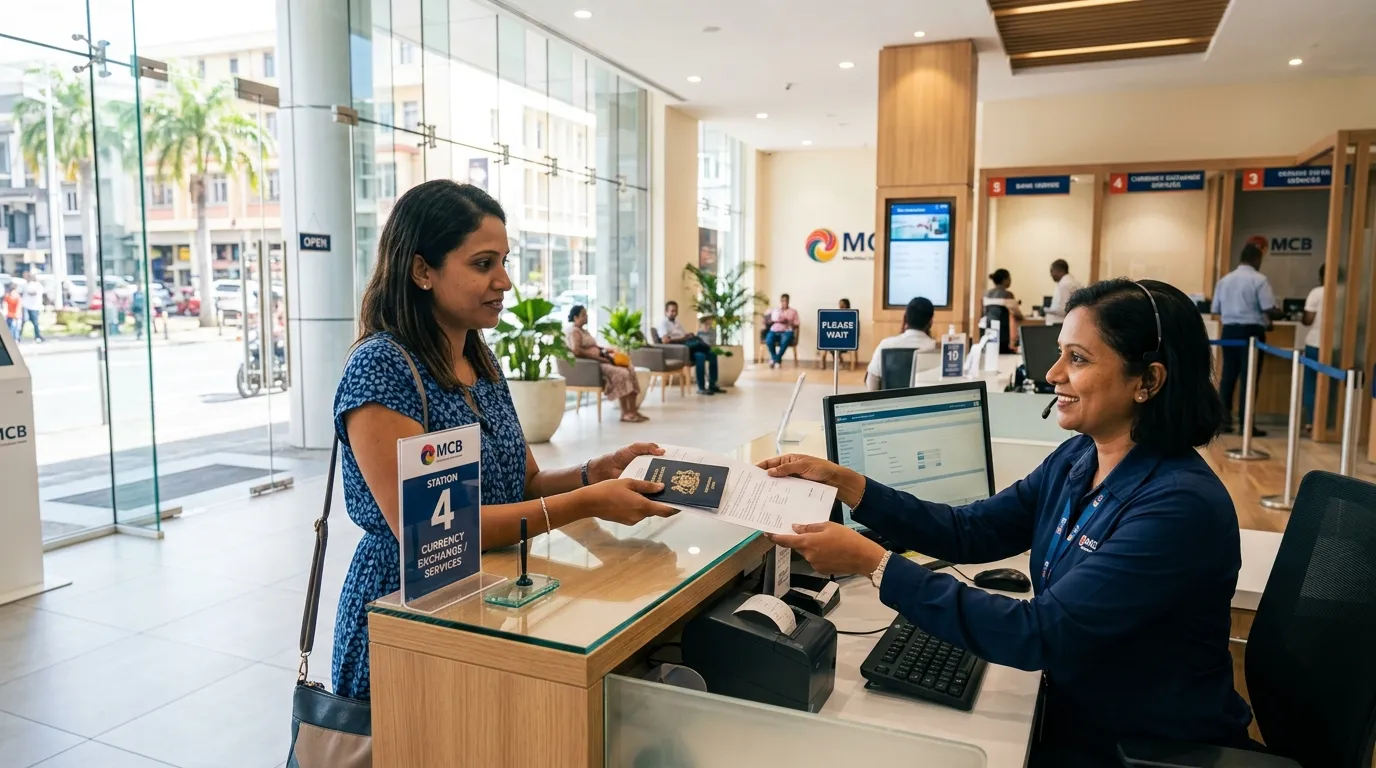
In Mauritius, a bank account can hinge on a single document.
To succeed on the first try, you need to choose a bank that suits your profile (employee, retiree, entrepreneur, investor), and prepare an application that meets the requirements. KYC/AML (identity, address, source of funds) and anticipate the issues that most often hinder expatriates: proof of residence, tax self-certification (CRS), and, for some, FATCA. This guide explains the procedures, the relevant banks, and the pitfalls to avoid, in a practical way.
If you would like assistance with the setup (including the bank), you can also consult Expat Mauritius and its practical resources.bom.mu)
1) Understanding the banking system in Mauritius
Licensed banks: where to check the official list?
Before choosing an establishment, check that it is properly licensed. List of banks (banking license) is published by the Bank of Mauritius (BoM) via its “List of Licensees” page. (bom.mu)
The BoM also publishes official lists in its periodic documents, for example a list “as at February 28, 2025”in the Mauritius Statistical Bulletin. (bom.mu)
A dense (and very “compliant”) banking sector
The Mauritian banking sector includes 22 registered banks (figure cited “as of March 2024” in an OECD report).rcemauritius.org)
In practice, banks apply a strict compliance approach: the Bank of Mauritius (BoM) is the AML/CFT supervisory authority for institutions under its jurisdiction and sets the framework for anti-money laundering and counter-terrorist financing requirements through dedicated guidelines.bom.mu)
The most useful types of accounts for expatriates
- Current account (MUR) : salaries, deductions, local debit card.
- Savings account : according to the banks, remuneration is subject to conditions.
- Currency/multicurrency account : useful if you invoice or receive funds in EUR/USD/GBP (conditions vary depending on bank and profile).
- Business account : Mauritian company, subsidiary, or internationally oriented structures (documentary requirements are significantly more burdensome).
2) Choosing a bank in Mauritius: truly important criteria
Beyond “reputation”, a good choice depends above all on your use: collecting a local salary, paying daily, receiving international transfers, managing several currencies, or operating a business.
- Onboarding (opening) : in branch, online, or hybrid (pre-application + appointment).
- KYC Requirements : proof of address accepted, certified copies required, in-person interview for non-residents.
- Costs : monthly fees, card fees, international transfer fees, minimums, commissions (always consult the updated table).
- Digital (app / e-banking) : notifications, transfers, payments, card management.
- International Service : ability to process cross-border flows (and to clearly explain the justifications for “source of funds”).
Comparative table (reference points): banks and account opening procedures
| Bank (examples) | Opening / Pre-application | "Basic" documents displayed publicly | Expat attention point |
|---|---|---|---|
| MCB (Mauritius Commercial Bank) | Visit us at the branch (appointment recommended) | Passport + proof of address (CEB/CWA/MT bill) + minimum deposit stated for a standard current account (e.g., Rs 1,000) | If the proof of address is in the name of a third party: letter of authorization + copy of the holder's identity document |
| SBM (State Bank of Mauritius) | Online processing is possible for some offers (often followed by an appointment). | To open an “All-In-One” account online: NIC + utility bill less than 3 months old (conditions apply); for non-residents/foreigners: KYC with enhanced requirements | Certified copies are available for non-resident foreigners + “statement of source of funds/source of wealth” mentioned |
| Absa Bank (Mauritius) | Contact / agency (and digital journey depending on offers) | Proof of identity (ID/passport/driver's license) + utility bill in your name (less than 3 months old) | Check the required original documents (and alternatives if you have just arrived) |
| AfrAsia Bank | Relationship-oriented onboarding | Public notice: In-person meeting required for non-residents to "clear the KYC"“ | Anticipate a physical visit (and availability on site) |
| BCP Bank (Mauritius) | Opening at the Business Centre (support recommended) | Identity + proof of address (less than 3 months old) + proof of income (e.g., payslip, employer's certificate, tax notice) | Prepare a coherent income statement (also useful for limits and services) |
| Bank One | Online start possible | Emphasis on opening online accounts and accounts in MUR and other currencies | Check the actual process based on residence/status (and required documents). |
Sources (pages consulted): MCB standard current account (mcb.mu) ; SBM All-In-One + steps + documents (banking.sbmgroup.mu) ; SBM KYC checklist (non-residents/foreigners) (sbmgroup.mu); Absa account opening (absabank.mu) ; AfrAsia non-residents (afrasiabank.com); BCP account opening (bcpbank.muBank One digital (digital.bankone.mu)
3) Steps: opening a personal account (step by step)
Step 1 — Prepare the documents (before the appointment)
In the vast majority of cases, the bank will seek to verify:
- Your identity : valid passport (and sometimes visa / proof of stay depending on profile).
- Your address : recent invoice / bank statement / contract (depending on what the bank accepts).
- The origin of the funds : salary, dividends, sale of an asset, savings, rental income, etc. (with supporting documents).
Tip: Create a clear PDF file with a summary page (name, address, occupation, source of funds, estimated monthly amount, country of tax residence) and your supporting documents as attachments. This often speeds up the compliance review.bom.mu)
Step 2 — Book an appointment / initiate an online application
Depending on the bank, you will have:
- A appointment at the agency (often recommended); ;
- or a hybrid pathway : online pre-application followed by an appointment to finalize.
Example: an MCB page indicates to “book an appointment” and lists the documents expected for a standard current account (passport, proof of address, minimum deposit).mcb.mu)
Example: SBM describes an online onboarding process for certain offers, with contact on the "next working day" followed by an appointment at the branch to finalize the process.banking.sbmgroup.mu)
Step 3 — KYC/AML Validation and Effective Opening
The bank may request additional documents, as AML/CFT operates at “risk-based approach” The more international your profile, the more detailed the requests for proof (source of wealth, proof of activity, etc.) may be. The Bank of Mauritius (BoM) regulates these obligations through its AML/CFT guideline.bom.mu)
4) Non-residents, new arrivals, current permits: what really changes
Topic #1: Proof of address (when you've just arrived)
Many expatriates do not immediately have a local bill in their name. However, some banks explicitly list local bills (electricity/water/telecom) as proof of address, with specific rules if the bill is in the name of a third party.mcb.mu)
In practical terms, if you are in temporary accommodation, you will often have to switch to:
- lease agreement sign ;
- Or proof of accommodation + proof of the link (marriage/birth) as appropriate; ;
- or cumulative supporting documents accepted by the bank (on a case-by-case basis).
SBM's KYC checklist mentions, for example, the lease/tenant agreement and proof of relationship if the address is in the name of a relative, as well as an expectation of a “statement of source of funds/source of wealth” for non-residents.sbmgroup.mu)
Certified copies: common for non-resident foreigners
If you are not present (or if the establishment requires it), you may be asked for copies. certified compliant. The SBM KYC checklist specifies, for non-resident foreigners, documents that are “certified true copies” by a notary/lawyer/embassy (and information on the identity/authorization of the certifier).sbmgroup.mu)
In-person meeting: sometimes unavoidable
Some establishments clearly state that a face-to-face meeting is required for KYC in the case of non-residents. AfrAsia, for example, indicates that, “as a non-resident”, the team must meet you in person to complete KYC.afrasiabank.com)
5) Entrepreneurs: Opening a bank account for a company in Mauritius
Why is it taking longer than for a personal account?
A business account almost always implies:
- identification of signatories ;
- identification of beneficial owners (UBO) ;
- understanding of the activity: customers, countries, flows, amounts; ;
- evidence of source of funds and sometimes source of wealth depending on the risk.
This is a direct application of AML/CFT obligations, as framed by the BoM (information gathering, verification, traceability).bom.mu)
Concrete example of a checklist (Global Business)
As an example, an MCB checklist for opening a “Global Business” account mentions requirements such as:
- proof of registered address of the company (dated less than 6 months ago); ;
- identity documents (passport/ID); ;
- and the possibility that the bank may request additional documents in a “risk-based” approach.
This type of checklist illustrates the level of detail expected whenever there is an international dimension.mcb.mu)
6) Pitfalls to avoid (those that waste weeks)
Trap #1: Choosing an unlicensed “bank” (or an opaque intermediary)
Don't rely on a logo or a Facebook page. Always check the bank on the official BoM list.bom.mu)
Trap #2: Inadmissible proof of address (or not in the correct name)
Banks often ask for proof of address recent (e.g., “not older than 3 months”) and in your name. Absa and others display this requirement.absabank.mu)
If your supporting document is in the name of a third party, please provide the requested additional documents (letter of authorization, copy of identity document, proof of family relationship, etc.).mcb.mu)
Trap #3: Underestimating the “source of funds / source of wealth” issue”
This point is central to AML/CFT. A solid case avoids back-and-forth:
- Employee Contract + last 3 payslips + bank statements.
- Entrepreneur statutes, proof of activity, invoices, financial statements, statements.
- Investor : proof of transfer (deed), certificates, statements showing traceability.
The Bank of Mauritius (BoM) specifically outlines AML/CFT requirements (CDD, risk-based approach, documentation).bom.mu)
Trap #4: Ignoring tax self-certification (CRS) and reporting obligations
Mauritian banks must apply the CRS (Automatic exchange of information). The MRA explains that, under CRS, Mauritian financial institutions must report annually on accounts held by non-residents (first reporting related to 2017, exchanges from 2018 onwards).mra.mu)
In practice: you will often have to sign a self-certification and declare your tax residence(s). Prepare your NIF/tax identification number for the country concerned and ensure consistency with your supporting documents.
Trap #5: For US persons, forget FATCA (W-9 / W-8)
If you are subject to US taxation, expect specific forms. A public example: HSBC states that in Mauritius “the principles of FATCA have been incorporated into local law” and that the bank may need to collect US tax returns/forms (W-9/W-8) to establish your status.fatca.hsbc.com)
Trap #6: Not reading the fees (monthly, card, transfers, inactivity)
Prices vary depending on the package. For example, an MCB page mentions a monthly service fee (e.g., Rs 25 + VAT) and a minimum opening deposit for a standard current account (e.g., Rs 1,000).mcb.mu)
Absa also displays a monthly fee (e.g., Rs86.25) and specifies “no minimum opening balance” on its account opening page.absabank.mu)
Conclusion: compare the official grids and ask for a written summary before validating (SWIFT transfer fees, exchange commissions, card fees, etc.).
Trap #7: Arriving at the meeting without a “flow plan”
A compliance advisor wants to understand: where the funds come from, how often, in what currency, and to which countries. A mini “plan” (1 page) with estimated monthly amounts and the main source (salary, dividends, business activity) often saves time.
7) Actionable checklist (copy-paste)
- Choose 2 banks (a main one + an alternative one) after verification on the BoM. (bom.mu)
- Prepare identity : passport + color copy + (if applicable) visa/permit.
- Prepare address : invoice less than 3 months old OR lease/certificate + supporting documents if in the name of a third party.mcb.mu)
- Prepare income : contract + payslips / proof of activity / statements.
- Prepare for tax compliance : country of tax residence, TIN, CRS self-certification; if applicable, FATCA documents.mra.mu)
- Prepare “source of funds” : simple explanation + traceable evidence.
- Make an appointment and request the exact list of documents for your profile (employee, retiree, entrepreneur).
Key points to remember: In Mauritius, a "good application" is often more valuable than "the right bank." Compliance (KYC/AML + CRS/FATCA) is the number one cause of delays, not the signing stage.
FAQ — Opening a bank account in Mauritius: frequently asked questions
Can you open a bank account in Mauritius before you have your permit (Occupation Permit / residence permit)?
It's sometimes possible, but it's never "automatic." Some banks require an in-person meeting to complete KYC when you're a non-resident, and may demand certified copies or enhanced supporting documents (address, source of funds). Plan an alternative scenario: online pre-application + appointment upon arrival, or opening an account once a lease is signed. The clearer your situation (employment contract, housing, source of funds), the better your chances.afrasiabank.com)
What proofs of address are accepted if I have just arrived (Airbnb, hotel, temporary accommodation)?
Banks often prefer recent documents (less than 3 months old) in your name, typically a utility bill (electricity/water/telecom). If you don't have one, some will accept a lease/tenancy agreement or a "residential" arrangement with proof of relationship (marriage/birth certificate) and a letter of authorization, depending on each institution's rules. Plan ahead: as soon as possible, get a housing contract in your name to stabilize your application.absabank.mu)
Why is the bank asking me for the “source of funds” or the “source of wealth”?
Because financial institutions must implement AML/CFT (anti-money laundering) controls and a risk-based approach, they need to understand the origin and consistency of the funds you deposit. In practice, you will be asked for proof: payslips, contracts, bank statements, company documents, deeds of sale, etc. The best approach is to provide a brief explanation and traceable supporting documents (amounts + dates + origin). This avoids suspensions and a cascade of requests.bom.mu)
CRS and FATCA: Will my account in Mauritius be “declared”?
Mauritius applies the CRS: the MRA indicates that Mauritian financial institutions must report annually certain accounts held by non-residents for exchange with partners (CRS principle). If you are a US person, FATCA may also apply: a public example (HSBC) explains that FATCA principles are integrated into local law and that tax forms (W-9/W-8) may be required to establish your status. If in doubt, have your situation reviewed by a tax advisor.mra.mu)
How much does a bank account cost in Mauritius (and which fees are the most surprising)?
Fees vary considerably depending on the bank and the package: monthly fees, card fees, international transfers, exchange commissions, and sometimes eligibility requirements (e.g., checkbooks). For reference, public pages may display monthly fees (MCB: mention of a low monthly fee on a standard current account; Absa: monthly flat rate displayed on its opening page), but these amounts are subject to change. The classic pitfall: confirming without reading the "fees & charges" table (SWIFT, exchange rate, inactivity). Always ask for an up-to-date written summary.mcb.mu)
And now ?
If you want to secure your application (proof of address, CRS/FATCA tax compliance, proof of source of funds) and avoid back-and-forth with banks, Expat Mauritius can help you structure your relocation. You can also find practical resources in the [section/section name]. expatriation guides and discover the comprehensive support on Living in Mauritius: a turnkey expatriation solution.