
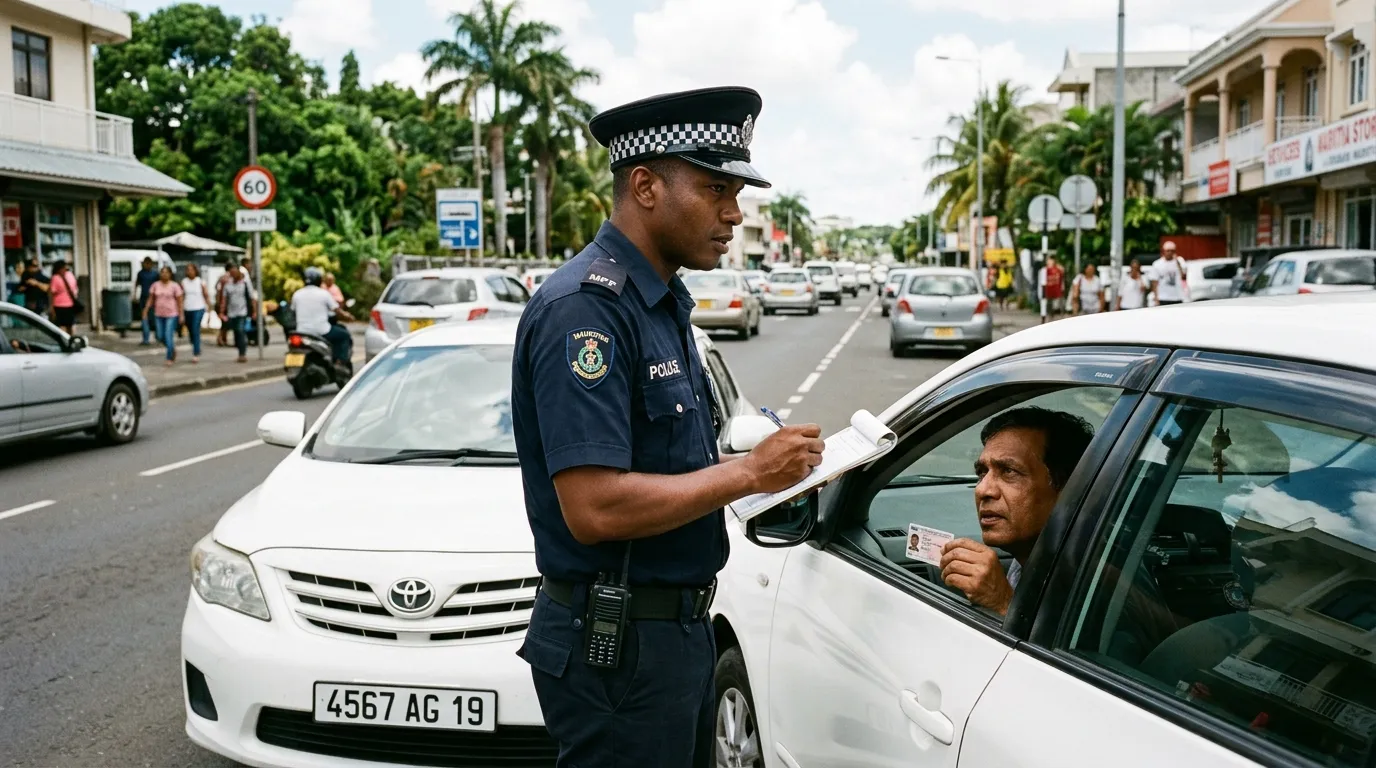
A traffic fine can quickly become expensive in Mauritius. Since the reintroduction of the penalty points system by the amended law of 2025, certain traffic violations result not only in a fine, but also in an accumulation of points which can lead to a license suspension.president.govmu.org)
The best course of action is to identify the type of notice received, respect the payment deadlines, and check whether the infraction results in points being deducted. In 2026, the applicable framework remains that of the amended Road Traffic Act, with scales and procedures that may change, especially for fixed notices and notices issued by camera surveillance.
Keep in mind two key deadlines: 28 days to pay most fixed fines, and 14 days for certain responses related to camera notices or reviewing photographic evidence.police.govmu.org)
How does the penalty point system work in Mauritius?
The Mauritian system concerns the holder of a driving licence, a provisional licence or an international driving permit. The 2025 reform reintroduced penalty points, with a maximum of 10 points over 36 months for a provisional licence, and 15 points over 36 months for a standard driving licence or an international driving permit. Points generally remain active for 36 months from the date they are issued, unless they have already been used to support a disqualification decision.landtransport.govmu.org)
The penalty scale is not fixed at a single value for each offense. The law provides a range of points, and the court then selects the relevant number within that range. If several offenses are involved in the same case, the rule is to assign the highest number associated with the most severely punished offense.
If you have just arrived on the island and still need to familiarize yourself with the roads, the practical guide to driving in Mauritius and the page on converting a French driving licence can help you prepare your procedures before even the first traffic violation. The practical guide to driving in Mauritius And the conversion of a French driving licence
Penalty point system for common offences
| Frequent offence | Point range | Key takeaways |
|---|---|---|
| Not wearing a seatbelt, crossing a solid white line, not respecting a traffic light, driving on a sidewalk or neglecting pedestrian priority at a protected crossing. | 2 to 4 points | These violations are among the most common traffic offences in the updated scale. |
| Exceed the speed limit by more than 15 km/h without exceeding 25 km/h. | 2 to 4 points | The text sets a lower range for moderate excesses, but they are still punishable. |
| Using a handheld phone or microphone while driving. | 3 to 6 points | Using a phone while driving is one of the behaviors specifically targeted by the scale. |
| Do not yield the right-of-way when exiting a less important road into a more important one, or transport passengers in the open space of a double-cab pickup truck. | 3 to 6 points | These traffic and passenger transport faults are dealt with within an intermediate range. |
| Exceeding the speed limit by more than 25 km/h. | 4 to 6 points | The greater the excess, the higher the number of points rises within the expected range. |
| Taking part in an unauthorized road race or speed test. | 8 to 10 points | Behaviors associated with racing or speed competition are among the most severely penalized. |
| Using a vehicle or trailer that may present a danger, driving with a worn tire, using unauthorized lights or failing to comply with certain signaling instructions. | 2 to 4 points | The scale also targets technical or equipment defects that increase road risk. |
| Failing to give the correct signal before turning or stopping, or driving against the flow of traffic on a one-way street. | 2 to 4 points | Driving and traffic violations remain punishable even without an accident. |
In practice, the official table goes beyond these examples and can be updated. Before considering a scale as definitive, you should always check the current version of the Road Traffic Act and the type of notice received.landtransport.govmu.org)
How to pay a traffic fine in Mauritius?
For a Fixed Penalty Notice (FPN), the logic is simple: payment is made within the specified timeframe, usually at a District Court, and non-payment triggers a more complex procedure. For a Photographic Enforcement Device Notice (PEDN), the procedure remains similar, but you must also properly address Part B if you were not the driver at the time of the offense.
- First check whether you have received an FPN or a PEDN, as the rest of the procedure is not exactly the same.
- Pay the requested amount within the specified period, in principle within 28 days from the date of issue of the notice, in order to avoid referral to the District Court.
- If the notice is from a camera and you were not the driver, complete part B and return the complete notice to the police within the 14 days stipulated by law.
- If you wish to view the photographic evidence, make a written request within 14 days and pay the fee indicated by the police, namely Rs 100 for the viewing.
- If an adult pays on your behalf, the police allow this possibility subject to written authorization and the required original documents.
A useful point to remember for drivers living in Mauritius: the cost of owning a vehicle isn't limited to fines. Road tax has its own schedule, so it's important to keep track of your payment deadlines. (See the section on road tax.)
If you received a traffic ticket via camera, the Traffic Branch also specifies that late payment may result in the case being transferred to the District Court of the location of the offense, with a notice instead of a summons. In the case of camera tickets, the wording of the form also stipulates that if payment is not received within 28 days, the offense will be presumed to have been committed and will result in a fine of at least double the original amount, as well as the maximum number of applicable penalty points.
When can a license be suspended or cancelled?
The key threshold to monitor is the maximum number of points allowed. As soon as points are awarded, the court determines that this maximum has been exceeded, it must issue a disqualification notice. For a standard license, the disqualification period is between 6 and 12 months. For a provisional license, the license is revoked, and the disqualification period is also between 6 and 12 months. For a person without a valid license or holding an international driving permit, the disqualification period can be up to 24 months in certain cases.
The law also specifies that a license holder may appeal, following the same procedure as an appeal against a penalty, and that the court's decision is suspended pending the appeal. The Licensing Office maintains an up-to-date register of points and can issue, upon request and payment of the prescribed fee, a Penalty Points Certificate indicating the number of points still active.
After the disqualification period, the Traffic Branch indicates that the license is reinstated after the period expires and, if applicable, after a rehabilitation course organized by the Mauritius Institute of Training and Development, with a fee listed at Rs 1000 on its reference page. As with the rest of the matter, this amount is subject to change and should be verified at the time of application.
If your driving record becomes complicated after a collision or accident, understanding the procedures to follow after a road accident also helps you grasp the correct administrative and insurance steps.
The step-by-step approach to avoid an unpleasant surprise
For an expat, the most effective approach is to treat the fine like an administrative matter, not just a piece of paper. The correct order is as follows: read the notice, note the deadline, check if the infraction results in points being deducted, pay or contest within the allotted time, then keep the proof of payment and monitor your point balance. Notices related to cameras also require a prompt response if you were not the driver.
The primary point of contact for points and driving licenses remains the Traffic Branch of the Mauritius Police Force, through its Licensing Office. Depending on your residency situation, other public bodies may also be involved in the same administrative process, including the EDB, CBRD, MRA, NTA, PIO, Registrar of Companies, Civil Status Office, and MQA. The EDB assists with investment and business establishment, the CBRD manages company registration, the MRA handles taxation, the NTA regulates land transport, the PIO provides passport and immigration services, the Registrar of Companies handles company registration, while the Civil Status Office and MQA become relevant depending on your family situation or qualifications.
If you want to secure your installation before even getting behind the wheel, reviewing local rules and driving habits is still a good idea. the page on local driving rules and car insurance
FAQs about fines, points and license suspension
What offences will result in penalty points on a driving licence in Mauritius in 2026?
In 2026, points will be awarded for offenses including not wearing a seatbelt, crossing a solid line, running a red light, using a handheld phone while driving, certain speeding offenses, equipment defects such as worn tires or unauthorized lights, as well as more serious behaviors like illegal street racing. Points are awarded within a range, not always as a fixed value, allowing the court some leeway depending on the actual severity of the case.
How do I pay a traffic fine in Mauritius and what are the deadlines to avoid surcharges?
In practice, you must pay the requested amount within the timeframe indicated on the notice, most often 28 days. For a traffic violation ticket issued by a camera, payment is made at the District Court, and the police also specify that a response is expected within 14 days if you were not the driver. If you exceed this deadline, the case may be referred to the District Court, with more serious financial consequences and, depending on the circumstances, the addition of penalty points.
What is the scale of points deducted for each traffic violation in Mauritius?
The official penalty scale works in ranges. For example, several common offenses are penalized between 2 and 4 points, using a mobile phone while driving between 3 and 6 points, certain speeding offenses between 4 and 6 points, and illegal street racing between 8 and 10 points. The judge then assigns the penalty that best applies to the case. To avoid any errors, it is therefore essential to read the exact instructions and, if necessary, check the current version of the Road Traffic Act.
How does the suspension or cancellation of a driving licence work after accumulation of points in Mauritius?
As soon as the limit is exceeded, the court must issue a disqualification order. For a standard license, the period ranges from 6 to 12 months. For a provisional license, it is revoked, and the disqualification period is the same. For a person without a valid license or, in some cases, for a holder of an international driving permit, the duration may be longer. The decision can be appealed, and enforcement is suspended during the appeal process.
How many days do I have to pay a fine and what are the consequences of being late to the Mauritius Road Traffic Branch?
The most common time limit is 28 days from the date the notice is issued. For camera notices, Part B must be processed within 14 days if you were not the driver, and reviewing the photographic evidence also falls within a 14-day time limit. Failure to comply may result in your being summoned to District Court, the loss of the benefit of a simple payment, and, depending on the offense, a higher fine and additional penalty points.
And now ?
If you're preparing to move or simply want to avoid an unpleasant surprise behind the wheel, start by refreshing your driving skills, then check your license status before hitting the road. You can also return to the EXPAT MAURITIUS homepage to prepare the next steps of your expatriation project to Mauritius with a broader view of the essential procedures.