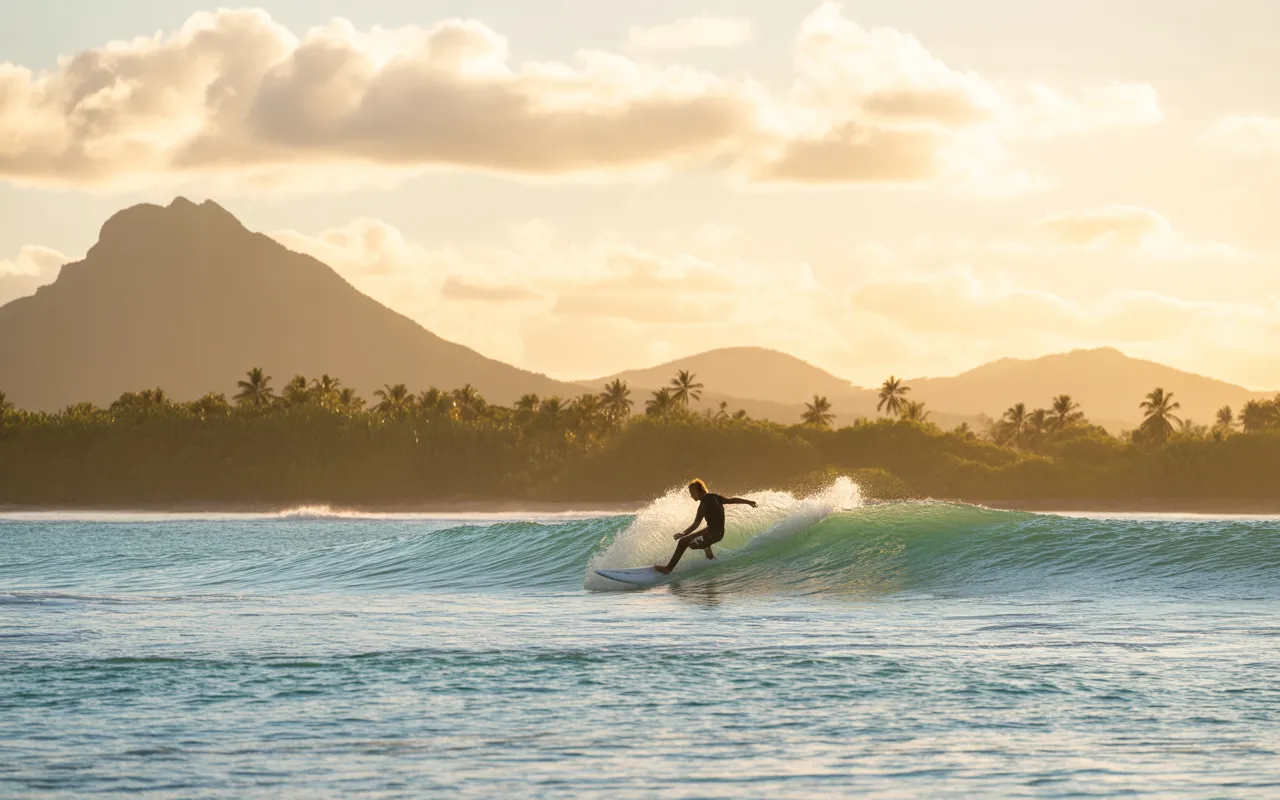
Mythical reef waves, all year round.
If you are looking where to surf in Mauritius And when to leave in 2026, Remember the key point: the most regular period occurs during the’southern winter (approximately April/May to October (depending on the spots), when the southern swells hit the West and Southwest coasts more often. The Mauritian summer, hotter and more humid, can offer smaller (often more accessible) sessions, sometimes with cyclonic swells rarer but powerful.
This guide will help you plan your surf trip (or your setup): 2026 seasons, weather, reef safety, and a clear comparison of the best spots.
Why surfing in Mauritius is unique (and demanding)
Mauritius is a unique destination in the Indian Ocean: the island is surrounded by a lagoon protected by a coral reef, but the best waves often form on Passages and reefs more exposed. Result: hollow, fast, sometimes very powerful waves… and a terrain that demands humility.
- Wave quality : reef breaks with tubular sections, particularly on the West/South-West coast (Tamarin, Le Morne).
- Frame : warm water, volcanic landscapes, sunrise sessions, “island life” atmosphere.
- Microclimates : the weather changes quickly depending on the region (East coast more windy, West often more sheltered).
Golden rule in Mauritius: Prioritize safety (reef + currents), respect priority, and choose a spot suited to your level — a “nice wave” here can become serious very quickly.
Understanding the surfing seasons in Mauritius (climate, swells, wind)
Climate: two seasons + two inter-seasons (useful benchmarks for 2026)
The official Mauritian weather service describes two seasons :
- Hot and humid summer : November to April
- A cooler and drier winter : June to September
May and October are generally transition month. This is important for planning your sessions, as swell frequency and wind exposure vary greatly depending on the season.
Some official figures (very useful for planning ahead):
- Average temperature : summer 24.7°C, winter 20.4°C (moderate deviation from 4.3°C). Source : Mauritius Meteorological Services.
- Hottest months January/February, with an average daily maximum around 29.2°C. Source : Mauritius Meteorological Services.
- Coolest months July/August, with an average nighttime minimum temperature around 16.4°C. Source : Mauritius Meteorological Services.
- Average annual rainfall : 2010 mm (1971–2000 averages), wettest months February/March, driest month october. Source : Mauritius Meteorological Services.
Swells: the “real” surfing season (often) from April to October
At most renowned spots (especially in the West and Southwest), the best window is the’southern winter : THE swells from the south and southwest are more frequent and more structured. For example, Tamarin Bay and One Eye (Le Morne) are often advertised with a Best season: April to October in the spot guides. Sources: Surfline – Tamarin Bay And Surfline – One Eye's.
In summer (November to April), the waves are often smaller over the West, but there may be more powerful episodes linked to tropical systems.
Wind: Southeast trade winds (and their impact on the water surface)
The wind is extremely important in Mauritius. southeast trade winds are very much present, especially during the "windy" season of the southern winter. For example, a specialized windsurfing/kiteboarding media outlet mentions typical SE trade winds 15–25 knots during the season of’April to October (with local effects around Le Morne). Source: SURF Magazin (Mauritius spot guide).
In practical terms: at some spots, a SE wind can clean out a wave (side/side-off), but at others it can degrade it. Hence the importance of choosing the good coast depending on the wind direction of the day.
Water temperature: shorty or lycra depending on the month
Good news: the water remains pleasant. Here are some figures for Port Louis (a useful benchmark, even though the island has slight variations):
- In FEBRUARY, The average sea temperature is forecast to be around 28.3°C. Source : Weather Atlas – Port Louis (February).
- In august And september, the water can flow down towards 23.7°C (the “coolest” period). Source: Weather Atlas – Port Louis (August).
Equipment tip: most surfers are in boardshort/lycra in summer, and spend in shorty (or even a little more on long windy sessions) in the middle of the southern winter.
The best surf spots in Mauritius (by area)
In Mauritius, the “signature” spots are mainly located on the West coast and at Southwest. Section names and accessibility vary, but the constants are: reef, fluent, and need for a minimum wave reading.
West Coast: Tamarin Bay (and its sections)
Tamarin Bay is the most famous spot on the island. It is a reef wave renowned for its quality, but also for its demands: fast take-off, shallow reef, and high traffic on good days.
- Best season often indicated from April to October. Source : Surfline – Tamarin Bay.
- Dangers Coral reef (cutting), fast and hollow waves. Source: Surfline – Tamarin Bay.
If you are a beginner, aim for smaller days and inquire locally about the tide and placement: Mauritius is not the best place to “learn on the reef” without supervision.
Southwest: Le Morne, One Eye & the waves of passes
Le Morne is famous for water sports, and the surfing there is spectacular at certain exposed spots. The most famous wave is One Eye, a left-handed pass, quick and deep.
- Best season often described as April to October. Source : Surfline – One Eye's.
- Fluent Pay particular attention to the outgoing tide, as the lagoon water can drain through the channel and create a very strong current (sometimes impossible to paddle against). Source: Surfline – One Eye's.
- Wind The SE wind can help maintain a clean wave on certain directions. A local guide also highlights the preference for the austral winter (May–October) on One Eye. Source: Kite in Moris – Le Morne One Eye.
For intermediate surfers, there are also more "playable" waves in the area (often accessible by boat depending on the spot). A local website, for example, presents options such as Manawa (more of a “fun wave”) and other breaks around Le Morne, with access recommendations. Source: Surf Mauritius – list of spots.
South: more exposed waves, more “wild” sessions”
The south coast is more exposed to swell and can be more choppy, with sometimes rough seas. It attracts surfers looking for fewer crowds and more raw conditions, but it requires a good level of understanding (currents, sets, reef, wind).
Regardless of the location, keep an eye out for rough sea warnings: the Mauritian weather service publishes heavy swell warnings and recommends avoiding sea trips when sea conditions deteriorate. Example of a bulletin: Mauritius Meteorological Services – Heavy Swell Warning Bulletin.
Summary table: spots, levels, best windows
| Area | Spot (landmark) | Recommended level | Wave type | Best season (trend) | Points to be aware of |
|---|---|---|---|---|---|
| West | Tamarin Bay | Intermediate to expert (depending on size) | Reef / Fast sections | April to October | Reef, committed take-off, crowd |
| Southwest | Le Morne – One Eye | Solid intermediate to advanced | Pass / reef break | April to October | Strong current (outgoing tide), reef |
| Southwest | Morne area (e.g., Manawa, etc.) | Beginner to intermediate (depending on location/day) | Reef (often with specific access) | Southern Hemisphere winter + inter-seasons | Access sometimes by boat, current |
When to go surfing in Mauritius in 2026? (simple planning by period)
The seasons don't particularly "change" in 2026: it's more about an annual climate cycle. The best plan is to time your trip around the swell window and to maintain flexibility from day to day (wind, tide, size).
- April – October : most regular period for the West and Southwest (southern swells + winds often more “readable”).
- May & October Transitional months, sometimes excellent (fewer crowds, more stable weather than the heart of the humid summer). Climate source (transitional months): Mauritius Meteorological Services.
- November – April : warmer, more humid; sessions often smaller, with rarer but potentially powerful swell episodes.
Attention The official cyclone season in Mauritius covers the period of November 1st to May 15th. Source : NDRRMC (Government of Mauritius) – Cyclones FAQ.
Forecasts, tides, safety: the trio to master
1) Check the official bulletins (essential when the sea is rising)
Before going in the water, take 2 minutes to check:
- THE weather reports (wind, sea state, rain warning) from the official service: Mauritius Meteorological Services.
- THE heavy swell warnings (very rough seas, waves of 4m forecast, etc.): Heavy Swell Warning Bulletin.
Note: the regulations relating to alerts state that a heavy swell warning is issued (where possible) approximately 12 hours before waves of 4.0 m or more. Source: Mauritius Meteorological Services – Legislation.
2) Understanding the tide (and channel currents)
On reef breaks, the tide changes everything: depth on the reef, wave speed, and especially the intensity of the currents. On One Eye, for example, a spot guide describes a very strong current at the outgoing tide when the lagoon empties through the pass. Source: Surfline – One Eye's.
3) Reef: Basic equipment and reflexes
- Don't surf alone on a reef spot if you don't know the area.
- Leash in good condition, suitable board, and wax suitable for hot water.
- Slippers if you are sensitive (useful on coral/rocks, without replacing the technique).
- Respect local : priority, no “snake”, no unnecessary drops, and avoid “wasting” the series on a technical line-up.
In the event of a high seas warning, the weather service reminds people of simple precautions (avoid the beach and the sea, secure boats, etc.). Source: Mauritius Meteorological Services – Precautions (High Waves).
Where to stay to surf (and live) near the surf spots
If your goal is to surf often, choosing the right "base camp" will save you time (and sessions). The most convenient areas, depending on your priorities:
- Tamarin / Black River : ideal for exploring the West coast, close to boat ramps and practical daily life (shopping, restaurants, schools/activities depending on profile).
- Flic en Flac : a good compromise “daily life + access to the West”, often appreciated for its residential aspect.
- La Gaulette / Le Morne : perfect if you want to be as close as possible to the South-West (wind + waves), more “outdoor” atmosphere.
If you are preparing to move (and not just travel), also consider the practical aspects: housing, schools, banking, insurance, vehicles, and administrative status. To explore these topics, you can consult the... expatriation guides from Expat Mauritius.
FAQ – Surfing in Mauritius (frequently asked questions in 2026)
What is the best time to surf in Mauritius?
The most consistent period is generally during the austral winter, when south/southwest swells are more frequent. Many surf spot guides indicate a better season around’April to October in the west and southwest areas (e.g., Tamarin Bay, One Eye). That said, Mauritius remains surfable year-round: summer is often warmer, sometimes less consistent, but can offer smaller, more accessible waves, with occasional more powerful ones. Ideally, choose the coast according to the swell and wind conditions of the day.
Is surfing in Mauritius suitable for beginners?
Yes, but not everywhere, and not anytime. The most famous spots are often... Reef breaks Sharp reef, fast take-off, hollow sections, currents. For beginners, choose small waves, a sheltered area, and local instruction if possible. Avoid entering the water at an "expert" spot just because it's well-known. In Mauritius, choosing a spot suited to your skill level is the best way to progress... and enjoy yourself without stress.
Do you need a wetsuit to surf in Mauritius?
Most of the time, the water is warm enough to surf in a rash guard/boardshorts. In the depths of the Mauritian “winter,” the water can be cooler: some surfers prefer a shorty, especially when the wind is blowing and the sessions are longer. For reference, climate data for Port Louis mentions a sea around 28.3°C in February and about 23.7°C in August. As the island has microclimates, allow for some leeway: the feeling also depends on the wind and your tolerance to the cold.
Is there a cyclone season to consider when surfing in Mauritius?
Yes. The official cyclone season in Mauritius runs from November 1st to May 15th. This doesn't mean there's a cyclone every day, but the risk of severe weather (heavy rain, wind, rough seas) is higher. If you're traveling during this period, be flexible and keep an eye on the weather forecasts. Tropical systems can also generate large swells : potentially incredible… but also dangerous, especially near the passes and on the reef.
And now ?
Are you coming for a few weeks of surfing… or are you planning to… living in Mauritius Looking for places near your favorite spots? Expat Mauritius assists individuals and entrepreneurs with key procedures: visas/permits, real estate, facility (housing, schools, banking, insurance) and business creation. Discover the services and request a free evaluation from the homepage: Expat Mauritius – Turnkey Expatriation and Real Estate in Mauritius.