A turquoise lagoon… and a real underwater world.
If you are looking Where to go diving in Mauritius in 2026, Remember this: the island is plunging all year round, with water temperatures around 23–29°C Depending on the season, there is a beautiful diversity (reefs, drop-offs, drift dives) and many shipwrecks – all overseen by a national federation, the MSDA (Mauritius Scuba Diving Association). To save time, this guide groups the best sites (by region and by level), the ideal periods, THE rules to know and practical advice for organizing your stay.
Why is diving in Mauritius so appealing (even in 2026)?
There Diving in Mauritius combines three advantages rarely found together:
- Pleasant conditions In summer (November to April), the water is forecast to be between 26 and 29°C, and in winter (May to October) between 23 and 25°C according to the MSDA.
- Good visibility : the MSDA indicates that it can reach up to 70 meters on certain sites/conditions.
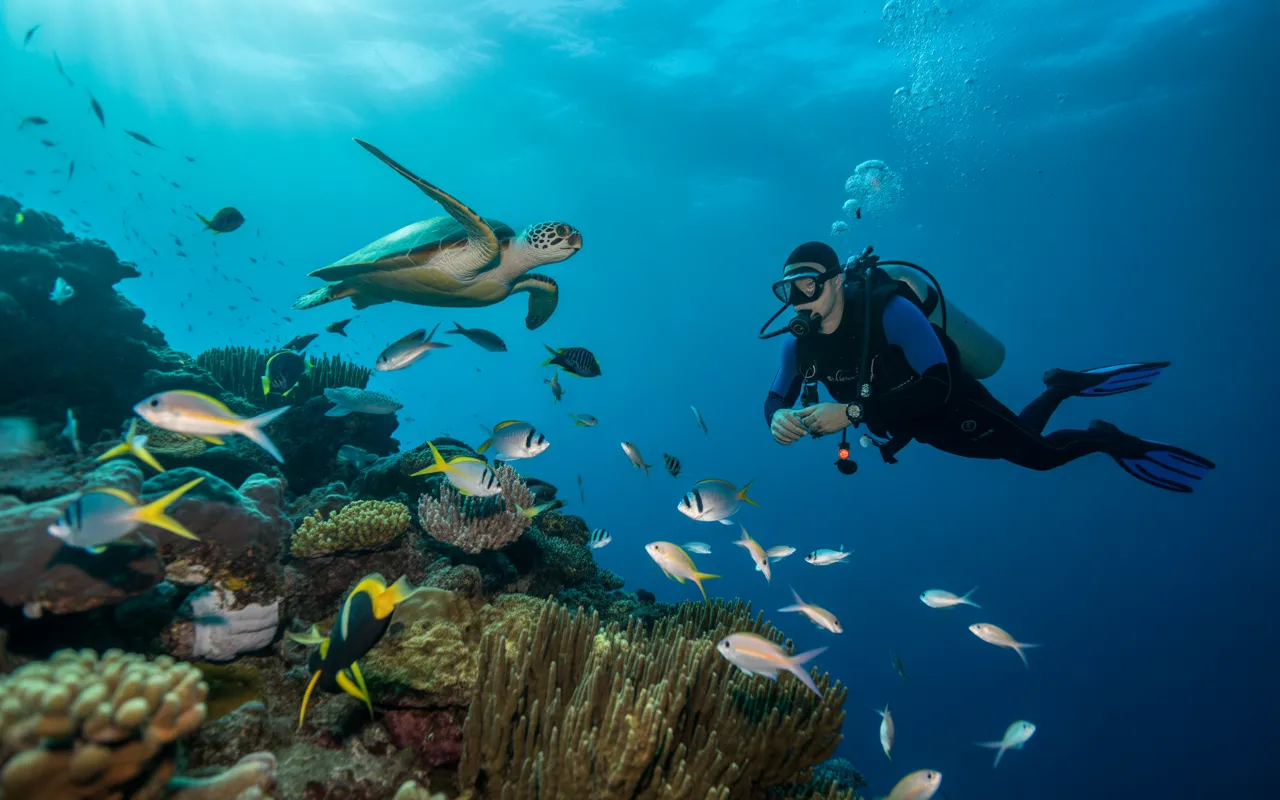
- Variety of dives : reefs and coral gardens, drop-offs, drift dives, and surrounding areas about twenty shipwrecks (old or modern boats) according to the MSDA.
As for wildlife, you can encounter a wide variety of tropical fish and, depending on the area and season, more "deep blue" encounters. The MSDA also reminds us of the Passage of humpback whales during their migration (period associated with the austral winter).
For a general (and recent) overview of the seasons and the types of matches possible, see the article by Forbes The article on diving in Mauritius details in particular the differences between “summer” and “winter” (calmer sea and warmer water in summer; slightly cooler water and more possible pelagic species in winter).
When to dive in Mauritius? Seasons, weather and temperatures (2026 data)
Water temperature: simple guidelines
The MSDA accurately summarizes the reality on the ground:
- November → April water generally 26–29°C (A 3mm shorty (may be sufficient depending on your tolerance).
- May → October water rather 23–25°C (a 5 mm combination is often more comfortable).
Cyclone season: what it will change for diving in 2026
Diving remains possible year-round, but planning must take weather risks into account. In Mauritius, the cyclone season officially covers the period of November 1st to May 15th (Information from the National Disaster Risk Reduction and Management Centre – NDRRMC, Government of Mauritius). During this window, it is normal to have “no boat” days (swell, wind, rain, weather warnings).
Practical tip for 2026: consult the Seasonal bulletins and forecasts from the Mauritius Meteorological Services. As a methodological example, their Summer Outlook 2025/26 (published on November 3, 2025It provides trends (rainfall, humidity, number of named weather systems in the basin). This does not replace daily weather forecasts, but it helps to understand the seasonal context.
Summary table: choosing your diving period (practical)
| Period | Water temperature (reference points) | Sea / weather (trend) | For whom? |
|---|---|---|---|
| November to April | About 26–29°C (MSDA) | Hot and humid season; increased vigilance during this period November 1 → May 15 (NDRRMC) | Ideal if you prioritize thermal comfort and a sea that is often "easier" (depending on conditions). |
| May to October | About 23–25°C (MSDA) | Fresher, often drier; trade winds more prevalent along the coast. | Excellent for back-to-back dives; period associated with the passage of humpback whales (MSDA) |
| October & May (off-season) | Variable | Often a good compromise (but it remains variable) | Perfect if you want to combine diving with land-based activities (hiking, sightseeing) while maintaining flexibility |
Best diving sites in Mauritius (2026): a useful selection by area
There are hundreds of dive sites around the island. For an "effective" selection, I rely here on reference sources (including the PADI list updated in January 2025) and on local fact sheets. The depths and the visibility These are reference points that can vary depending on the sea, wind and tides.
Table: Essential sites (depth, visibility, level)
| Site | Area | Kind | Maximum depth (reference point) | Visibility (reference point) | Recommended level |
|---|---|---|---|---|---|
| Djabeda Wreck | Coin de Mire (North) | Wreck | 34 m (PADI) | Up to 30m (PADI) | Rather advanced (wreck / depth) |
| Confetti Bay | Coin de Mire (North) | Sheltered reef | 18 m (PADI) | ~20 m (PADI) | All levels |
| Carpenter | Coin de Mire (North) | Relief / caverns | 18 m (PADI) | Up to 30m (PADI) | All levels (subject to conditions) |
| Grand Baie Aquarium | Grand Baie (North) | Canyon / reef | 14 m (PADI) | ~20 m (PADI) | All levels |
| Emily & Waterlily Wrecks | Trou aux Biches (Northwest) | Wrecks (2 barges) | 25 m (PADI) | Up to 30m (PADI) | Intermediate |
| Coral Garden | Trou aux Biches (Northwest) | Coral garden | 22 m (PADI) | Up to 25m (PADI) | All levels |
| Sea Fan Valley | Belle Mare (East) | Falling / Gorgons | 30 m (PADI) | Up to 25m (PADI) | Intermediate / Advanced |
| St. James Pass | Le Morne (Southwest) | Drifting | 30 m (PADI) | Up to 25m (PADI) | Advanced (current) |
| Cathedral (Flic en Flac) | West | Arches / caves | 30 m (Sundivers) | Variable | Advanced / Deep |
North (Grand Baie, Coin de Mire): topography, shipwrecks and large banks
The North is a safe bet if you want to string together varied and photographic outings.
- Corner of the Sight : a very popular “combo zone” with Djabeda Wreck, Confetti Bay, Carpenter or The Wall (PADI selection). Perfect for alternating between wreck and reef dives in the same day.
- Grand Baie : Grand Baie Aquarium is often cited for its topography and abundance of life (PADI). For more experienced divers, the area also offers deeper dives (e.g. Silver Star Wreck, PADI).
Northwest (Trou aux Biches): coral gardens & accessible shipwrecks
For a Mauritius diving experience focused on "colors + comfort", Trou aux Biches ticks many boxes:
- Coral Garden Moderate depth and great diversity of life (PADI), often recommended for all levels and even in night dive (PADI mentions the site's suitability for night diving).
- Emily & Waterlily Wrecks : two wrecks close together, max 25m (PADI), ideal for “wreck diving” without getting into the very technical stuff.
- Stenopus Reef : deeper (up to 35m according to PADI), interesting if you have an advanced level and like canyon/hard coral forest formations.
East (Belle Mare): gorgonians and drop-offs
The East is appreciated when seeking a "wide open landscape" atmosphere. The PADI selection cites Sea Fan Valley (Belle Mare): a route above a valley with gorgonians, which can descend up to 30m depending on your certification.
West (Flic en Flac): caves, arches and “dive scenery”
The West is very popular, and not just for life on land. The site Cathedral (Flic en Flac) is often cited as an essential "scenographic" feature: arches, rocks, cavities, with a maximum announced at 30 m and a recommended level of “Advanced/Deep” according to the Sundivers listing.
South & Southwest (Le Morne, Blue Bay): drifting boats and protected areas
- Le Morne : St. James Pass is described by PADI as a dive often adrift, with currents that are more changeable than at other sites; it is typically an “action” dive for divers comfortable in currents.
- Blue Bay Marine Park Perfect if you're looking for coral reefs and an iconic area of Southeast Asia. The site is recognized as a protected area, with a specific management framework and rules: the Ramsar (RSIS) information sheet notably states that threats related to diving are controlled by only authorizing certified operators/divers and that management is based on... Fisheries and Marine Regulations (2001).
Regulations & best practices (safety + environment)
MSDA: the national benchmark for supervised diving
In Mauritius, the MSDA is presented as the national diving federation: it “regulates and manages” the activity, and MSDA accreditation must be displayed by dive centers. The MSDA also indicates that divers complete a federal certificate valid for 2 months (and that residents can obtain an annual license under certain conditions, including a medical certificate).
In short: favor a affiliated center and always ask how the supervision is organized (levels, sea conditions, emergency plan).
Marine parks: access and rules
Two useful points to know:
- Blue Bay Marine Park : the Ramsar sheet specifies that the activity is regulated to limit the impact on the coral (certification, regulations, patrols).
- Balaclava Marine Park The legislative text published on the Mauritian government website (Blue Economy) mentions the activities permitted in the conservation area and recalls the existence of’infractions and penalties (fines in Mauritian rupees for failure to comply with the rules/conditions of the permit).
Marine mammals: responsible observation (up-to-date and unambiguous)
Distances, schedules, and exclusion zones can be strict and subject to change. Without going into legal interpretation, remember this simple rule: We observe, we do not pursue.
A widely circulated excerpt from the approach guidelines (reproduced online by a local center) defines, in particular:
- a restricted area around the animals (order of magnitude often cited: 50 m for dolphins and 100 m (for whales),
- time slots framing certain commercial activities,
- and a restriction of certain water sports (including diving) within a perimeter around the cetaceans.
To understand the origin of this framework, the Prime Minister's Office website (Cabinet Decisions) August 3, 2012) mentions the implementation of regulations under the Tourism Authority Act in order to better regulate whale & dolphin watching and swimming with dolphins, in line with international guidelines.
Finally, if you see any "borderline" practices on social media, be aware that the press has reported a hardening of the ban on swimming with whales announced at the end October 2023 and a desire to improve tourist information.
Practical tips for organizing your diving trip (without any unpleasant surprises)
Equipment: what to expect (2026)
- Combination Base your choice on the MSDA guidelines (3mm shorty in warm weather; 5mm in cooler weather). If you are prone to feeling cold, allow for a margin of extra room.
- Coral protection : opt for a “reef-friendly” sunscreen (and above all, avoid touching/placing yourself on the reef).
- Currents Some sites (e.g., drift dives) require good buoyancy. A DSMB (Dynamic Sail Buoyancy Control Module) and appropriate training are a real advantage.
Health & insurance: the basics
- Medical certificate : the MSDA specifies that it is recommended for training, and mandatory from a certain level and for minors.
- Emergency plan In case of suspected decompression sickness, the approach recommended by the Divers Alert Network (DAN) is to have the diver assessed by a medical service and then coordinate access to a container if needed (availability may change, hence the importance of going through emergency channels).
Living in Mauritius when you love diving (expatriation perspective)
If diving is part of your daily life (not just a holiday activity), the challenge becomes: where to live to reduce travel, take advantage of good weather windows and maintain a good quality of life.
- North / Northwest : often chosen for the density of sites (Coin de Mire, Grand Baie, Trou aux Biches) and a very “seaside” lifestyle.
- West : appreciated for certain "relief" dives (e.g. Flic en Flac) and a coast that is often more sheltered depending on the time of year.
- South / Southeast : superb for protected areas (Blue Bay) and landscapes, but you have to accept weather that is sometimes more exposed depending on the season.
If you are considering settling (or investing) on the island, you can start with the page Living in Mauritius: turnkey expatriation and real estate, then delve deeper with the expatriation guides Expat Mauritius.
FAQ – Diving in Mauritius (Frequently Asked Questions)
What is the best month for diving in Mauritius?
There isn't one single "best" month, but rather compromises. For many divers, the shoulder seasons are very comfortable: october And may They can offer a good balance between warmth and more stable weather. The MSDA indicates that summer (November–April) has warmer water (26–29°C), while winter (May–October) tends to be around 23–25°C. Think especially of “weather windows”: during the official hurricane season (November 1–May 15), occasional cancellations should be expected.
Do I need MSDA authorization to dive in Mauritius?
In practice, the MSDA regulates the activity at the national level, and indicates that divers fulfill a federal certificate valid for 2 months. This is a routine matter handled by the dive center upon your arrival (paperwork, medical information, etc.). The MSDA also specifies that residents can obtain an annual license with a medical certificate stating no contraindications. The easiest way: choose an affiliated center and clearly ask what is included (membership, insurance, formalities).
Where can I see shipwrecks while diving in Mauritius?
For an accessible first "wreck" experience, the area Trou aux Biches is often cited: PADI notably recommends the Emily & Waterlily Wrecks (max 25 m). If you are looking for a more striking wreck, Djabeda Wreck (Coin de Mire) is a reference point (max 34 m according to PADI). For more experienced divers, PADI also mentions Silver Star Wreck (deeper, deeper profile). Be careful: a wreck is not just scenery, it also presents risks (penetration, sediments, depth).
Can you see whales while diving in Mauritius?
The MSDA indicates that humpback whales They can be observed during their migration (which coincides with the more "winter" months in the region). In practice, sightings are mostly done during dedicated excursions (from a boat) and depend on the weather, sea conditions, and luck. Important: activities involving marine mammals are regulated (distances, zones, times), and stricter regulations have been reported in the press in recent years. The best approach: choose a licensed operator and strictly follow the briefings.
And now ?
You come to Mauritius for diving… and realize that the island has everything you need for a more permanent stay (family, business venture, investment)? Expat Mauritius can assist you with your expatriation (permits/visas, real estate, settling in, and starting a business). Start by discovering our comprehensive approach on the page Expat Mauritius, then explore the expatriation guides to structure your project with peace of mind.