Planning to move to Mauritius in 2026 is underway.
Whether you're coming to work remotely, start a business, invest, work for a company, or retire, the procedures for...’expatriation to Mauritius are based on one key point: choosing the good status (visa/permit), then compile a compliant file and submit it on the official platform.
In this guide, you will find: the main options (Premium Visa, Occupation Permit, Residence Permit…), the conditions (amounts, duration, renewal), the documents, and a clear method to proceed without errors.
1) Understanding the regulations for expatriation to Mauritius (2026)
In Mauritius, a distinction is generally made between:
- Visas (tourism, business, Premium Visa): more suited to a temporary stay, or to remote work without entering the Mauritian labor market.
- The permits (Occupation Permit / Residence Permit / Permanent Residence Permit): suitable for a more permanent settlement (working locally, starting a business, investing, retirement).
Important point for 2026: a application fee of 50 USD (non-refundable) is indicated as applicable from December 1, 2025 for Occupation Permit and Residence Permit applications via EDB/NELS channels.
2) Overview of the most commonly used visas and permits
The Premium Visa (1 year, renewable): remote work and long stay
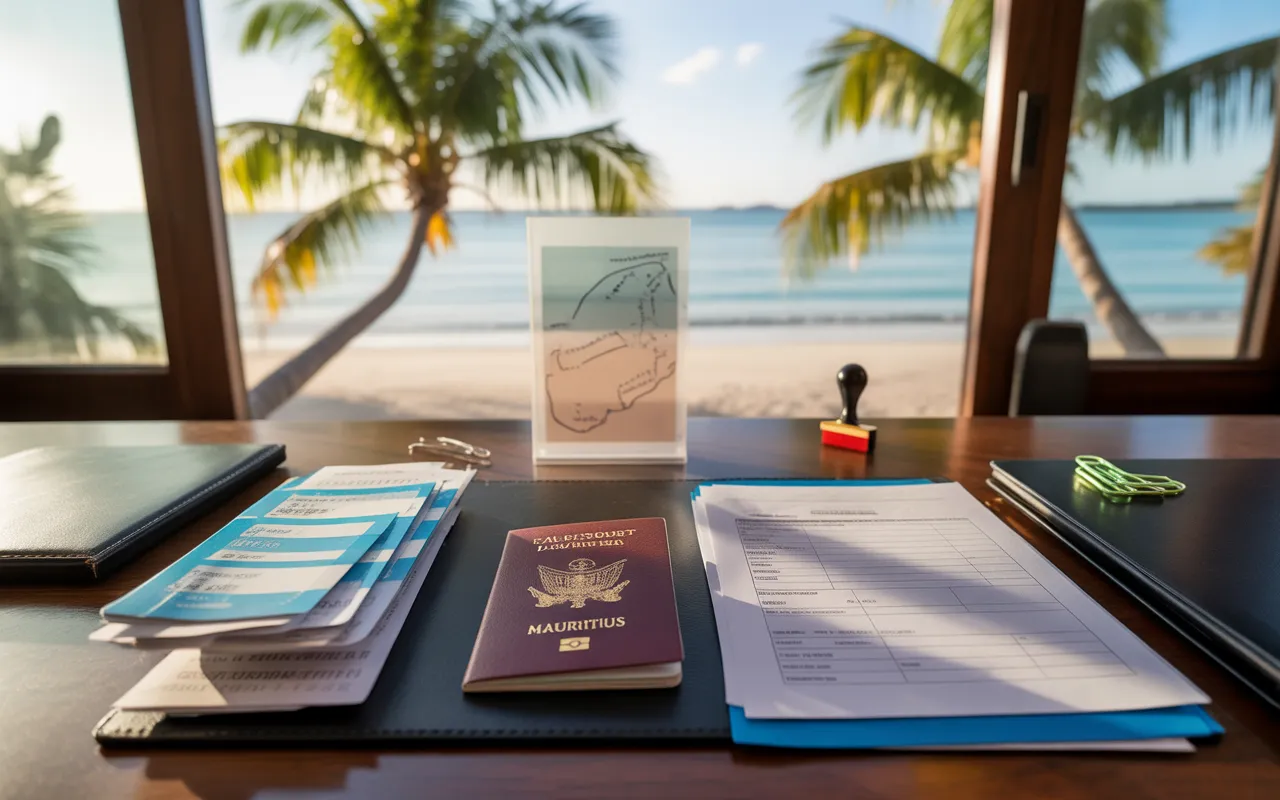
THE Premium Visa allows you to stay in Mauritius up to one year (renewable) as a tourist, retiree or working professional from a distance. It targets people whose the source of income is outside of Mauritius and who do not enter the Mauritian labor market. Travel/health insurance and supporting documents (accommodation, reason for travel, etc.) are required. The Premium Visa is announced. free by the authorities.
Note: The EDB also outlines a specific tax framework for Premium Visa holders (particularly regarding the remittance basis, depending on the circumstances). For a binding decision (duration, amounts), have your situation reviewed by a professional (tax advisor).
The Occupation Permit (OP): to work, start a business, or invest
L'’Occupation Permit is a permit combining residence and activity, with 3 main categories: Professional (employee), Self-Employed (independent) and Investor (investor). Applications are made online via the official platform (NELS).
- Professional : local employment contract and minimum wage (see section “Comparative Table”).
- Self-Employed : minimum investment in USD, letters of intent and sales/revenue targets.
- Investor : minimum investment in USD and revenue targets (turnover).
The Residence Permit “Retired Non-Citizen” (50+)
THE Retirement Residence Permit is aimed at non-citizens aged 50 or over. The official pages consulted show information that is not entirely harmonized regarding the expected monthly/annual amount (some pages mention $1,500 USD/month, others $2,000 USD/month and/or USD 24,000/yearIn practice, it's the checklist and the requirements for filing on the official platform take precedence: it is therefore necessary to align with the most recent request at the time of filing.
The Family Occupation Permit: “family” option (10 years)
THE Family Occupation Permit includes a residence 10 years for the applicant and his family unit, with a contribution of USD 250,000 (advertised as non-refundable) to the stated fund (COVID-19 Projects Development Fund) and fees “starting from USD 1,000”. Holders (applicant + spouse) may work and/or invest in Mauritius according to the conditions described.
The Permanent Residence Permit (PRP): 20 years
THE PRP (permanent residence) is presented as a 20-year residency, open to investors, retirees, professionals, the self-employed and their families, subject to conditions. The EDB specifies, in particular, a minimum seniority of 5 years on the initial permit and high thresholds (e.g., turnover or salary) depending on the category.
Residence via real estate purchase (example: “Ground + 2 Apartments”)
In some cases, purchasing property can grant a right to residency. For example, the scheme “Ground + 2 Apartments”" mentions a Residence Permit granted to non-citizens upon the acquisition of an apartment in a building of at least 2 floors above the ground floor (G+2), with an announced price at least USD 375,000 (or equivalent) and also a threshold indication at WALL 6 million (or equivalent); the permit is indicated as valid as long as The non-citizen remains the owner.
3) Quick comparison (2026): which status to choose?
Comparative table of the main visas/permits
| Profile | Most common status | Approximate duration | Key conditions (examples) | Working in Mauritius? | Filing / Authority |
|---|---|---|---|---|---|
| Teleworking (income earned outside Mauritius) | Premium Visa | 1 year, renewable | Insurance + supporting documents, not to enter the local job market | No (local use prohibited) | Online (EDB/PIO references) |
| Employee in a Mauritian company | Occupation Permit (Professional) | Up to 10 years according to EDB (depending on the contract) / also mentions a maximum of 3 years on a PIO page | Minimum wage mentioned in WALL 30,000 on EDB (check sector/changes) | Yes | NELS (EDB) + employer |
| Independent / freelance | Occupation Permit (Self-Employed) | 10 years, renewable | USD 50,000 + 3 letters of intent (including 2 local ones) + revenue/turnover (MUR) over several years | Yes (own activity) | NELS (EDB) |
| Business creation/management (investor) | Occupation Permit (Investor) | 10 years, renewable | USD 50,000 + minimum turnover (e.g. 1.5M WALL from year 1, cumulative 20M WALL (at 5 years) + renewal criteria | Yes (within the company) | NELS (EDB) |
| Retirement (50+) | Residence Permit (Retired Non-Citizen) | 10 years, renewable | Displayed thresholds vary depending on the page (e.g. USD 1,500 Or USD 2,000/month) + bank statements + annual monitoring | No (but investment possible under certain conditions) | NELS (EDB) / PIO for dependents |
| Family (overall setup) | Family Occupation Permit | 10 years | USD 250,000 (contribution) + fees “from” USD 1,000 | Yes (applicant + spouse) | EDB email file (according to EDB page) |
| Long term “permanent residence objective” | Permanent Residence Permit (PRP) | 20 years, renewable | Example after 5 years: Investor WALL 15M/year over 5 years or 75M WALL cumulative; Professional salary MUR 400,000/month over 5 years, etc. | Yes (depending on category) | EDB |
Official sources to consult for arbitration: EDB pages “Residency in Mauritius” and “Passport & Immigration Office”. Some government pages are not always synchronized (duration/salary), hence the importance of relying on the submission platform (NELS) and checklists when submitting.
4) 2026 procedures: the simple method (without choosing the wrong status)
Step 1: Clarify your “real purpose” of stay
- You do not work for a Mauritian company and your income remains outside Mauritius: Premium Visa (often the most consistent).
- You are hired locally : OP Professional via your employer.
- You are launching a business (business / investment): OP Investor or OP Self-Employed depending on the structure and criteria.
- You are retiring : RP Retired Non-Citizen.
Step 2: Enter Mauritius with the appropriate visa (if you are arriving before approval)
The EDB reminds us of practical entry rules:
- Business visa On-site for investors/entrepreneurs/professionals: eligibility announced at 120 days per calendar year and do not exceed 90 days during the first stay under a business visa.
- Tourist visa : retirees and dependents generally enter as tourists; announced ceiling at 180 days per calendar year.
The authorities also indicate that the visas and extensions are free (immigration side).
Step 3: Submit the application on the official platform (NELS)
For Occupation Permits and several Residence Permits, the application is submitted via the National Electronic Licensing System (NELS), official platform. A notice there mentions the’application fee of 50 USD effective at December 1, 2025 for OP/RP requests.
The typical route is:
- Creating an account on the platform.
- Upload of the requested “Approval-in-Principle” (AIP) documents.
- Receipt of the AIP (if accepted).
- Finalization (presentation of originals, medical examinations if required, payment of statutory fees, issuance).
Step 4: Managing the essential "extras" for the installation
A successful expatriation is not limited to the permit: housing, insurance, schools, banking, telecom, vehicle, business creation… This is often where the timing and comfort of arrival are determined.
For a comprehensive overview of the installation steps and turnkey support, you can also consult the page Living in Mauritius: turnkey expatriation and real estate.
5) Documents: practical checklists (as appropriate)
The exact lists vary depending on the status, but here are the items that appear most often on the official pages (and which explain the majority of blockages when a document or translation is missing).
Frequently requested parts (all profiles)
- Passport (bio page) and passport photos in the required format.
- Birth certificate (often in original, or certified translation if necessary).
- Medical certificate (often < 6 months) according to the statutes.
- Certificate of good character / extract from locker according to the steps.
Specific: Investor (OP)
- Business plan (according to template) + project information.
- Proof of funds / bank documents, then compliance with turnover targets over the years.
Specific: Self-Employed (OP)
- Minimum investment USD 50,000.
- 3 letters of intent (of which 2 of potential local customers).
- Revenue/turnover targets (e.g., MUR 750,000 in the first year, and cumulative over 5 years).
Specific: Retired (RP)
- Age : 50 years or older.
- Proof of funds/flows (amounts vary depending on the page, and sometimes there is a standard annual requirement) USD 24,000/year displayed).
- Follow-up: the EDB mentions an annual check via bank statement/certificate at the end of the year.
6) Coming as a couple, with children, or parents: dependents and rights
The EDB pages indicate that the dependents (Spouse, parents, children — including adopted/stepchildren, subject to conditions) may apply for a permit linked to that of the primary holder. The application as a dependent is indicated as being processed by the Passport and Immigration Office (PIO).
Note: generally speaking, a “dependent” status” does not automatically allow work (the spouse must then switch to their own permit/OP if they wish to carry out an activity).
7) Useful cost and quantified benchmarks (without inventing)
Permit fees (examples shown)
- OP Investor: USD 1,000 “upon approval of application” (according to EDB page).
- OP Self-Employed: USD 1,000 “upon approval of application” (according to EDB page).
- Retired RP: USD 1,000 (according to EDB page “Retired Non-Citizen +50”).
- Premium Visa: announced free.
Application fee (effective December 1, 2025)
Several official pages (NELS and EDB “Residency”) display a notice: USD 50 non-refundable starting from December 1, 2025 for Occupation Permit and Residence Permit applications.
A tax benchmark for 2025–2028 (useful for high earners)
The Mauritian Revenue Authority (MRA) indicates a Fair Share Contribution at the rate of 15% on “leviable” income beyond Rs 12 million, applicable for the income year beginning on July 1, 2025 and for the the following two years (until the June 30, 2028).
Tip: If you're unsure whether to choose a Premium Visa, OP, or residency through real estate, or if you have multiple income streams, have your strategy (immigration and tax) reviewed. Mistakes regarding your status are more costly than preparation.
8) The most common mistakes (and how to avoid them)
- Confusing teleworking with local employment : the Premium Visa is aimed at remote work with income outside Mauritius, without entry into the local market.
- Submitting an incomplete application (translations, photo formats, recent documents): many documents are required to be “less than 6 months old” and originals at some point in the process.
- Underestimating performance obligations (turnover/revenues) on Investor and Self-Employed: the announced thresholds are multi-year, not just at entry.
- Don't anticipate the family : dependents follow a PIO circuit, and the right to work is not automatic.
- To take for “set in stone” An isolated page: some official pages may not be perfectly aligned with each other (duration/salary/amounts). The submission on the platform and the checklist at time T are considered authoritative.
9) In practice: how Expat Mauritius supports you
Expat Mauritius is a company based in Azuri Village and specializing in providing support for expatriation to Mauritius: visas and permits, real estate investment, facility (housing, schools, banking, insurance) and business creation.
The goal: to simplify your process, secure the documents in your file, and coordinate the steps (submission, follow-up, installation) with a personalized approach and quick responses.
To explore the different resources, you can consult the expatriation guides Expat Mauritius.
FAQ – Expatriation to Mauritius (frequently asked questions)
Which visa should I choose to work remotely from Mauritius in 2026?
THE Premium Visa is generally the most suitable if you are working remotely for clients/a company out from Mauritius: it allows you to stay until one year (renewable) and prohibits entry into the Mauritian labor market. In practice, you must prepare insurance (travel/health) and proof of stay (accommodation, intention of long-term stay). If you plan to invoice locally or be employed in Mauritius, you should instead consider a Occupation Permit.
Is it possible to move to Mauritius and start a business?
Yes, the’Occupation Permit includes dedicated categories, notably Investor And Self-Employed. Both involve financial criteria (e.g. USD 50,000) and revenue/sales targets to be met over time. The Investor focuses on company turnover; the Self-Employed targets independent activity and specifically asks for 3 letters of intent (including 2 potential local customers) according to the EDB. The application is submitted via the official NELS platform.
What are the conditions for retiring in Mauritius?
The permit “Retired Non-Citizen”"targets people of 50 years and older. The official pages consulted display varying amounts (some mention USD 1,500/month, others USD 2,000/month and a logic of USD 24,000/yearTherefore, you must prepare solid bank statements (income/pension/savings) and comply with the requirements of the filing process. The EDB also indicates annual monitoring via bank statements/certificates.
Can my spouse work in Mauritius if I hold a permit?
In general, the spouse often arrives via a status of addicted, This status, linked to the primary holder's permit, does not automatically grant the right to work. If your spouse wishes to work (local employment) or start a business, they will generally need to obtain their own permit. own permits (e.g., a Professional Operator's Permit if hired, or an Entrepreneur/Investor category depending on the project). "Dependent" applications are indicated as being handled by the Passport and Immigration Office.
Is it possible to obtain a residence permit by buying an apartment in Mauritius?
Yes, some housing schemes grant a right of residence. For example, the EDB page “Ground + 2 Apartments”" indicates that a Residence Permit is granted upon the acquisition of an apartment in a building of at least G+2, with a starting price announced from USD 375,000 (or equivalent) and a threshold mention at WALL 6 million (or equivalent). The permit is stated to be valid as long as you remain the owner. Assistance is strongly advised (notary, program compliance, taxation).
And now ?
If you want to move quickly and stress-free, Expat Mauritius can help you choose the right status, secure your application (documents, translations, residency requirements), and coordinate your relocation (housing, schools, banking, insurance) as well as your investment and business creation projects. Start on the page Expat Mauritius – turnkey expatriation and real estate, then explore the expatriation guides to prepare your action plan.
Useful official sources (external links)
- Passport & Immigration Office – Premium Visa
- Passport & Immigration Office – Visa requirements
- Passport & Immigration Office – Occupation Permit / Residence Permit (overview)
- EDB – Mauritius Premium Visa
- EDB – Occupation Permit (Professional)
- EDB – Occupation Permit (Self-Employed)
- EDB – Occupation Permit (Investor – USD 50,000)
- NELS – National Electronic Licensing System (filing platform)
- MRA – Fair Share Contribution (official information)