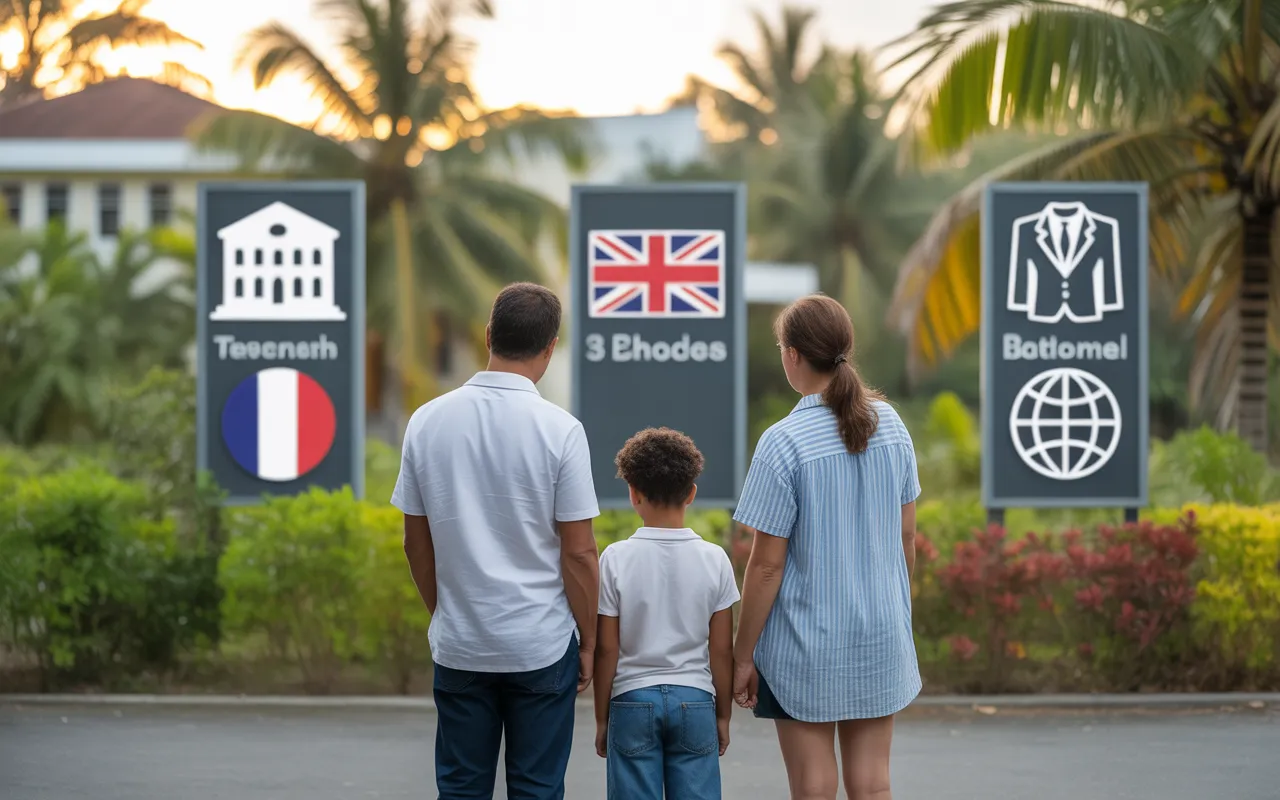
Choosing a school in Mauritius can quickly become a headache.
Between the school calendar, language of instruction, qualifications (Baccalaureate, IGCSE, IB…) and budget, the right choice depends primarily on your family plans and the length of your stay abroad. In this guide, EXPAT MAURITIUS helps you understand the three major systems (Mauritian/national, French, British & international) and to be sorted the truly decisive criteria to find the most suitable establishment.
To discover the comprehensive support offered by EXPAT MAURITIUS (visas/permits, housing, banks, schools, etc.), you can also consult the official website.
Understanding the school systems in Mauritius
The Mauritian (national) system: structure, examinations and key points
The Mauritian system is organized in cycles ranging from elementary school (Grades 1 to 6) to secondary school (Grades 7 to 13). Secondary school follows a cycle of 7 years (Grade 7 to Grade 13).education.govmu.org)
Key points to remember from an official standpoint:
- Secondary school is free in Mauritius since 1977. (education.govmu.org)
- Education has become compulsory until age 16 (Reforms/texts from the 2000s onwards; explicit mention of compulsory schooling up to age 16).education.govmu.org)
Regarding assessments, the Mauritian ecosystem is known for its milestones: PSAC (end of Grade 6), national assessments in Grade 9, then School Certificate and Higher School Certificate at the end of secondary education (depending on the stream and institution). Public statistics also provide an overview of recent results (e.g., PSAC, SC, HSC for the year 2023).statsmauritius.govmu.org)
The British curriculum: IGCSE / A-Levels
Many private/international schools in Mauritius follow a typical British curriculum: IGCSE Then AS/A-Levels. The advantage for an expatriate family is the international readability of the journey, particularly in the case of mobility to other English-speaking countries.
Regarding assessment benchmarks, Cambridge, for example, indicates the IGCSE grading scales (A* to G) and level equivalencies with British qualifications.help.cambridgeinternational.org)
The French system (AEFE program): continuity, Baccalaureate and specific calendar
In Mauritius, there is a network of schools with a French curriculum, with a common calendar validated locally for the 2025–2026 school year, including in particular: Lycée des Mascareignes, Lycée La Bourdonnais, École du Centre Pierre Poivre, École du Nord, École Paul et Virginie. (lyceedesmascareignes.org)
If your goal is to stay in the French route (return to France, further studies in a French-speaking environment, Baccalaureate), this system often offers a educational continuity reassuring. The Lycée des Mascareignes, for example, is listed by the AEFE and presents its accredited levels.aefe.gouv.fr)
The “international” programs: IB (PYP/MYP/DP), bilingualism and mobility
The term “international” encompasses several approaches (IB, British + IB mix, bilingual, etc.). International Baccalaureate (IB) program is frequently sought after by highly mobile families, as it is standardized and recognized by many universities.
Useful reference point: the IB specifies that the Diploma Programme (DP) is intended for students of 16 to 19 years old. (ibo.org)
Which system should you choose? The differences that really matter.
Comparative table of the main systems in Mauritius
| System | Dominant language(s) | Degrees / Milestones | Ideal if… | Points to be aware of |
|---|---|---|---|---|
| National (Mauritian) | Often English/French (depending on the institution), local context | Course outline Grades 1–13; PSAC/Grade 9 benchmarks; SC/HSC (depending on the program) | Are you aiming for local integration, a controlled budget, or schooling that follows the national calendar? | Specific calendar (year “January–October/November” depending on levels); transitions to foreign systems to be anticipated |
| French program (AEFE network) | French (with LV) | Typical educational path: National Education; Baccalaureate (high school) | You want continuity between France and the Baccalaureate and a "late August - early July" timetable“ | Places requested; private budget; administrative requirements (files, assessments) |
| British / International (IGCSE, A-Levels) | English | IGCSE; AS/A-Levels (depending on schools) | You are aiming for English-speaking universities and subject flexibility. | Program discrepancies with French; choice of subjects to be calibrated early |
| International (IB) | Often English + bilingual depending on the school | IB (DP 16–19 years) | You want a standardized international framework and frequent mobility | Academic rigor; continuity of IB to be ensured (PYP/MYP/DP depending on age) |
Selection criteria: how to decide without making a mistake
1) Your child's age and the "moment" of the transition
A good system depends a lot on When you arrive and at what level your child enters:
- Kindergarten / Primary The issue is not just the diploma, but also the language, the methods and the adaptation.
- College entrance / Grade 7 : strategic moment (cycle change) — ideal for changing systems.
- IGCSE / high school / DP : at this age, changing programs can have a direct impact on options and academic record.
2) Language of instruction: immersion or continuity?
Ask yourself a simple question: is your priority rapid integration into English or the continuity in French ?
- If your child is French-speaking and arrives late (middle/high school), a French system can limit the “double shock” (new country + new academic language).
- If your project is long-term in Mauritius (or very international), English can become a logical investment.
3) School calendar: the most common mistake among expatriates
In Mauritius, Not all calendars are the same. Two concrete examples:
- National Calendar 2025 : 1st quarter of Friday, January 10, 2025 At Friday, April 11, 2025 (primary and secondary), then resumption at the end of April; the third term differs between primary and secondary.education.govmu.org)
- National Calendar 2026 : 1st quarter of Monday, January 12, 2026 At Friday, April 3, 2026, then the second quarter until the Friday, July 17, 2026. (education.govmu.org)
- Calendar “French program” 2025–2026 : back to school for students on Friday, August 29, 2025, then periods up to Friday, July 3, 2026 (with intermediate holidays).lyceedesmascareignes.org)
Practical tip: If you arrive between November and January, check immediately if your target school starts in January (national calendar) or in August/September (often French programs and some international schools). This changes everything for registration.
4) Budget: beyond “tuition fees”, list everything
In the private/international sector, the annual budget is rarely limited to "tuition":
- Application fee
- Registration fee / inception fee / capital fee
- Refundable deposit (often several months of tuition)
- Books, resources, ed-tech, activities, uniforms
- School transport
- Options (EAL/English as an additional language, SEN/Special Educational Needs)
5) Location and travel time (a quality of life criterion)
In Mauritius, travel time can vary greatly depending on the time of day and the route. Many families prefer:
- a school near home, then look for accommodation accordingly; ;
- or the reverse: housing first, school second (risky if you have space constraints).
6) Accreditations, continuity and “exit” (universities/returns to country)
If you're already thinking about what comes next (returning to France, studying at universities in the UK/Europe/elsewhere), check:
- there continuation of the program (e.g. IB up to DP, British up to A-Levels, French up to Baccalaureate); ;
- THE results and guidance support; ;
- the institution's ability to manage an international profile (files, transcripts, equivalencies).
How much does a private/international school cost in Mauritius? Real examples (2024–2026)
Prices vary considerably depending on the program, level, and fee policy (Mauritian vs. Expatriate, entry fees, deposits, etc.). To avoid guesswork, here are some public examples taken from school sources (or official documents):
- French program (Lycée des Mascareignes) – 2025/2026: initial registration fees indicated at WALL 60,000 ; price list WALL 215 050 (French/Mauritian nationality, standard academic track) and WALL 263 175 (other nationalities, normal track).lyceedesmascareignes.org)
- International School (Northfields) – Reception Expat, 2025–2026: “Yearly Fee” WALL 288 200, with deposit and entry fees as per the fee schedule.northfields.nyc3.digitaloceanspaces.com)
- International School (Northfields) – Year 7–11 Expat, 2025–2026: “Yearly Fee” WALL 559,900, and additional costs (books, ed-tech, resource levy, etc.) detailed.northfields.nyc3.digitaloceanspaces.com)
- Saint Exupéry International School Mauritius: page “Tuition fees” indicating annual fees at WALL 222,000, plus a refundable deposit and initial registration fees.en.seis.mu)
A simple method for comparing two schools: ask for (or reconstruct) a total cost year 1 = (registration/inception/capital fee) + (deposit) + (tuition) + (mandatory additional fees) + (transportation + uniform + canteen if applicable). Only then, compare the cost year 2 (often lower if the entry fees are not repeated).
Registration: documents, tests, deadlines (checklist)
The most frequently requested parts
- Report cards/transcripts (last 2–3 years if possible)
- Passport copy (child + parents) and birth certificate
- Vaccination record / medical file (depending on the school)
- Letter of recommendation / school certificate (depending on level)
- Possible assessments (speech therapy, psychology, etc.) if adjustments are needed.
Placement tests and interviews: what to expect
Depending on the school and age, you may be offered:
- an English or French test (reading/listening comprehension)
- a mathematics test
- a family/student interview (motivation, adaptation, project)
Deadlines: when to start?
In practice, the older your child is, the more you need to plan ahead. Ideally, you should start the process several months before arrival, especially if you are aiming for a specific program (French/IB) and a specific start date (August/September or January depending on the system).
Concrete scenarios: what choice depending on your expatriation project?
Scenario A: “We stay for 1 to 2 years, then return to France”
The French program can be a convenient option to avoid a break in your studies, especially at the middle/high school level. Check the calendar (start of term at the end of August) and available places. The French program network in Mauritius publishes a common calendar for 2025–2026, which is useful for planning your arrival.lyceedesmascareignes.org)
Scenario B: “We settle down permanently, international career, English-speaking universities”
A British (IGCSE/A-Levels) or IB pathway becomes logical: progression in English, subjects chosen early, structured university guidance. If you are aiming for the IB, remember that the DP targets 16–19 year olds: it is better to ensure continuity before this age.ibo.org)
Scenario C: “Two children, different profiles, budget to control”
In this case, the choice is often a compromise between: proximity (travel), linguistic continuity, and total cost (entrance fees + deposit + tuition + additional expenses). The most effective approach is to identify 2–3 target schools and compare them based on a “year 1 / year 2” budget.
Useful data (Mauritius) for gaining perspective
To make an objective decision, it is helpful to look at publicly available data. Statistics Mauritius, for example, publishes indicators for 2024: 342 primary schools (84,220 students), 175 secondary schools (94,747 students), as well as information on PSAC/SC/HSC results (year 2023).statsmauritius.govmu.org)
You can view this data on the official website of Statistics Mauritius (Education Statistics 2024).
The role of EXPAT MAURITIUS: to save time and avoid unpleasant surprises
When you move abroad, you don't choose your school "on its own": it's linked to the visa/permit, At accommodation, to the address, travel arrangements, and installation schedule. EXPAT MAURITIUS supports families and entrepreneurs relocating to Mauritius with a turnkey approach, and can help you with structure your search for schools (shortlist, timing, consistency with your living area, preparation of the installation procedures).
- EXPAT MAURITIUS: Expatriation support in Mauritius
- Living in Mauritius: turnkey expatriation and real estate
- Expatriation guides – Expat Mauritius
FAQ – Schools in Mauritius and support for EXPAT MAURITIUS
Can EXPAT MAURITIUS help me find a school in Mauritius?
Yes, as part of a relocation project, EXPAT MAURITIUS can help you structure your search: clarify your criteria (program, language, schedule, area), build a coherent shortlist, and establish a realistic timeline for your arrival. The goal isn't to "choose for you," but to save you time and avoid common mistakes (incompatible schedules, unmanageable commutes, underestimated budget). To get started, you can go through the EXPAT MAURITIUS website.
How long does it take to enroll a child in a school in Mauritius?
It's best to plan a few months in advance, especially for highly sought-after programs or when your child is entering a pivotal level (Grade 7, IGCSE, high school/DP). Deadlines depend on the school calendar (some schools start in January, others in August/September), placement tests, and available places. The key is to coordinate: arrival date, start date, and the availability of documents (report cards, certificates, translations if necessary).
What school budget should an expatriate family in Mauritius plan for?
The budget depends on the program and the level, but it's important to think in terms of "total cost". Public sources, for example, show annual costs of around WALL 215 050 to WALL 263 175 for a French-curriculum high school (depending on nationality) and amounts that may exceed WALL 500,000 at certain levels in international schools, not including deposits and additional fees.lyceedesmascareignes.orgThe best practice is to compare year 1 (with entry fees) and year 2.
Is it possible to join a French school in Mauritius mid-year?
It is sometimes possible, but it depends on the level, available places, and the calendar. In Mauritius, schools with a French curriculum follow a common 2025–2026 calendar (start of term at the end of August, specific holiday periods).lyceedesmascareignes.orgIf you arrive in January/February, you may be considered "mid-year" according to the French calendar, but "early year" according to the national calendar. In any case, prepare a complete academic record and anticipate a period of adjustment.
British or IB program: which to choose for university?
Both can lead to good universities, but the choice should follow the student's profile. The IB DP is explicitly designed for 16–19 year olds and imposes a demanding and cross-disciplinary structure.ibo.orgThe British system (IGCSE then A-Levels) can offer a more gradual specialization, with subjects chosen earlier. The key is to ensure continuity (avoiding changing systems at the wrong time) and to verify the availability of guidance counseling.
And now? (next step)
If you want to move forward quickly and smoothly, the next step is to align school + living area + installation schedule. EXPAT MAURITIUS can assist you with the entire project (settling in, real estate, administrative procedures, and practical arrangements). To explore the options, consult the page “Living in Mauritius: Turnkey Expatriation” and the expatriation guides, or contact EXPAT MAURITIUS via the official website.