Surfing in Mauritius is a dream.
Between turquoise lagoons and reefs, the island offers waves perfect for progressing… provided you choose your spot wisely and respect a few essential safety rules. In this guide, you'll find practical advice for getting started, understanding the seasonality (swell, wind, tides), identifying areas suitable for beginners, and avoiding common pitfalls (currents, coral, overcrowding, localism).
Understanding surfing in Mauritius: lagoon, reef and passes
Why Mauritius is different from many “beach” destinations”
In Mauritius, a large proportion of the waves form on Reef breaks (Waves breaking on the reef). It's magnificent… but more technical than a simple beach break (wave breaking on sand). The reef can be sharp, sometimes very shallow at low tide, and currents can strengthen near the pass (openings in the coral reef).
Beginner: the number one objective is to reduce the risk
When you're starting out, you first look for:
- an area sheltered from the wind and not too exposed to the swell,
- a fund sandy or a “gentle” wave,
- easy access (no boat needed),
- Little current and easy entry into the water.
In Mauritius, this often involves targeting smaller waves (or shore breaks) rather than “the postcard wave” on the reef.
When to surf in Mauritius? Seasons, wind, swell and cyclones
Waves can be found almost year-round, but their quality and power vary greatly depending on the time of year. Generally speaking, the southern winter brings more consistent swells, while summer can bring rarer but sometimes very powerful cyclonic swells.
Practical guide: choosing the right time to start (surfing in Mauritius)
| Period | What often happens | Advantages for beginners | Points to be aware of |
|---|---|---|---|
| May to September | Trade winds are more prevalent, and this period is known for good conditions, especially during the austral winter. Certain windows offer consistent waves. | Conditions are more “readable” (if you choose a sheltered area) and there is better swell regularity at certain spots. | Strong winds possible (especially East/South), stronger currents and waves on exposed reefs. |
| October to April | Sea often warmer, alternating periods of calm and swell peaks. Possible cyclonic swells (rarer episodes, sometimes powerful). | Smaller waves more frequent at times, ideal for the first whitewater and take-offs. | Cyclone season In the region: increased caution and monitoring of weather conditions are essential. |
| November 1st to May 15th | Official window of the cyclone season for Maurice. | Can offer some nice "in-between" periods if the weather is stable. | Possible marked weather events: never rely on habit, always check the forecasts. |
The period November 1st – May 15th is indicated as cyclone season in Mauritius by the government platform dedicated to disaster risk reduction. Source: NDRRMC (Government of Mauritius) – Cyclone FAQs.
An essential reflex: check the sea alerts
Before each session, check the official alerts: when the notices “High Waves Advisory”"As conditions go out, they can become dangerous even near the shore. The Mauritius Meteorological Services, for example, publishes bulletins detailing..." wave heights and the affected coastal areas. Consult the sea warnings (Mauritius Meteorological Services).
Where to surf when you're a beginner: spots to aim for (and spots to avoid)
The names of certain spots come up frequently (Tamarin, Le Morne…), but not all are suitable for beginners. The key: choose a location consistent with your skill level for the day, not with the picture you have in mind.
Spots often cited as accessible (depending on conditions)
- Tamarin (Public Beach area / shore break) Some sections are easier, especially when the waves are small. The bay also contains areas known for being more challenging on the reef. A local guide points out that the shore breaks are suitable for beginners, while the reef sections should be approached with caution, especially at low tide. Reference (spot overview and recommendations – Tropicscope).
- Le Morne – “Ti reef” / “Manawa” The waves are sometimes described as "fun" and accessible, but access can be remote and currents may be present. Some surf spot guides also indicate that boat trips may be necessary depending on the location. Reference (spot descriptions – Surf Mauritius).
Spots to avoid when starting out (example: One Eye)
Some Mauritian spots are world-renowned, but not made for learning. This is the case of One Eye (Le Morne), often described as a powerful wave on shallow coral reef, requiring self-reliance and experience. Reference (features and safety – Kite in Moris).
Simple rule: If the wave is “hollow / tubular”, on a very shallow reef, with a technical entry into the water or a difficult exit, it is not a beginner spot.
Practical tips for a successful first session
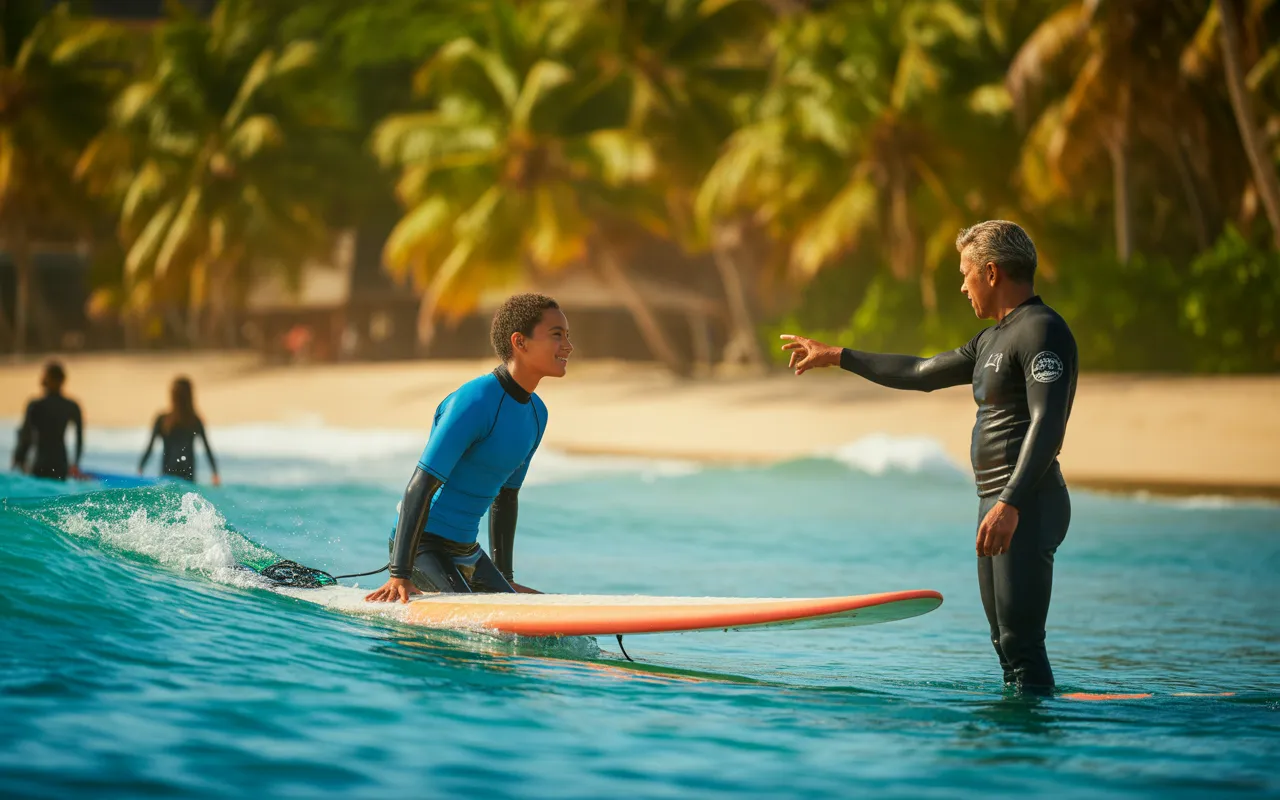
1) Take a course (the biggest accelerator of progress)
In Mauritius, learning to read the waterways (reef, channels, currents, tides) is a skill in itself. A course will help you to:
- choose an area suited to the actual level of the day.,
- learn priorities (safety rules + etiquette),
- correct the position and the take-off,
- to avoid injuries to coral and panic situations.
2) Choose the right board to start with
- Soft-top (foam): more stable, safer for you and others.
- Generous volume: for catching more waves and standing up more easily.
- Leash Mandatory: your board is your float and a risk to others if it goes off on its own.
3) Equip yourself with “anti-coral” gear (without overloading)
Depending on the location and the tide, useful accessories may include:
- reef booties (reef booties) if the entry/exit is in a coral zone,
- lycra / rashguard (anti-irritation and anti-sun),
- sunscreen water-resistant (ideally more respectful of marine environments),
- small “minor injuries” kit (disinfection) for micro-cuts.
4) Learn the 3 fundamentals: tide, current, right-of-way
- Tide On a reef, the difference between "OK" and "dangerous" can be a matter of water depth. Some dive guides clearly state that reefs become very shallow at low tide. Example (spot guide mentioning the risk at low tide – Surfnerd).
- Currents : identify the direction of drift before moving away.
- Priority : only one person on the wave. Don't "drop in" in front of someone who's already committed.
Security: the real risks (and how to reduce them)
The number one risk: drowning (even near the edge)
Drowning is a global public health issue. The WHO points out that there have been over 300,000 drowning deaths in 2021 (estimate), and that these are often tragedies that could be avoided with good prevention practices. Source: WHO (updated December 13, 2024).
Rip currents: knowing how to react
Rip currents can occur on beaches and surf areas, especially when the swell is rising. The RNLI (sea rescue service) explains that a rip current can be too fast to swim "by force": they recommend not fighting the current, of stay calm, then of swim parallel to the shore to get out of the current channel, before returning to the beach. RNLI Guide: Rip Currents.
Cuts on coral: prevention and common sense
- Avoid jumping "flat" in shallow water.
- Do not walk on the reef (dangerous for you and destructive to the ecosystem).
- In case of a wound: clean, disinfect, and monitor. If the cut is deep, painful, or if the area swells/reddens significantly, consult a healthcare professional.
Overcrowding and “localism”: remain discreet and respectful
Some spots can be tricky, especially on days with good conditions. Surfers report sometimes tense atmospheres at renowned waves. The best approach: respect priority, don't hog the set, greet people, and agree to stay in designated areas (inside/beach break) while you're progressing. Feedback (Magazine Session).
Weather and water temperature: what to expect in terms of comfort
The water temperature in Mauritius remains pleasant for much of the year, but it varies depending on the season and the coastline. Monitoring sites provide data from satellite measurements (NOAA) at various points around Mauritius. Example: Water temperature in Mahébourg (NOAA data via SeaTemperature.org).
In practice:
- The majority of surfers use boardshorts/jersey + lycra,
- a lightweight neoprene top This can be appreciated if you are sensitive to the cold (especially early in the morning or during cooler periods).
Settling in Mauritius and maintaining a simple “surf” lifestyle
When you arrive on the island (or prepare for expatriation), you often underestimate the logistics: accommodation close to good roads, insurance, schooling, banking, permit/visa, business creation… All of this affects your ability to regularly enjoy the ocean.
To prepare for a smooth transition to Mauritius (life projects or entrepreneurial projects), you can consult Expat Mauritius – Living in Mauritius: turnkey expatriation and real estate, as well as their practical resources via Expatriation guides.
FAQ – Surfing in Mauritius (beginners)
Can you learn to surf in Mauritius if you've never surfed before?
Yes, but you have to be strategic. Mauritius has waves that are accessible depending on the swell size and the spot, but it also has many reefs (which are more technical). For a first experience, opt for a guided session, a soft-top board, and an area with low power (whitewater/small waves). Avoid the "legendary" spots on shallow reefs: they are impressive, but not suitable for learning. Finally, always check the sea conditions forecast and turn back if a high wave warning is in effect.
What is the best time to start surfing in Mauritius?
There isn't one single "best" time, but rather a range of opportunities. The southern winter (often associated with more consistent conditions) can be excellent if you choose sheltered spots and the swell size remains manageable. Summer can offer calmer periods, sometimes with swell peaks linked to tropical systems. In all cases, monitor the weather and sea conditions daily, and remember that the cyclone season in Mauritius runs from November 1st to May 15th (government reference).
What are the main dangers for a beginner surfer in Mauritius?
- the current (drift, rip currents), (
- injuries to coral/sea urchins on reef breaks, and (
- Overestimating one's skill level on a fast, hollow wave is a common mistake. Prevention involves choosing a suitable spot, a favorable tide, using a leash, and observing the water conditions before entering. In the event of a rip current, the best course of action is to avoid fighting it, remain calm, and exit by swimming parallel to the shore.
Do you need a wetsuit to surf in Mauritius?
Often not: the water is generally warm. Many surfers wear a swimsuit/boardshorts and a rash guard (useful for sun protection and chafing). That said, depending on your sensitivity to cold, the time of day (early morning sessions), and the season, a lightweight neoprene top can improve comfort. To decide, rely on water temperature readings (ideally from reliable sources) and adjust to how you feel: it's better to be a little too comfortable than to cut your session short because you're getting cold.
And now ?
If surfing in Mauritius is part of your life plan (or if you're considering a long-term move to enjoy the ocean), securing your residency will save you valuable time once you arrive. Expat Mauritius assists individuals and entrepreneurs (visas/permits, real estate, relocation, business creation) with a personalized approach and a free assessment: discover their services on their website and explore the practical resources to best prepare for your arrival.