A place that commands respect.
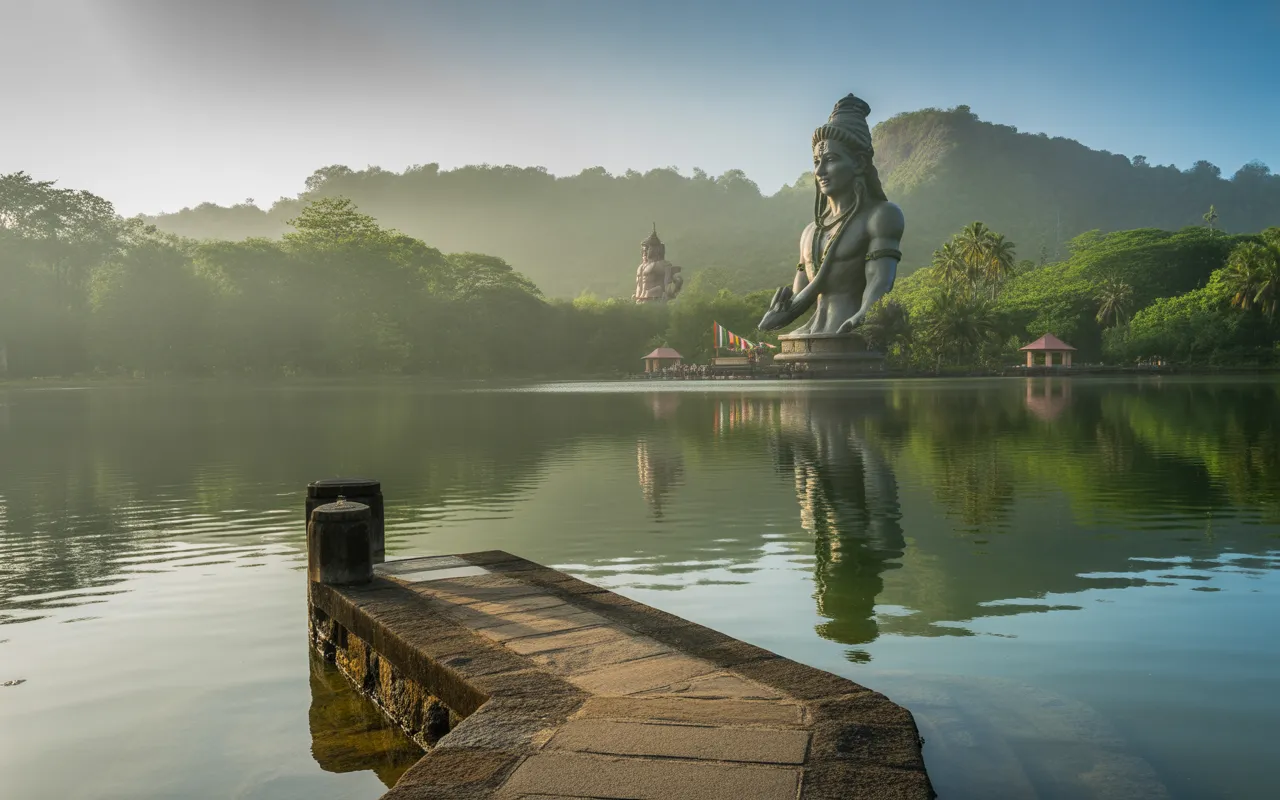
Grand Bassin, also called Ganga Talao, is the sacred lake of Mauritius The most iconic site is an ancient volcanic crater that has become the spiritual heart of Mauritian Hinduism, accessible free of charge and open to visitors of all faiths. In this guide, you'll find everything you need to understand its history, what to see, and how to plan a stress-free visit (appropriate attire, best times to visit, duration, and practical advice).
Grand Bassin (Ganga Talao): Why this sacred lake in Mauritius is a must-see
Located in the highlands of the southwest of the island, Grand Bassin (Ganga Talao) is both:
- A natural site (a lake formed in an ancient volcanic crater); (fr.wikipedia.org)
- A major pilgrimage site, particularly during Maha Shivaratri (February–March according to the lunar calendar); (hindumauritius.com)
- A cultural landmark which helps to understand Mauritian society, where Indian heritage and religious traditions occupy an important place.
Useful reference point (numerical data, 2022) Hinduism is the country's main religion. The 2022 census published by Statistics Mauritius provides the numbers by religion (and declared subgroups). By adding the listed Hindu categories (Hindu, Tamil, Telugu, Marathi, Vedic/Hindu Vedic, Arya Samajist, etc.), we obtain 590 263 Hindu people out of a resident population of 1 233 097, that is approximately 47,9% (calculation based on census tables).statsmauritius.govmu.org)
For an expat, visiting this sacred lake in Mauritius is also an excellent way to better understand local customs (respect for places, religious holidays, cultural diversity) — details that often facilitate integration into daily life.
Where is Ganga Talao? Access, altitude, and atmosphere on site
Grand Bassin is located in the Savannah district, in the heart of a mountainous area. It is generally indicated around 540–550 m altitude according to sources.fr.wikipedia.org)
In practical terms, this is noticeable: the air can be cooler and more humid, and fog is not uncommon. Pack a light layer even if you're staying on the coast.
Practical guide: organizing your visit to the sacred lake (Grand Bassin)
| Key point | Key points to remember |
|---|---|
| Site type | Lake in an ancient crater + complex of temples and statues |
| Altitude | Approximately 540–550 m (cooler and often foggy area) |
| Recommended visit duration | 1 to 2 hours (more if you take the time to observe rituals and statues) |
| Price | Access generally free (Donations may be accepted depending on the temple) |
| Attire / Etiquette | Outfit sober ; Shoes must be removed in temples; photos must be taken discreetly |
| Best moments | Morning for tranquility; Feb.–March for the Maha Shivaratri atmosphere (large crowds) |
Access Most visitors arrive by car, taxi, or via a day trip to the south (often combined with Chamarel, the Black River Gorge, or the tea plantations). Parking is usually available nearby.
History of Grand Bassin: from volcanic crater to Hindu sanctuary
The “vision” of 1897 and the first pilgrimages (1898)
Local tradition recounts that a Hindu priest had, in 1897, a dream spiritually associating the waters of the lake with Ganges in India. This narrative helped to establish the idea of Ganga Talao as a symbolic “extension” of the sacred river.fr.wikipedia.org)
The first group of pilgrims mentioned in mainstream sources is dated to 1898 (Group from Triolet, led by Pandit Giri Gossayne).fr.wikipedia.org)
Maha Shivaratri: the great walk to the sacred lake (February–March)
Maha Shivaratri (Shiva's "great night") is the most important event at Ganga Talao. The festival follows the Hindu lunar calendar, which explains why it falls between February and March depending on the year.hindumauritius.com)
On an island-wide scale, the phenomenon is impressive: several tourist sources mention hundreds of thousands of participants, sometimes around 300,000 to 400,000 pilgrims (order of magnitude, varies depending on the year and estimates). (mauvillas.fr)
Concrete example: in 2024, A Mauritian website providing information on religious events announced the night of Maha Shivaratri on March 8, 2024 to Ganga Talao.hindumauritius.com)
To be observed on site : the procession of the faithful, the offerings, the songs, and the nighttime atmosphere during the “great night”.
What to see in Grand Bassin (Ganga Talao)? Must-sees and points of interest
The lake and the walk around the temples
The lake itself is best explored by leisurely strolling around its accessible shores: you'll observe rituals (prayers, offerings), families gathered in quiet contemplation, and an atmosphere very different from the Mauritian coast. It's also an excellent place to understand the role of religious sites in daily life.
The monumental statues: Shiva and Durga
Two statues particularly stand out on the site:
- Mangal Mahadev (Shiva) : a statue of approximately 33 meters, inaugurated in 2007, which has become a major visual landmark at the entrance to the complex.en.wikipedia.org)
- Maa Durga : a statue announced at 108 feet (≈ 33 m), associated with consecration ceremonies around the September 30, 2017 (Durgotsav). (hinduismtoday.com)
These monuments are not only “photogenic”: they also symbolize the place of spirituality in Mauritian public space and the strength of traditions passed down from generation to generation.
Other sanctuaries and deities
Around the lake, you will see several temples and representations of deities (including Ganesh and Hanuman, often cited as among the most visible to visitors).fr.wikipedia.org)
Wildlife and small details not to be overlooked
The site is known for the presence of macaques (Monkeys) in the area. They are used to visitors: keep your snacks closed, avoid feeding them and watch your belongings, especially with children.
Visitor tips: respect the site, avoid pitfalls, enjoy it to the fullest
Dress and behavior: the basic rules
- Dress modestly (shoulders and knees covered if possible): it is a place of worship.
- Take off your shoes before entering a temple (bring socks if you are sensitive to the floor).
- Photograph discreetly : avoid filming people in the middle of prayer without permission.
- Speak softly : the atmosphere is spiritual, even outside of the festival.
What is the best time to visit the sacred lake of Mauritius?
Two approaches:
- For peace and quiet : favor the morning and days outside of major holidays, in order to tour the site at a leisurely pace.
- For the cultural experience come around Maha Shivaratri (February–March). You will then see the island living to the rhythm of the pilgrimage, but expect very large crowds. (mauvillas.fr)
Quick checklist (without overloading your day)
- A light jacket (cooler areas at altitude)
- Water
- Shoes that are easy to take off/put back on
- A closed bag (beware of macaques)
- A little change if you wish to make a donation
Grand Bassin and expatriation: a useful cultural reference point when settling in Mauritius
When you move abroad, certain places help you "read" the country beyond its landscapes. sacred lake of Mauritius is one of these reference points: it provides insights into festivals, holidays, solidarity between communities during major events, and the importance of respecting religious places in social life.
If you are preparing your move, you can also browse practical resources on the island via the expatriation guides from Expat Mauritius (formalities, installation, on-the-ground advice).
FAQ – Frequently asked questions about Grand Bassin (Ganga Talao), the sacred lake of Mauritius
Is it possible to visit Grand Bassin (Ganga Talao) for free?
Yes, visiting the lake and its surroundings is generally free. This isn't a ticketed site like an amusement park; it's primarily a religious and cultural place. However, it's common to see donation boxes or areas for temple upkeep, and some people choose to contribute. If you do give, do so simply, without feeling obligated. The most important thing is to adopt a respectful attitude (appropriate attire, silence, and proper footwear in the temples).
What should I wear to visit the sacred lake in Mauritius?
Opt for a simple attire Wear clothing that covers your shoulders and knees if possible, especially if you plan to enter temples. Bring shoes that are easy to slip off, as you will generally need to remove them before entering a prayer area. If you are coming from the beach, avoid showing your swimsuit, mini-shorts, and very low-cut tank tops. If in doubt, a stole or small scarf can be used to cover your shoulders.
How much time should I allow in Grand Bassin?
Most visitors plan 1 to 2 hours, This allows ample time to admire the monumental statues, stroll leisurely around the accessible areas, and soak up the atmosphere without feeling rushed. If you enjoy photography, religious architecture, or if you're visiting during a period of ceremonies, you can stay longer. Conversely, a 30- to 45-minute stop is sufficient if you incorporate it into a "Southern" day trip (Chamarel, gorges, tea plantations, etc.).
Can we go to Grand Bassin during Maha Shivaratri?
Yes, and it's even the most culturally significant period: Maha Shivaratri attracts hundreds of thousands of people according to various estimates, with a unique atmosphere of walking, singing and offerings.ilemauricetourisme.infoThe downside is the crowds: more complicated traffic, difficult parking, and a very dense site. If you wish to observe without causing a disturbance, arrive early, stay on the periphery of the rituals, and follow local guidelines.
What do “Grand Bassin” and “Ganga Talao” mean?
“Grand Bassin” is the common name in French, while “Ganga Talao” is the name associated with the sacred dimension of the place. “Ganga” refers to the Ganges (sacred river), and “talao/talab” means “lake” in several languages of the Indian subcontinent. The central idea is therefore that of a “lake of the Ganges,” in connection with the local tradition that spiritually associates the waters of Grand Bassin with the sacred river.en.wikipedia.org)
And now ?
If your visit to Grand Bassin inspires you to delve deeper (better understand local life, prepare for your arrival, or structure your project), Expat Mauritius can support you with a turnkey approach: administrative procedures, settling in, and practical advice. Start on the page Living in Mauritius: Expatriation, services and real estate, then explore the guides to move forward step by step. You can also contact us through the website for an initial consultation (free assessment).
Useful sources (further reading) :