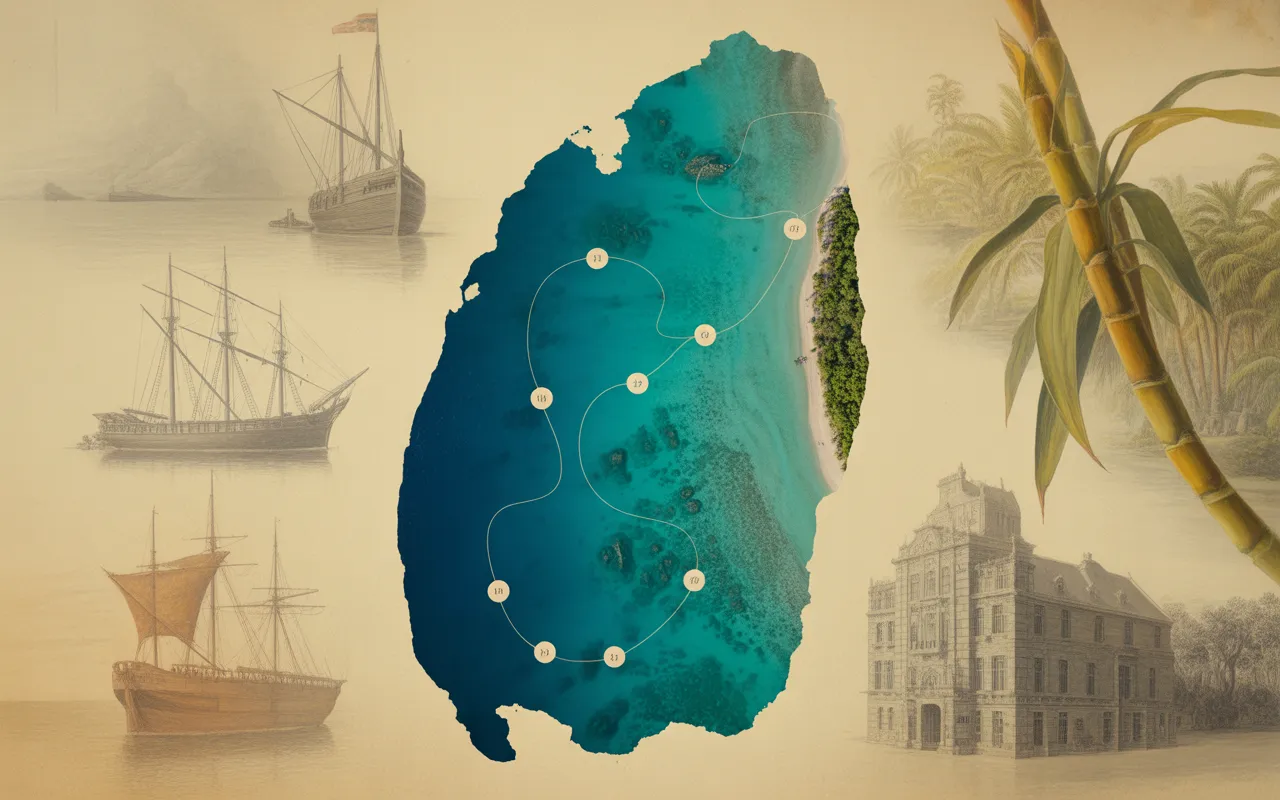
It all begins with an island that was uninhabited for a long time, which in a few centuries became a crossroads of peoples, languages and maritime routes.
If you are looking for a clear chronology of the history of Mauritius (colonization, abolition of slavery, arrival of indentured laborers, independence, Republic…), this article brings together the key reference points and explains Why These dates have shaped Mauritian society as we know it today. To further explore your plans for living there, you can also consult the expatriation guides from Expat Mauritius.
Before colonization: an island without a permanent population
Before the arrival of Europeans, Mauritius had no indigenous population: its history therefore begins without a “first people” in the classical sense. Arab and then Portuguese navigators sighted the Mascarene archipelago along the routes to the Indian Ocean, but without permanent installation. (en.wikipedia.org)
This lack of ancient human occupation explains two major features of the island: a highly vulnerable endemic biodiversity, and a society subsequently built by migratory waves successive (Europe, Africa, Madagascar, India, China…). (whc.unesco.org)
A global symbol: the dodo
The most famous bird in Mauritius, the dodo, This illustrates the fragility of island ecosystems in the face of introduced species and habitat transformation in the 17th century. Although precise extinction dates vary depending on the source, the scientific consensus places the dodo's disappearance at the end of the 17th century, after human settlement and the introduction of invasive animals.govmu.org)
The major colonial periods (1598–1810)
1598–1710: the Dutch period (Mauritius)
In 1598, a Dutch squadron led by Admiral Wybrand Van Warwyck lands at Grand Port and gives the island the name of Mauritius (in honor of Maurice of Nassau). The Dutch then attempted several settlements, notably exploiting ebony and introducing animals and plants (including sugarcane), before abandoning the island in 1710. (govmu.org)
1715–1810: the French period (Isle de France)
France officially took possession of the island in September 1715 and renames it Isle de France. Port Louis developed as a naval base and logistics center on the route to India; the sugar economy became structured and slavery became a pillar of the plantation system.govmu.org)
This French period left a lasting mark: a part of the law and administration, numerous place names, and French as the major language of cultural and media life.govmu.org)
1810: British conquest and geopolitical shift
In 1810, In the context of the Napoleonic Wars, the island (then Isle de France) was at the heart of naval rivalries. After fighting, France capitulated on December 3, 1810 The island reverts to British control and resumes its name of Mauritius. (britannica.com)
Essential chronology (quick reference points)
| Date | Event | Why this is important |
|---|---|---|
| 1598 | Dutch takeover, name “Mauritius” | Beginning of European colonization and the current name |
| 1710 | Departure of the Dutch | End of the first cycle of colonization |
| 1715 | French takeover, “Isle de France” | Structuring of Port Louis and the plantation economy |
| December 3, 1810 | French surrender | Beginning of the British administration |
| 1834–1920 | Massive arrival of indentured laborers via the Aapravasi Ghat | Demographic and cultural transformation |
| March 12, 1968 | Independence | Birth of the modern Mauritian state |
| March 12, 1992 | Proclamation of the Republic | New institutional stage (end of the monarchy) |
Mauritius under British administration (1810–1968): abolition, indentured servitude, plural society
One distinctive feature: legal and cultural continuities
The British period (1810–1968) did not erase the French legacy: the French language and certain legal frameworks remained very present, while English became established as the language of administration. This dual influence still explains the coexistence of languages and cultural references on the island today.govmu.org)
Abolition of slavery: a major social rupture (1830s)
In the British Empire, the Slavery Abolition Act receives royal assent in 1833 and enters into force in 1834, with a period known as ’apprenticeship“ before complete freedom.en.wikipedia.org)
In Mauritius, the transition was also accompanied by a logic of financial compensation for slave owners: British parliamentary debates on 1835 mention an amount dedicated to Mauritius as part of the overall compensation plan.api.parliament.uk)
On the ground, the end of slavery did not mean immediate equality: the organization of labor, access to land, and the social hierarchy were restructured over several decades, with tensions in the sugar sector.en.wikipedia.org)
1834–1920: Indentured servitude and the Aapravasi Ghat (UNESCO)
To replace slave labor, the British administration launched what it called the “Great Experiment”: the use of contract workers (hired). L'’Aapravasi Ghat, in Port Louis, is one of the central sites of this story: between 1834 and 1920, nearly half a million Indentured laborers arrive there from India (and other regions), primarily to work on sugar plantations.whc.unesco.org)
A UNESCO World Heritage Site, it can now be visited as a major memorial, on par with other symbolic sites. To learn more: UNESCO page of the Aapravasi Ghat. (whc.unesco.org)
Le Morne: a memorial to maroon communities (UNESCO)
Another essential landmark: Le Morne, used as a refuge by runaway slaves (maroons) in the 18th and early 19th centuries. The site is now a symbol of resistance and remembrance, and is a UNESCO World Heritage Site.whc.unesco.org)
Reliable resource: UNESCO page of the “Le Morne Cultural Landscape”. (whc.unesco.org)
Independence and Republic: Key political dates
March 12, 1968: Independence
Maurice obtains his independence on March 12, 1968. This date marks the birth of the modern country, after more than a century and a half of British rule, and is still celebrated every year.en.wikipedia.org)
March 12, 1992: Mauritius becomes a Republic
THE March 12, 1992, Maurice becomes a Republic within the Commonwealth, following a constitutional reform initiated in 1991. The coincidence of dates (March 12) underscores the symbolic continuity between independence and institutional evolution.en.wikipedia.org)
Contemporary Mauritius: Economic diversification and territorial challenges
The 1970s: The Export Processing Zone (EPZ) and economic transformation
After independence, the country implemented an export-oriented industrialization strategy. The law on Export Processing Zones enters into force in 1970. According to UNIDO, as early as March 1973, the EPZ has more than 14,000 jobs And 34 new factories, particularly in textiles and clothing.unido.org)
International institutions have also analyzed this model: the IMF highlights the importance of the EPZ and the global (textile) trade context in Mauritius' growth trajectory, particularly from the 1980s onwards.imf.org)
A very densely populated island nation: some recent figures
To situate the scale of the territory: the population of the Republic of Mauritius is estimated at 1,244,477 inhabitants at the end of 2024, with a breakdown shown by island (Mauritius, Rodrigues, other islands). These orders of magnitude help to understand the issues of land, mobility and planning.statsmauritius.govmu.org)
Useful official source: Statistics Mauritius (Demographic publications and indicators). (statsmauritius.govmu.org)
The Chagos issue: a colonial legacy that is still evolving (1965–2026)
An often overlooked aspect of the history of Mauritius concerns the archipelago of Chagos, separated from Mauritius in 1965 before independence. In February 2019, The International Court of Justice (ICJ) issued an advisory opinion stating that the decolonization of Mauritius was not legally completed in 1968 due to this separation, and that the United Kingdom must end its administration “as quickly as possible”.icj-cij.org)
In May 2019, The United Nations General Assembly adopted a text in line with this opinion, calling for the “complete decolonization” of Mauritius.press.un.org)
More recently, a UK/Mauritius agreement was announced as signed in May 2025 provides for a transfer of sovereignty, with a mechanism for 99-year lease for the Diego Garcia base. The details remain a political and diplomatic issue being closely monitored at the beginning of the year. 2026. (theguardian.com)
Why these historical landmarks (really) matter when settling in Mauritius
Understanding the history of Mauritius is not just about “learning dates”: it helps you understand the country on a daily basis. linguistic coexistence (administrative English, French widely used, Creole), the place of religions And festivals, or even culinary and cultural diversity, take on meaning when one understands the major milestones (slavery, indentured servitude, independence).whc.unesco.org)
For an expatriation project, these resources also facilitate communication: with government agencies, schools, banks, or business partners. Expat Mauritius presents its services and comprehensive support for living and investing on the island on its page. Living in Mauritius: turnkey expatriation and real estate.
FAQ – Frequently asked questions about the history of Mauritius
What were the major periods of colonization of Mauritius?
The history of Mauritius is often summarized in three major colonial periods: the Dutch period (1598–1710), the French period (1715–1810, under the name Isle de France), and then the British period (1810–1968). Between these dates, the island's role changed: maritime stopover, naval base, then plantation (sugar) economy structured around slavery, before a major transformation after abolition and the arrival of indentured laborers.govmu.org)
Why was Mauritius called “Isle de France”?
The name “Isle de France” dates back to the French period. In September 1715, France took possession of the island and renamed it accordingly, amidst naval and commercial rivalries on the route to India. The name reflects the strategic objective: to secure a base in the Indian Ocean and to develop Port Louis as a port and arsenal. Even after 1810, when the island reverted to British rule and resumed the name “Mauritius,” the French legacy remained very visible in the culture and place names.govmu.org)
What is the difference between the abolition of slavery and the arrival of indentured laborers?
The abolition of slavery corresponds to the legal end of servitude in the British Empire, implemented from 1834 onwards, with a transitional period known as "apprenticeship". The arrival of indentured laborers was a separate system: workers recruited under contract (particularly in India) to address the labor shortage on plantations after abolition. In Mauritius, this movement was massive and long-lasting: the Aapravasi Ghat is the emblematic site of this migration, recognized by UNESCO.en.wikipedia.org)
Why is March 12th such an important date in Mauritius?
March 12th is a doubly foundational date. First, Mauritius became independent on March 12, 1968: this marked the birth of the sovereign Mauritian state. Second, the country became a Republic on March 12, 1992, following a constitutional reform: this step ended the status of constitutional monarchy and confirmed a new institutional organization, while remaining within the Commonwealth. This is why March 12th is a central date in national memory and celebrations.en.wikipedia.org)
What is Aapravasi Ghat and why is it a UNESCO World Heritage Site?
Aapravasi Ghat, in Port Louis, is a former immigration depot: it is one of the places where the modern diaspora of indentured laborers (“engagés”) began. UNESCO points out that Mauritius was chosen as early as 1834 to experiment with this “free labor” system after the abolition of slavery. Between 1834 and 1920, nearly half a million indentured laborers arrived through this point of entry, profoundly transforming Mauritian society. The site is listed for its global historical value related to 19th-century migrations.whc.unesco.org)
And now ?
If you're planning a move (family, investment, entrepreneurial project), understanding Mauritius's history helps you grasp the country… but a successful expatriation also requires concrete steps (legal status, housing, schools, banks, etc.). Expat Mauritius offers personalized support and a free assessment: find information and contact details on their website. Expat Mauritius and explore the practical guides to structure your project.