
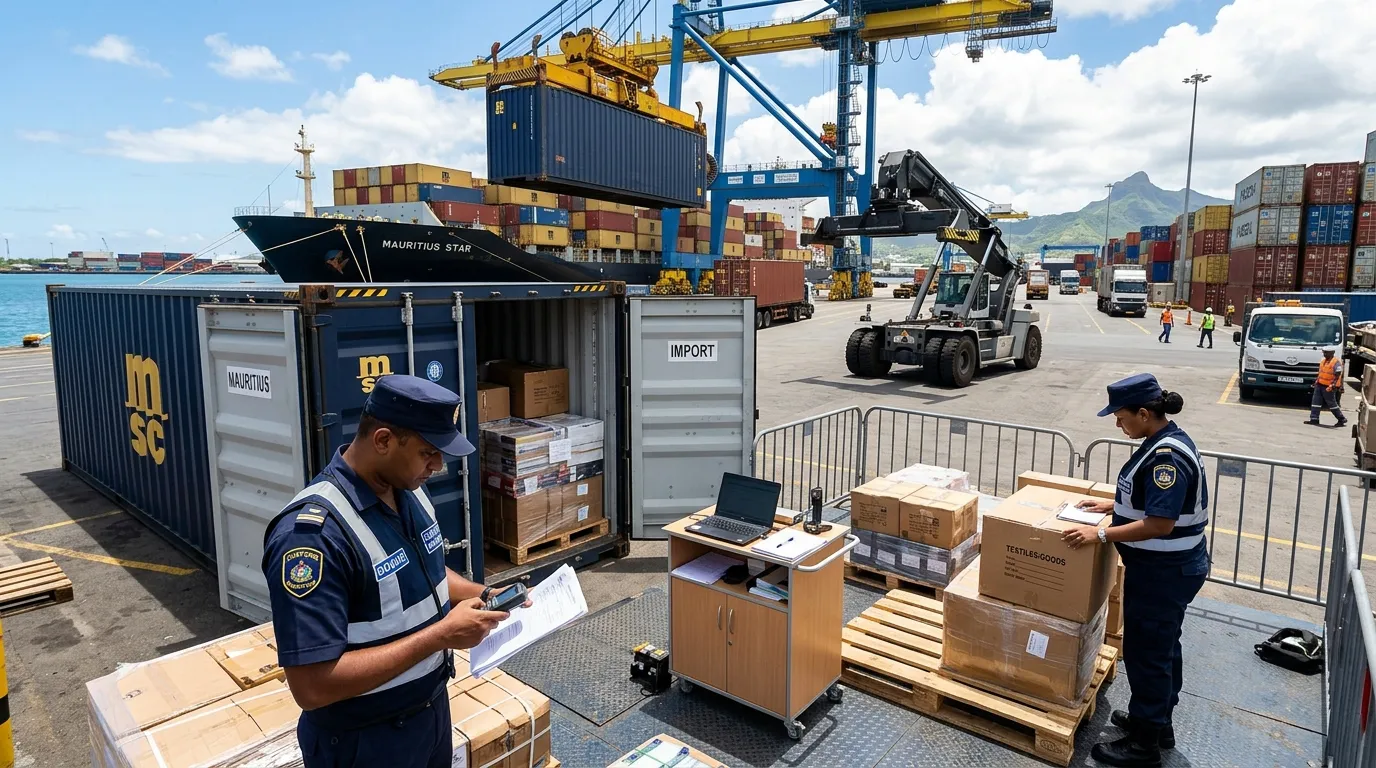
Importing goods for a company in Mauritius requires a methodical approach. The goods must be declared correctly, classified under the appropriate tariff code, and accompanied by the necessary supporting documents to avoid any issues during customs clearance.
The procedure is largely electronic. The MRA specifies that the declaration is made via the Bill of Entry on TradeNet, that duties are calculated on the transaction value, and that VAT is then applied based on the amount determined by Customs. The rules are subject to change, so it is always advisable to check the current version with official sources.
This guide concerns commercial imports by a company. If your goods are more akin to personal effects or belongings from a move, the process is different, as also explained in the guide. the guide on importing personal effects into Mauritius. (eservices16.mra.mu)
What needs to be put in place before the first shipment
If your company is not yet registered, start by establishing the legal and administrative framework. The EDB indicates that company registration is done online via the CBRD, and that TradeLink is then used to submit certain license, permit, import, and export applications to the relevant authorities. The EDB business start-up portal This logic is well summarized.edbmauritius.org)
If your team wants to handle some of the formalities internally, the MRA's eRegistration portal for importers and exporters allows self-registration as an importer, exporter, or declarant with a TAN and supporting documents. (eservices16.mra.mu)
When importing goods for a company, the real issue isn't just transportation. You also need to anticipate tariff classifications, supporting documents, any sector-specific permits, and, if necessary, the involvement of a customs broker. This preparation is what ensures a smooth customs clearance process.
Customs clearance procedures, step by step
There MRA Import page specifies that all imports are subject to a customs declaration, the Bill of Entry, transmitted electronically with the quantity, value, detailed description and country of origin of the goods.
- Clearly identify the goods, their nature, origin, and HS code, as the tariff classification determines customs treatment and may affect the applicable law.mra.mu)
- Gather all commercial documents before the shipment arrives. The MRA specifically mentions the invoice, bill of lading, packing list, certificate of origin, and any applicable permits.
- Submit the customs declaration, called the Bill of Entry, electronically via TradeNet. The MRA specifies that the declaration must include the quantity, value, detailed description, and country of origin of the goods.
- Wait for Customs validation. Depending on the control exercised, the MRA may request clarification, detain the goods until authorization is granted by another administration, refer the file for verification or scanning, or automatically release the cargo.
- Pay the duties and taxes due, then arrange for the release. The MRA indicates that discrepancies may lead to an adjustment of the declaration and additional duties and taxes, with penalties if applicable.
In practice, many importers use a Customs House Broker or a Freight Forwarding Agent, as the MRA recognizes that the declaration process involves technical aspects. However, importers can file certain declarations themselves if they are registered as a declarant and are proficient in the TradeNet system.
Documents and checkpoints to prepare
Here are the most common documents for a commercial import. They are not interchangeable, as each one serves to verify a part of the file, from the value to the origin.
Practical table of documents and checks
| Part or control | Role in the case | Point of vigilance |
|---|---|---|
| Commercial invoice | It allows the transaction value of the merchandise to be established. | The declared value must remain consistent with the price actually paid and the terms of sale. |
| Bill of lading, packing list and transport document | They describe the contents of the batch and facilitate physical or documentary verification. | The MRA requests that these documents be scanned and submitted with the electronic declaration. |
| Certificate of Origin | It may grant access to a preferential rate if the applicable agreement allows it. | It is only effective if the origin and documentary evidence comply with the rules of the chosen regime.mra.mu) |
| Sectoral permit or authorization | They cover goods subject to specific controls. | Without authorization, the delivery may be withheld until the regularization requested by the competent administration. |
| Registering, importing, exporting, or declaring | It allows you to file the declaration or to appoint an agent. | The MRA provides a self-registration option with TAN, applicant profile, and supporting documents. (eservices16.mra.mu) |
How to calculate customs duties and VAT
There page Calculation of MRA customs duties recalls that customs duty, where it exists, is applied to the transaction value, then VAT of 15 % is calculated on the value increased by duties, with freight and insurance as appropriate.
- Starting basis: the transaction value of the commodity.
- Possible additional charges: freight and insurance costs, depending on the nature of the shipment and the basis chosen by Customs.
- Customs outcome: a customs duty may apply depending on the product's tariff and classification.
- VAT: the MRA indicates a rate of 15 % on the value subject to duties.
To avoid mistakes, you must always start with the exact HS code and the applicable integrated tariff. The MRA publishes classification notes, complex cases, and an updated integrated tariff, demonstrating that customs classification remains the starting point for any reliable estimate.
Exemptions, preferential rates and special schemes
Yes, some imports may benefit from more favorable treatment, but never automatically. The MRA indicates that preferential agreements, depending on the origin and the evidence provided, can reduce customs duties, or even bring them down to zero in some cases. It also publishes targeted exemption notices for specific projects or categories of goods.
- Always check the origin of the goods before shipping.
- Ask if a certificate of origin is required for the agreement in question.
- Check if the product is listed in an exemption notice or a special scheme published by the MRA.mra.mu)
If in doubt, it's best to have the customs documentation validated before the container departs. An error regarding origin or classification can negate the intended benefit and complicate the release process.
Do I need to use a customs broker?
For a company that imports regularly, the answer is often yes. The MRA specifies that an importer can file their declaration if they are registered as a declarant and connected to the system, but it also adds that importers often prefer to use a Customs House Broker or a Freight Forwarding Agent due to the technical nature of the formalities.
The best approach is therefore to retain the broker or freight forwarder for the operational aspects, while the company maintains control over the invoice, bill of materials, proof of origin, and delivery tracking. This avoids data entry errors and delays related to requests for additional information.
FAQ
What are the customs clearance procedures for importing goods as a company in Mauritius and what documents are required?
The process involves filing a customs declaration, the Bill of Entry, electronically via TradeNet with complete information on the goods. The MRA also requests the usual commercial documents, including the invoice, transport document, packing list, certificate of origin, and, depending on the goods, any required permits. If the company is filing the declaration itself, it must be registered as a declarant; otherwise, it can appoint an agent or broker.
How to calculate customs duties and VAT on imports in Mauritius for a company?
The MRA explains that customs duties, when applicable, are based on the transaction value, meaning the price actually paid. VAT is then calculated on this value plus duties, and sometimes freight and insurance if these costs are included in the taxable base. In practice, this means starting with the HS code, verifying the applicable duty rate, and then recalculating the VAT base using all the information required by Customs.
What is the applicable VAT rate on goods imported into Mauritius and how is it applied?
The MRA (Mauritius Revenue Authority) indicates a VAT rate of 15% (%) on imported goods. This VAT is applied to the duty-inclusive value, meaning after the addition of any applicable customs duties. Depending on the documentation, freight and insurance costs may also be included. Therefore, a reliable estimate cannot be based solely on the supplier price; it is always necessary to consider the delivered cost and the customs value.
Are there any exemptions or reductions in customs duties for certain products imported by a company in Mauritius?
Yes, but only if the product, its origin, and the supporting documentation meet the applicable requirements. The MRA (Mauritius Revenue Authority) mentions preferential agreements that can reduce or even eliminate customs duties, as well as targeted exemption notices for certain projects or categories of goods. Before shipping, it is therefore essential to verify the origin, tariff code, and any certificate of origin; otherwise, the tax benefit may be denied at customs clearance.
What are the typical customs clearance times for goods imported into Mauritius and who pays the brokerage fees?
In practice, the processing time varies depending on the completeness of the application and the level of scrutiny, as the MRA (Mauritius Revenue Authority) may request further information, detain the goods until further authorization is granted, scan them, or physically inspect them. Using a broker is common precisely to streamline these exchanges. For brokerage fees, always request a written quote before shipment, and then confirm who pays what among the shipping company, the supplier, and the freight forwarder.
And now ?
If your project goes beyond importing and includes company formation or setting up your business in Mauritius, Expat Mauritius can help you structure the initial stages of the project. Start by the Expat Mauritius homepage or by The guide to setting up a company in Mauritius.