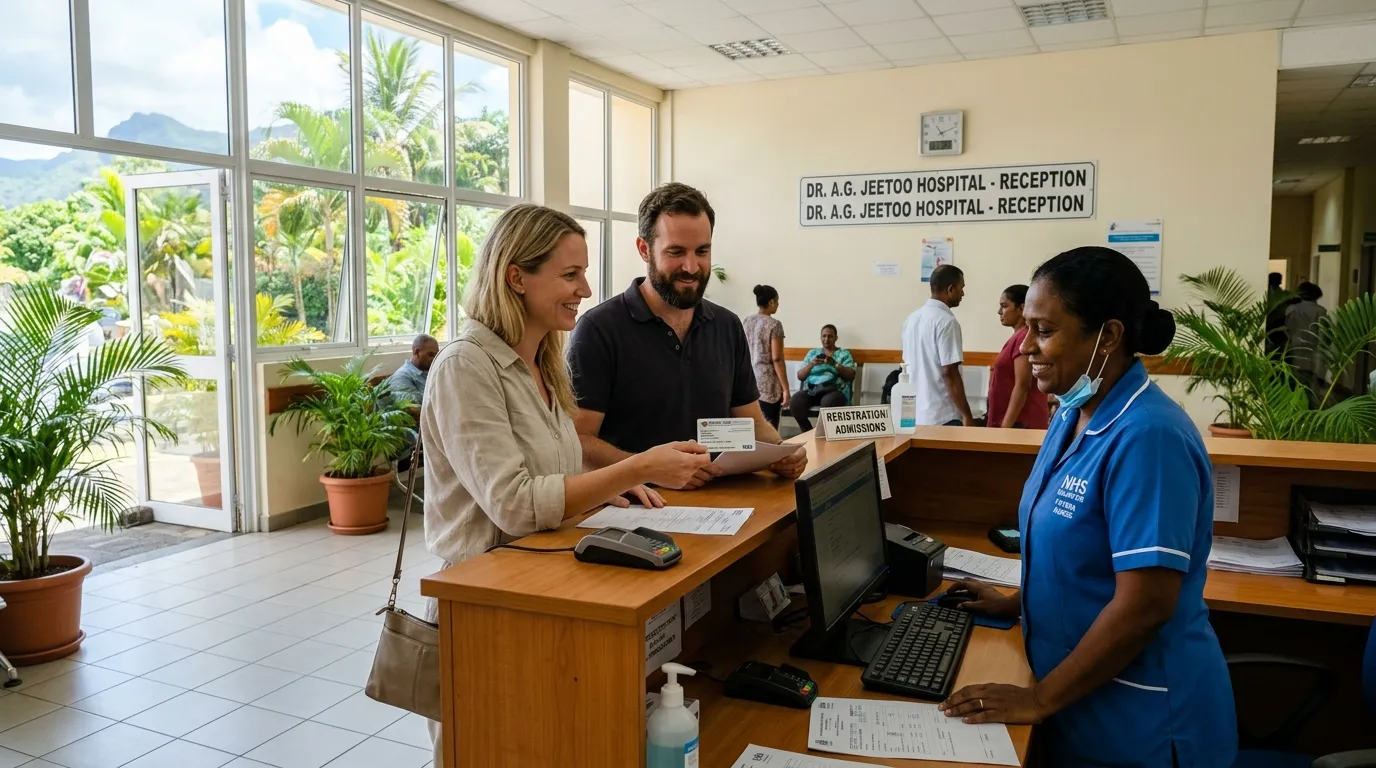

Buying in Mauritius as a foreigner is possible, but very regulated.
This guide explains what you can buy, within what frameworks (PDS, Smart City, Ground+2…), What amounts and taxes should be expected?, And how to secure each step (notary, authorizations, transfer of funds, residence). All with the key rules to know. March 25, 2026, including the rule of 85% in rupees and the tax changes announced for July 1, 2026. (edbmauritius.org)
For comprehensive support (visa/permit, real estate, settling in), you can go through Expat Mauritius. Their team is based in Azuri Village and offers a free assessment via phone/WhatsApp/email/online form (according to your preferences).
1) What the regulations say: can a foreigner buy property in Mauritius?
The most common frameworks accessible to non-citizens
In practice, non-citizens' access to residential real estate is primarily through:
- EDB Property Schemes“ (ex. Property Development Scheme – PDS, Smart City Scheme, etc.). (edbmauritius.org)
- Buying apartments in “Ground +2” (G+2) : condominium apartments in buildings of at least 2 floors above the ground floor, with prior approval, and a minimum price as indicated by the EDB. (edbmauritius.org)
Important thresholds to know (minimum price and eligibility for the residence)
- Ground+2 (G+2) : the EDB indicates a Minimum purchase price of MUR 6 million (or equivalent in convertible currency) so that a non-citizen can acquire an apartment, and also specifies that a residence permit can be granted from an investment ≥ USD 375,000 (or equivalent) for this type of property. (edbmauritius.org)
- PDS The EDB guidelines remind us that a residence permit is granted to the non-citizen upon the acquisition of property ≥ USD 375,000 (or equivalent), and that this permit remains valid as long as the asset is held. (edbmauritius.org)
Important point to note (very specific): buy a ground Owning land in a scheme (e.g., a "plot of serviced land") is not always sufficient to obtain residency: the PDS guidelines indicate that a non-citizen who acquires a plot is not eligible for a residency permit. as long as the construction is not completed. (edbmauritius.org)
What has been restricted/removed: the "off-scheme" purchase at USD 500,000
The 2025–2026 Budget notably includes the following: discontinue the scheme introduced in 2023 which allowed non-citizens to acquire residential properties (including “bare land”) everywhere in Mauritius above USD 500,000. (nationalbudget2025.govmu.org)
Another restriction to be aware of: State Land & “Geometric Not” (G+2 apartments)
The same budget document also indicates a ban targeting the disposition/acquisition of an apartment (building ≥ 2 floors) built on State Land Or Not Geometric by a non-citizen (or a non-resident person).nationalbudget2025.govmu.org)
2) Choose the right “purchase framework” according to your project (residence, investment, rental)
Comparison of the most common options for foreigners (2026)
| Option | Type of property | Thresholds (official examples) | Is residency possible? | Points to consider |
|---|---|---|---|---|
| PDS (Property Development Scheme) | Villas, apartments, penthouses, sometimes serviced plots depending on the project | Residence: ≥ USD 375,000 (well constructed) (edbmauritius.org) | Yes (as long as the property is held) (edbmauritius.org) | If purchasing a plot of land: residence after construction is completed (edbmauritius.org) |
| Smart City Scheme | Residential + services (shops, offices, leisure) according to the “masterplan” | EDB framework; payment rules (85% MUR) apply (edbmauritius.org) | Possible depending on investment conditions | Smart City incentives revised (according to certification date): carefully review the project |
| IRS / RES / IHS (depending on projects) | Often high-end (luxury residences / resorts / hotel investments) | EDB rules + payment 85% MUR (edbmauritius.org) | Possible depending on conditions | Often there are operational/management constraints (e.g., “hotel scheme”) depending on the product. |
| Apartment Ground+2 (G+2) | Condominium apartment in a building ≥ 2 stories above ground level | Minimum price MUR 6 million (EDB) (edbmauritius.org) | Yes, if investment ≥ USD 375,000 (EDB) (edbmauritius.org) | Approvals, building compliance, “State Land/Geometric Notions” restrictions (edbmauritius.org) |
Residency through real estate: what it changes in concrete terms
When you cross the thresholds (often USD 375,000 (according to EDB guidelines for several frameworks), the advantage is twofold:
- You own an asset (primary residence, secondary residence or rental investment depending on the project).
- You may be eligible for a residence permit as long as you retain the asset, according to the framework (e.g., PDS). (edbmauritius.org)
Ownership vs. rental investment: how to decide
- If your priority is to live : prioritize location (schools, transport, services), the quality of the co-ownership (management, charges), and resale potential.
- If your priority is to rent : look at the demand (long term vs seasonal), the rules of the program (e.g. some residences “hotel scheme”), and your recurring costs (condominium management, maintenance, insurance, administration).
The EDB also indicates that owners can to rent out the good and that there is no no restrictions on repatriation Funds/income from the sale or rental (within the framework presented). (edbmauritius.org)
3) Purchase budget: taxes, notary fees, exchange rate… (and what changes on July 1, 2026)
The “standard” taxes on a property sale (general rule)
In a real estate purchase, one very often finds:
- Registration Duty classically 5% (buyer's side).
- Land Transfer Tax classically 5% (seller's side).
These principles are outlined in a document from the Registrar-General (which states that transfers are carried out through a notary and that the buyer pays 5% of registration duty and the seller 5% of land transfer tax).registrar.govmu.org)
Important: Increase announced for non-citizens from July 1, 2026. Several benchmark analyses on the Finance Act 2025 indicate that’effective July 1, 2026, the rights on real estate transactions of non-citizens (on EDB schemes and eligible apartments) change from 5% to 10% (registration and/or transfer as applicable), with a specific rule for resale (tax calculated at the higher of a percentage of the value and a share of the profit).ey.com)
Numerical example: typical costs on a property worth 10,000,000 (for understanding)
| Job | Who pays? | Calculation (based on MUR 10,000,000) | Remarks |
|---|---|---|---|
| Registration Duty | Buyer | 5% = MUR 500,000 (before 01/07/2026); 10% = MUR 1,000,000 (from 01/07/2026 for non-citizens concerned) | The increase on 01/07/2026 for non-citizens should be anticipated in the signing/registration schedule.ey.com) |
| Land Transfer Tax | Seller | 5% = MUR 500,000 (classic rule); from 01/07/2026, for certain non-citizen cases, mechanisms at 10% / or linked to the gain are announced. | The terms “10% or 30% of the gain” are mentioned in post-Finance Act 2025 summaries.assets.kpmg.com) |
| Administrative fees (minimum stamp duty) | Buyer | Minimum MUR 1,700 | Minimum amount cited in a notary's FAQ (to be confirmed according to the deed).etudelow.com) |
| Notary fees (legal scale, example) | Often a buyer (unless otherwise agreed) | According to the scale: 2% on 250k + 1.5% on 500k + 1% on 1M + 0.5% on the remainder (i.e., MUR 63,750) + VAT + disbursements | Scale presented as derived from Notaries Act 2008 (example). (etudelow.com) |
Monetary rule since December 13, 2024: 85% in MUR (don't miss it)
Since the December 13, 2024, The EDB has published operational amendments/reminders: for acquisitions by non-citizens in certain schemes (IRS/RES/IHS/PDS/SCS), payment must be made in such a way that 85% of the price to be paid in Mauritian rupees (MUR) to the promoter, And 15% in convertible currency or in MUR. It is also specified that the funds can be transferred from abroad in convertible currency (and that it's not “85% to be transferred to MUR” from abroad), and that the notary must ensure the proper implementation of this rule. (edbmauritius.org)
Financing (mortgage): understanding the interest rate environment
Loan conditions vary depending on the bank and your profile (income, down payment, currency, loan term). To provide some context, the Bank of Mauritius has maintained its Key Rate at 4.50% during the decision of February 11, 2026. (bom.mu)
Also worth noting: the EDB has communicated about a change related to the local funding (local loan financing) with a threshold mentioned in USD 750,000 (instead of USD 500,000 previously) under certain conditions, depending on the LOA and signing dates. (edbmauritius.org)
4) Steps to a secure purchase (checklist from the land to the deed)
Step 1 — Determine your eligibility (before even booking)
- Check that the property is accessible to non-citizens (EDB scheme / G+2 eligible, and not on State Land/Geometric Notions if applicable). (edbmauritius.org)
- Identify the objective: residence (thresholds, conditions) vs investment (rental rules, management, taxation).
- Anticipate the calendar (especially if you want to avoid an increase on 01/07/2026, when applicable to non-citizens).ey.com)
Step 2 — Reservation / preliminary contract (VEFA if buying off-plan)
If you buy on plan (VEFA), a practice described by notaries is the existence of a reservation contract (CRP), with a deposit (capped according to deadlines) and payment in installments linked to progress (foundations, making the structure watertight, completion, handover of keys).etudelow.com)
Good reflex: prioritize projects with guarantee of satisfactory completion (GFA), when available, because the idea is to mitigate the risk of non-completion.etudelow.com)
Step 3 — Notary, due diligence, and deed of sale
In Mauritius, Real estate transfers are carried out through a Notary Public and the deed is then filed/registered with the Registrar-General. A document from the Registrar-General reminds the buyer that they pay 5% of registration duty and the seller 5% of land transfer tax (general rule), and that the sale is completed by a notary.registrar.govmu.org)
The notary verifies the title and prepares the deed; for your part, you must provide KYC information (identity, source of funds) and comply with payment rules (including the 85% rule in MUR when applicable). (edbmauritius.org)
Step 4 — Transferring funds: avoiding currency and timing errors
- Plan for the conversion to a wall for the section 85% (FX risk + bank delays). (edbmauritius.org)
- Align the signing schedule with the approval steps (LOA/authorization), and with your bank if financing is involved.
- Document carefully the origin of the funds (to streamline AML/KYC compliance).
Step 5 — After the deed: handover of keys, building management, insurance, rental
- In a co-ownership: retrieve the regulations, understand the charges and governance (trustee).
- If renting out: define the lease, management, and taxation (withholding tax may apply to rents in certain cases).mra.mu)
- If the objective is tax residency: understand the criteria (183 days, or 270 days over the previous two years, according to the Income Tax Act).mra.mu)
5) Taxation: rental income, capital gains, tax residence, local taxes
Tax residency in Mauritius (useful if you are settling there)
The Mauritian Revenue Authority (MRA) reminds us that an individual is resident especially if he is present in Mauritius 183 days or more on the fiscal year, or 270 days or more over the fiscal year plus the two preceding years (according to the detailed criteria).mra.mu)
Income tax (recent tax brackets) and rents
Since the July 1, 2025 (Mauritian fiscal year), the MRA presents a progressive scale on the chargeable income : 0% on the first Rs 500,000, 10% on the Rs 500,000 following, then 20% about the rest. (mra.mu)
Rental income from a property located in Mauritius is generally taxable (depending on your resident/non-resident status and deduction rules). In the case of rent payments by certain payers, a mechanism may exist for Tax Deduction at Source (TDS) on rents (separate rates depending on resident/non-resident).mra.mu)
Capital gains: careful with words, but one point is clear.
The MRA has published a clarification stating that capital gains (capital gains) are not not subject to income tax in Mauritius in the aforementioned context (capital gains treatment).mra.mu)
However, for non-citizens, a distinction must be made. capital gains tax And transaction/resale taxation The post-2025 budget framework provides for resale taxation mechanisms that can be calculated at the higher of a percentage of the value and a share of the gain, depending on the circumstances and the date (particularly from 01/07/2026).assets.kpmg.com)
Local taxes: “no national property tax” does not mean “zero taxes”
There is no national annual property tax “in the French style”, but the Local Government Act predicts that a local rate An annual tax may be levied on the owner of a property located in a municipal council area (depending on the zone and exemptions).mauritiuslii.org)
Inheritance: practical points (without dramatizing)
Beyond taxes, inheritance in Mauritius involves important civil rules (notably the reserved portion of the estate (according to the Civil Code, cited by notaries), which can impact how real estate assets are transferred.etudelow.com)
6) Common pitfalls (and how to avoid them)
Most frequently seen traps
- Booking too quickly without confirming “non-citizen” eligibility (scheme, LOA, G+2 compliance, State Land/Geometric Pas restrictions).
- Underestimating the timeframes (authorization, bank, notary) whereas a tax change may depend on the registration date.
- Forget the 85% rule in a wall (and find themselves having to convert urgently). (edbmauritius.org)
- Off-plan purchase : not checking the completion guarantees and payment schedule.
- In co-ownership : do not read the documents relating to syndicate/charges/usage (short term rental, animals, works…).
"Peaceful shopping" checklist (10 simple checks)
- Is the good within a framework? explicitly authorizing Purchase by a non-citizen? (edbmauritius.org)
- If G+2: is the building good ≥ 2 floors above the ground floor and the price ≥ 6M WALL (edbmauritius.org)
- Is the property outside of "State Land / Not Geometric" if you are a non-citizen (according to the announced restriction)?nationalbudget2025.govmu.org)
- Your housing goal: are you reaching the threshold USD 375k (according to the framework)? (edbmauritius.org)
- Does your budget include registration duty, Notary fees, disbursements, insurance, charges? (registrar.govmu.org)
- Does your schedule take into account the announced switchover to 01/07/2026 If this applies to you?ey.com)
- Is your bank ready to handle currency conversion and transfers (including the 85% in WALL) ? (edbmauritius.org)
- In off-plan sales: do you have a clear timeline and guarantees?etudelow.com)
- In a co-ownership: have you read the rules/charges?
- Taxation: Do you know if you will be a tax resident (183/270 days) and how rental income/returns will be taxed?mra.mu)
7) Market benchmarks (official data available)
To objectify the trends, Statistics Mauritius publishes a Residential Property Price Index (RPPI). In the “4th Quarter 2024” edition (published in May 2025), the index reached 237,9 in Q4 2024 (base 2019 = 100), i.e. +11,5% vs Q3 2024 and +29,8% vs Q4 2023. (statsmauritius.govmu.org)
Key takeaway: this type of index measures price dynamics on recorded transactions (useful for comparing periods), but does not replace an analysis by area, typology (villa/apartment) and strategy (residence vs yield).
FAQ — Buying property in Mauritius as a foreigner
What is the minimum amount required to obtain a residence permit when purchasing property in Mauritius?
The thresholds depend on the framework. The EDB guidelines of Property Development Scheme (PDS) indicate that a residence permit is granted to the non-citizen upon the acquisition of property of a value at least equal to USD 375,000 (or equivalent) and that it remains valid as long as the property is held. For apartments in Ground+2, The EDB also mentions a residence permit starting from USD 375,000 (or equivalent). In practice, the exact plan, the nature of the asset and the conformity of the file must always be validated before signing.
(edbmauritius.org)
How does the “85% in Mauritian Rupees (MUR)” rule work?
For certain acquisitions by non-citizens in schemes (IRS/RES/IHS/PDS/SCS), amendments came into effect on December 13, 2024 impose a payment structure: 85% of the price must be paid in WALL to the developer, and 15% can be paid in convertible currency or in MUR. The EDB also specifies that you are transferring your funds from abroad in convertible currency (not “in a WALL”), and that the notary You must ensure that the payment complies with the rules. Anticipate exchange rate fluctuations and bank processing times.
(edbmauritius.org)
What taxes should be expected when buying in 2026 (and what happens on July 1, 2026)?
In a "classic" sale, we often find 5% of registration duty buyer's side and 5% of land transfer tax Seller's side (references provided by the Registrar-General). For non-citizens, several analysis documents of the Finance Act 2025 indicate an increase starting from the July 1, 2026 : the rate would go from 5% to 10% For certain transactions under EDB schemes, resale could be taxed according to a mechanism that is at the higher end of a percentage of the value and a share of the gain (depending on the case). The registration schedule therefore becomes crucial.
Can a foreigner buy land and build on it?
It all depends on the framework. Outside of authorized schemes, access to land is limited and highly regulated for non-citizens. In some scheme-based projects (e.g., PDS), serviced plots may exist, but the PDS guidelines state that a non-citizen who acquires a serviced land plot is not eligible for a residence permit until the construction of the residence is complete. In other words: buying land "for later" may be possible depending on the program, but residency (and sometimes other rights) will depend on the completion and compliance of the project.
(edbmauritius.org)
If I rent out my property, can I repatriate the rents and the proceeds from the resale?
In the EDB presentation of the property schemes, it is stated that the owners can to rent out the good and that there is no no restrictions Regarding the repatriation of funds or income from the sale or rental (within the framework described). From a tax perspective, rental income remains taxable income depending on your status (resident/non-resident) and the applicable rules; some landlords may apply withholding tax (TDS) to the rental income in certain circumstances. The key is to organize the rental (lease, management, compliance) and tax aspects from the outset.
(edbmauritius.org)
And now ?
If you want to move forward without wasting time (and without making mistakes in the scheme, tax calendar, or payment structure), the ideal solution is to have support throughout the entire process: project scoping, selection of eligible property, coordination with the notary/bank, and, if needed, permit and relocation strategy. Find an overview of the services at [website address]. Living in Mauritius: turnkey expatriation and real estate and explore useful resources via the Expatriation guides – Expat Mauritius. For personalized assistance, you can also contact us directly. Expat Mauritius.