
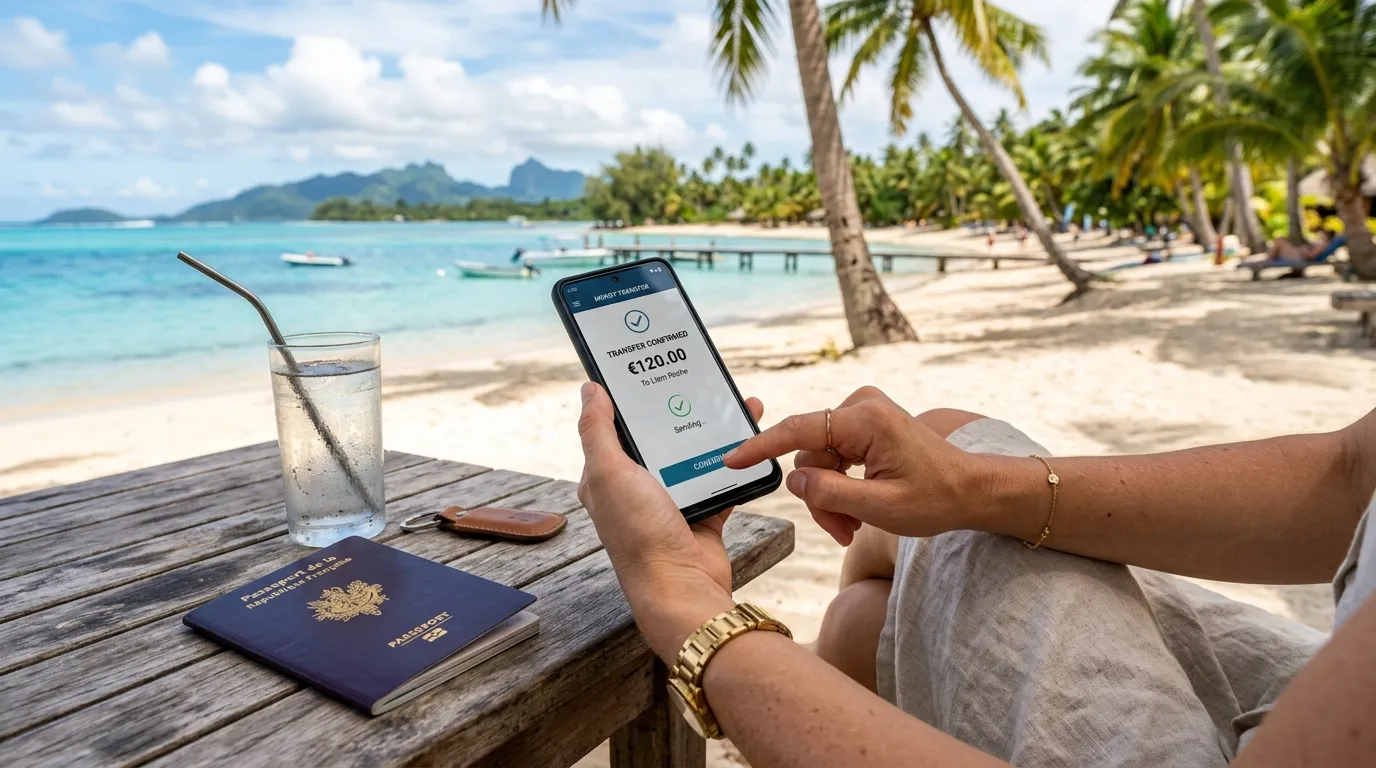
Transferring money to Mauritius is not something to be done on a whim. Between SWIFT transfers, exchange fees, processing times, and required documentation, the actual cost depends primarily on the method chosen. (banque-france.fr)
For a future resident or investor, the challenge is twofold: to send the right amount and to convert it into Mauritian rupees (MUR) at the best time, because the rates applied by banks and exchange bureaus vary depending on the transaction.
Understanding money transfers between France and Mauritius
A transfer from France to Mauritius is not a standard SEPA transfer.
The Bank of France reminds users that international transfers outside the SEPA zone generally use the SWIFT network and may be routed through a correspondent bank or intermediary. The bank may also request the reason for the transaction and supporting documentation, especially if the amount is significant. Official rules for international transfers outside the SEPA zone (banque-france.fr)
In practice, always have the beneficiary's name, address, IBAN or account number, and the recipient bank's BIC/SWIFT code ready. If the account does not have an IBAN, your bank may request additional information. (banque-france.fr)
Why does the amount received in MUR vary so much?
The Bank of Mauritius publishes indicative rates for banks and currency exchange offices, with different values depending on whether it is an electronic transfer, a bank draft, or banknotes. This means that the “true” cost of a transfer is not limited to the displayed commission. the indicative MUR rates published by the Bank of Mauritius
For example, on July 22, 2026, the Bank of Mauritius posted indicative EMU rates of 53.1439 for buying and 54.7436 for selling euros. This difference shows why it is necessary to compare the net amount received in MUR, not just the fixed fees.
This increases the bill
The total cost of an international transfer generally consists of three components: sending fees, exchange rate margin, and sometimes receiving fees at the beneficiary's end. The Bank of France also specifies the three most common fee structures: OUR, SHA, and BEN. (banque-france.fr)
- Issuance fees are sometimes a flat rate and sometimes calculated as a percentage of the amount sent. (banque-france.fr)
- The exchange rate margin is added to the official rate and can significantly impact large amounts. (banque-france.fr)
- The recipient may also pay a receiving fee depending on the bank chosen. (banque-france.fr)
- In the case of intermediary banks, additional fees may be incurred during SWIFT transit. (banque-france.fr)
In practice, the best approach is to ask for the expected net amount in MUR before sending anything. Two offers with similar commissions can result in very different amounts received if the exchange rate applied is not the same. (banque-france.fr)
Which solutions should you use depending on your project?
International bank transfer
For a property purchase, a company contribution, or a significant asset transfer, international bank transfer often remains the most transparent option for all parties involved. It leaves a clear banking record and facilitates proof of the origin of the funds. The Bank of France also indicates that it generally takes 4 business days. (banque-france.fr)
Specialized online services
Specialized or multi-currency online solutions can be advantageous for more frequent or smaller transfers, especially if you want to quickly see the total cost. Their value is primarily determined by the net amount received, the exchange rate, and any fees charged to the recipient. (banque-france.fr)
The physical transport of funds
This option should remain only a temporary solution. The Public Service reminds us that a customs declaration is mandatory for any amount of €10,000 or more being physically transported, and that for amounts exceeding €50,000, proof of the origin of the funds must be provided. Customs regulations regarding the transport of money abroad (service-public.fr)
Quick comparison of solutions
| Solution | Strengths | Costs to watch | Usual timeframe | For which case? |
|---|---|---|---|---|
| International bank transfer | Traceable and suitable for large amounts. (banque-france.fr) | Issuance commission, exchange rate margin and any receiving fees. (banque-france.fr) | Generally 4 business days. (banque-france.fr) | Property purchase, down payment, asset transfer. |
| Specialized or multi-currency online solution | Often useful for quickly visualizing the total cost. | Check the applicable rate, commission, and any fees on the beneficiary's side. (banque-france.fr) | Varies depending on the operator. | Monthly budget and regular transfers. |
| Physical transport of funds | Can be used in exceptional circumstances. | Customs declaration required for amounts over €10,000 and supporting documents required for amounts over €50,000. | Immediate, but restrictive. | Occasional cases only. |
The right choice therefore depends on the amount, the level of evidence required, and the timeframe you have available. For an expatriation or investment project, the clarity of the documentation is often as important as the price quoted. (banque-france.fr)
Deadlines and safety: what to anticipate
The Bank of France indicates that an international transfer takes longer than a SEPA transfer and generally requires four business days. This timeframe may increase if the order is placed on a weekend, a public holiday, or if an intermediary bank blocks the transaction for verification. (banque-france.fr)
«"Generally, it takes 4 business days." (banque-france.fr)
In other words, if your real estate project or your move to Mauritius depends on a deadline, always send your funds well in advance instead of relying on a last-minute transfer. This caution is even more important when the bank requires proof of the origin of the funds or the reason for the payment. (banque-france.fr)
Checklist before sending
- Request the expected net amount in MUR before confirming the transaction. (banque-france.fr)
- Check whether the fees are your responsibility, shared, or the responsibility of the beneficiary. (banque-france.fr)
- Schedule your mailing outside of weekends and public holidays if the date is important. (banque-france.fr)
- Keep your receipts in case the bank questions the origin of the funds or the reason for the payment. (banque-france.fr)
If you are also preparing your installation budget, the practical guides on expatriation to Mauritius can help you estimate the amount to transfer month by month.
Money transfer and expatriation project in Mauritius
For a prospective resident, the transfer of funds must be considered in conjunction with their financial planning. The EDB reminds us that upon purchasing a residential property exceeding USD 375,000, a non-citizen can obtain a residency permit as long as they retain ownership of the property. The agency also specifies that purchasing an apartment in a condominium building with at least two stories above ground level may be possible starting at MUR 6 million, subject to approval. the residency rule related to real estate purchase in Mauritius
In this context, sending euros to Mauritius is often used to finance a purchase, build up local cash reserves, or establish a permanent presence. Therefore, currency conversion should be considered in conjunction with the project timeline.
From a tax perspective, the key point to remember is that Mauritian VAT is 15% and the standard corporate tax rate is also 15%. However, for individuals, the 2025-2026 tax brackets remain progressive, with rates of 0%, 10%, and 20% depending on the income bracket. the Mauritian VAT rate corporate taxation in Mauritius (mra.mu)
This content is for informational purposes only and does not replace personalized tax, banking, or legal advice.
Frequently Asked Questions about Money Transfers Between France and Mauritius
What are the fees and exchange rate for transferring money from France to Mauritius?
Three key factors should be considered: sending fees, exchange rate margin, and any receiving fees. The Bank of France points out that an international transfer is generally more expensive than a SEPA transfer, and that there may also be fees charged to the recipient. In Mauritius, the Bank of Mauritius publishes different indicative rates depending on the type of transaction, including for electronic transfers. The best approach is to compare the net amount received in MUR, not just the displayed commission. (banque-france.fr)
What is the best method to send money in Mauritian Francs from France?
For a property purchase or a large asset transfer, international bank transfers often remain the easiest to track. For regular transfers of living expenses, specialized online services can be advantageous if the rates and fees are more transparent. Cash withdrawal networks, such as Wise, Revolut, or Western Union, are mainly useful for comparing speed and ease of use, but the best choice depends primarily on the amount, the need for supporting documentation, and the desired simplicity. (banque-france.fr)
How long does an international money transfer from France to Mauritius take?
The Bank of France indicates that an international transfer outside the SEPA zone takes longer and generally requires four business days. This timeframe can increase if you initiate the transfer on a weekend or public holiday, if supporting documents are requested, or if a correspondent bank is involved. To avoid delays in an expatriation or property purchase, it is best to plan several days in advance. (banque-france.fr)
How to compare the fees between a traditional bank and a specialized online solution?
Compare the total cost, not just the commission. Look at the sending fees, the exchange rate applied, any receiving fees, and the breakdown: OUR, SHA, or BEN. Two offers may seem similar but result in very different net amounts in MUR. If you are preparing a large transfer to Mauritius, request a written quote and compare the offers side-by-side before confirming. (banque-france.fr)
Is it possible to send money without going through a bank?
Yes, you can physically transport cash or certain instruments, but customs requires a declaration for amounts over €10,000 and supporting documentation for amounts exceeding €50,000. In practice, this option is rarely the most economical or simplest for a relocation project in Mauritius. For transferring assets, a bank transfer is often more secure in terms of proof and traceability.
And now ?
If you are planning a move, a property purchase, or an investment structure in Mauritius, Request a free evaluation from Expat Mauritius and contact the team via WhatsApp or the website form. You can also browse the practical guides on expatriation to Mauritius and check the legal notices before launching your project.