
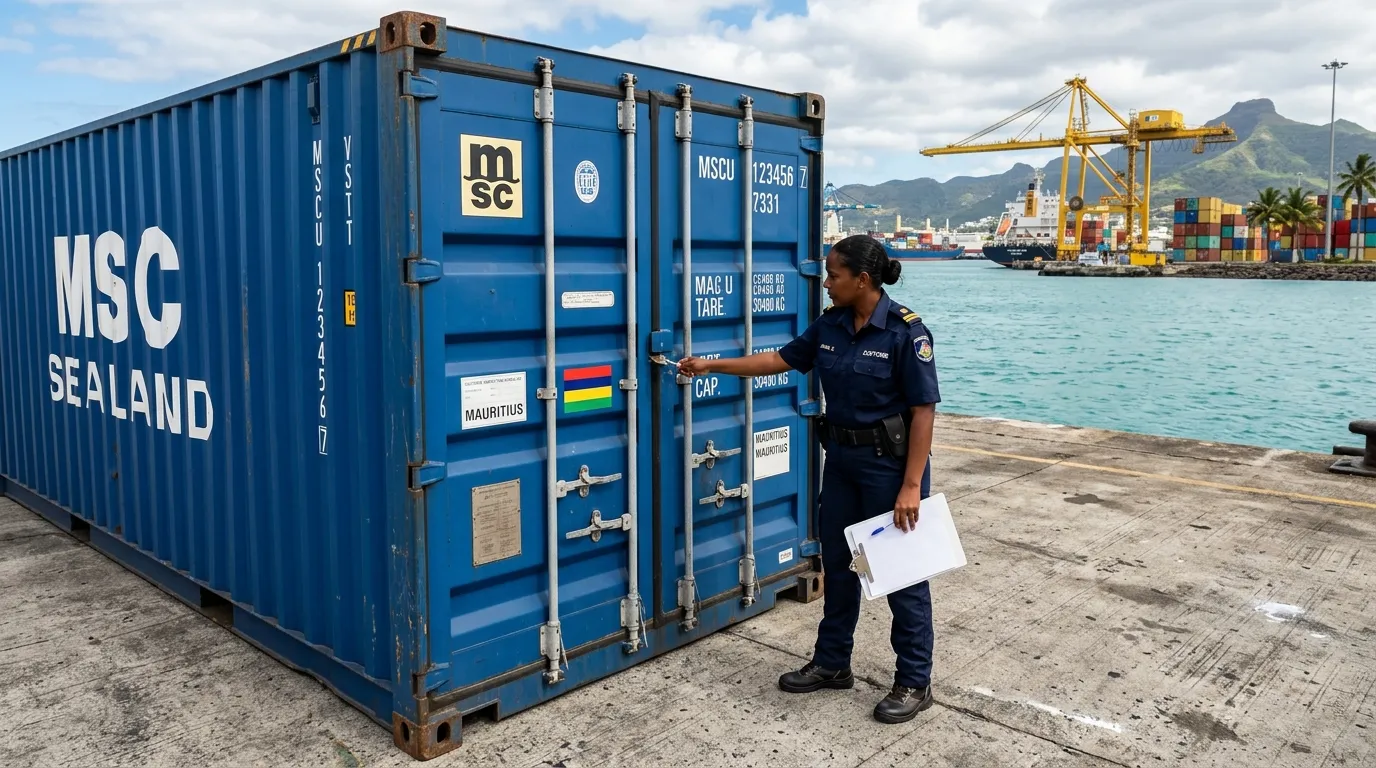
Moving to Mauritius in a container is not something you can do on a whim.
To avoid a container being stuck at the port, storage fees, or the seizure of prohibited items, you need to prepare customs documents, a detailed packing list, and check in advance if certain items require an import permit (plants, food, ICT equipment, vehicles, etc.). This guide provides you with a clear method, official links, and a operational checklist to ensure a successful arrival in Mauritius.
If you are looking for comprehensive support (visa/permit, housing, schools, banking, insurance, business creation), you can start on the homepage of Expat Mauritius (free assessment and contact).
1) Understanding customs regulations when moving to Mauritius by container
Who is involved in your customs clearance?
In Mauritius, customs clearance for a move (personal and household effects) often involves several authorities:
- MRA Customs (Mauritius Revenue Authority) : customs control and exemption rules/conditions.
- Passport & Immigration Office : delivers the Passport Memo requested by customs for the clearance of personal effects.
- Ministry of Agro-Industry / NPPO (Plant Protection) : permits and inspection for plants/seeds/wood/plant products.
- Division of Veterinary Services (DVS) : permits for live animals, animal products, and procedures for pets.
- Ministry of Health : clearance for some foodstuffs and pharmaceutical products.
- Police : clearance for weapons, ammunition, certain replicas/similar items.
- ICTA (Information and Communication Technologies Authority) : eClearance for certain ICT equipment (including non-commercial/personal import, as applicable).
Personal effects/household effects: an exemption is often possible, but under certain conditions
The MRA defines the household and personal effects (furniture, bedding, dishes, appliances, etc.) and specifies that they can be not subject to duties and taxes if you are eligible for the exemption and if you meet the conditions (not intended for sale, import within the deadlines, etc.).
- passenger who takes up permanent residence in Mauritius, (
- Mauritian citizen returning after at least one year abroad, (
- non-citizen coming to work in Mauritius (presentation of an Occupation Permit/Work Permit)
Critical point: The MRA indicates that household/personal effects must be imported. within 6 months following your arrival (except for accepted justified reasons), and in the event of resale/transfer before 4 years, A notification procedure and duties/taxes may apply, with possible penalties.
Why the “packing list” is non-negotiable
The MRA recommends a detailed list (packing list) to facilitate clearance: without a precise list, a provisional entry may be required to list all items, which lengthens and complicates the process.
2) The steps involved in a container move to Mauritius (overview)
Step A — Choose the right logistics scheme (FCL/LCL) and secure insurance
- FCL (full container): simpler in terms of inventory/traceability, often less handling.
- LCL (grouping): suitable for a smaller volume, but more intermediaries and groupings.
- Insurance : check the coverage (breakage, theft, humidity, marine damage), exclusions, deductible.
Practical tip: ask your freight forwarder/mover Who handles customs on arrival (you, a customs broker, an agent) and what documents will be required on site.
Step B — Prepare the customs file before boarding
For customs clearance of personal/household effects, the MRA lists the following documents to be submitted: passport, Passport Memo (collected at the Passport and Immigration Office), inventory, And shipping arrival papers.
In practice, your transport provider will also give you transport documents (e.g., bill of lading / Bill of Lading), and an agent can help you with the formalities (e.g. Bill of Entry).
Step C — Anticipate items requiring clearance (permits/authorizations)
The MRA specifies that, for goods requiring permits, clearance must be obtained from the relevant authorities (e.g. agriculture, health, police).
And the official Mauritian government portal reminds us that certain goods are checked (import with permit/authorization) and others prohibited (prohibited).
3) Customs formalities: documents to prepare (summary table)
Table — “Moving container” file: parts, source, timing
| Document / element | Who supplies it? | When can I get it? | What is it for? |
|---|---|---|---|
| Passport | YOU | Before arrival | Basic document for clearance of personal/household effects. |
| Passport Memo | Passport & Immigration Office (Mauritius) | Upon your arrival / according to local procedure | Document explicitly requested by the MRA for clearance of personal/household effects. |
| Inventory / Detailed Packing List | You + mover | Before boarding | Speeds up clearance; avoids a lengthy provisional declaration. |
| Shipping arrival papers | Shipping company / moving company / freight forwarder | Upon arrival (or just before) | Arrival documents requested by customs. |
| Occupation Permit / Work Permit (if applicable) | Competent authority (work permit) | Before shipping, if possible | This can be used to justify eligibility for the exemption for non-citizens coming to work. |
| Agriculture Permit/Clearance (NPPO) required for plants/wood/seeds | NPPO (SPS portal) | Before shipment | Plant import permit + documents (phytosanitary, fumigation, B/L…). |
| DVS permit required if products/animals of animal origin | Division of Veterinary Services | Before shipping (required) | Import permit required, otherwise non-clearance and risk of destruction/return. |
| ICTA clearance (if ICT equipment is involved) | ICTA (eClearance portal) | Before customs clearance | Applications are made online; eClearance required for certain ICT imports (including non-commercial). |
4) Forbidden objects, controlled objects: what blocks a container (and how to avoid it)
4.1 Agricultural products, plants, seeds, wood: NPPO permit, phytosanitary, fumigation
THE National Plant Protection Office (NPPO) regulates the importation of plants and plant products to protect biodiversity. Plant Import Permit (PIP) may be required, including for items such as the wood and wooden articles (furniture, crafts), seeds, flowers, spices, etc.
The NPPO also lists frequently expected documents: phytosanitary certificate (export country), Invoice, Bill of Lading (container), and fumigation certificate (especially for wood and certain machines).
Good to know: the NPPO indicates a typical delay of 3 to 5 business days to issue a PIP (regular cases, complete file).
4.2 Food, animal products, pets: DVS permit
There Division of Veterinary Services specifies that the importation of any living animal (including pets) and many animal products must be accompanied by a Import Permit issued by the DVS, in accordance with the regulations cited on the SPS portal.
The same portal indicates a normal delivery time is 2 working days for the issuance of the permit (if the application is complete), and warns that the deposits are arriving without a license are not cleared (recommendation for destruction or reshipment at the importer's expense).
Of the costs official documents are also indicated, for example a veterinary clearance fee of Rs 500 per consignment (including pets), and additional amounts (e.g. Rs 500 per cat/dog, quarantine indicated at Rs 15/day on the page).
4.3 Medicines and supplements: Health clearance
The MRA mentions that the pharmaceutical products and some foodstuffs require clearance of Ministry of Health. In practical terms, if you put medications (even "common" ones), supplements, or specific foods in your container, it is wise to check before shipment to avoid holding the batch.
4.4 Weapons, ammunition, certain related items: Police clearance
The MRA indicates that the arms and ammunition / weapons require clearance from the Police. If you have any doubt about an item (replica, sporting weapon, spearfishing equipment, etc.), consider it “at risk” and clarify before placing it in the container.
4.5 Vehicles (and other “restricted” goods): pay attention to permits and rules
The Mauritian government explains that the importation of controlled/restricted goods requires a permit/authorization, and prohibited goods are forbidden.
If you are considering importing a vehicle, be aware that certain regulations list... restrictions on certain used vehicles (particularly depending on age) and categories of prohibited/restricted goods.
The Ministry of Commerce (official guidelines) also specifies that applications for import permits for “restricted” goods are made via the Mauritius TradeLink/Single Window (via TradeNet Users: clearing & forwarding agents, commission agents, customs brokers). Fees of up to Rs 6,000 for certain “restricted goods” permits and Rs 60,000 in the case of a second-hand motor vehicle (in situations specified on the page).
4.6 ICT Equipment (routers, smartphones, radio equipment, etc.): ICTA eClearance
The ICTA indicates that, since the October 1, 2019, Applications to import ICT equipment are made via its online portal. before customs clearance, and that a clearance can also concern imports non-commercial (personal use, gifts) depending on the equipment category.
When moving, this can include (depending on the exact nature of the devices): Wi-Fi equipment, radio equipment, certain connected devices, etc. The idea is not to block you, but to not to discover the requirement at the time of customs clearance.
4.7 Examples of prohibited/problematic objects (not to be placed in the container)
The MRA publishes an official list of prohibited and restricted goods (non-exhaustive), including various items (e.g., certain types of bull bars, certain products containing CFCs/HCFCs, certain types of rolling papers, etc.).
The MRA also publishes a dated list (version) of “Selected Prohibited Goods” (e.g., “roll your own cigarette papers”, ENDS/ENNDS and accessories, etc.), with maximum quantities mentioned in the document and customs contact information (dated document) January 21, 2026).
5) Checklist for moving to Mauritius by container (step by step)
-
D-90 to D-60: Define your strategy
- Decide between FCL and LCL, and confirm who manages the customs clearance upon arrival.
- Sort: “I take”, “I sell”, “I give away”, “I store”.
- Identify the items requiring a permit: plants/seeds/wood, food/animal products, ICT equipment, weapons, vehicles.
-
D-60 to D-30: Prepare the evidence and the inventory
- Build a detailed packing list : item by item, numbered cartons, description, brand/model if relevant (electronics), quantities.
- Gather your personal documents and (if applicable) your Occupation Permit / Work Permit to support eligibility for the exemption.
- For plant/wood products: anticipate the Plant Import Permit and the parts (phytosanitary, fumigation, B/L…).
- For pets/animal products: prepare the DVS (Import Permit) process, and comply with the permit requirement before arrival.
-
30 to 7 days before departure: lock permissions
- Confirm the necessary “clearances”: Agriculture (NPPO), Health (MOH), Police, ICTA.
- Check your insurance policy and exclusions (valuables, humidity, electronics, etc.).
- Ask your service provider for the exact list of shipping arrival papers expected upon arrival.
-
Day -7 to Day 0: Container loading
- Label clearly (cardboard 1/120, 2/120…).
- Keep outside the container passports, original documents, essential items for the first 2–3 weeks.
- Absolutely avoid putting "borderline" items (vape/ENDS, weapons, seeds, food) in there without having secured the legal framework.
-
Upon arrival in Mauritius: customs clearance
- Prepare: passport, Passport Memo, inventory, shipping arrival papers.
- If your shipment contains goods subject to permits, liaise with the relevant authority (NPPO/DVS/ICTA/Police/MOH).
- Prepare for an inspection (physical or documentary) depending on the risk profile.
6) Concrete (realistic) example: what can cause a blockage, and how to prevent it
Case : a family ships a container with furniture, kitchen boxes, a bicycle, a computer, Wi-Fi accessories, and some “nature” items (wooden decorations, “souvenir” seeds).
- Risk #1: seeds / plant products → potentially subject to Plant Import Permit, inspection, and documents (phytosanitary, etc.). It is best to remove the seeds, or treat the subject via NPPO before shipping.
- Risk #2: Wooden articles → a fumigation certificate may be required for certain wood products (depending on the type), and the “quarantine/inspection” approach is common on the islands.
- Risk #3: ICT equipment → if an eClearance is required for part of the equipment, customs clearance can wait for the ICTA document.
- Risk #4: Prohibited items (e.g. certain tobacco products, ENDS/ENNDS, “roll your own” papers, etc.) → exposure to seizure/penalty/proceedings.
The right approach : a precise packing list + “permit” check + removal of non-essential/risky items before boarding.
7) Reduce delays and indirect costs (storage, delays, re-presentation)
- Send the documents before arrival to your agent (when possible): final inventory, passport copy, BL/arrival information, permits/clearances.
- Don't underestimate the "small" items Seeds, food, medicine, connected devices, lasers, projectile toys… these are often what trigger a detention.
- Avoid ambiguity in the inventory Repeatedly using terms like "miscellaneous" or "various" raises questions. A simple and verifiable description is preferable.
- If you import for work, Keep a copy of your permit (Occupation/Work Permit): this is an element explicitly mentioned in the eligibility for exemption for non-citizens coming to work.
8) Useful (official) links + Expat Mauritius resources
- MRA exemption rules for “Household & Personal Effects”: MRA – Allowances on household and personal effects.
- Documents requested by customs for the clearance of personal effects: MRA – Clearance procedures.
- MRA lists (PDF): Prohibited & restricted goods And Selected prohibited goods (Jan 21, 2026).
- NPPO (plants/seeds/wood): SPS Portal – NPPO FAQ.
- DVS (pets/animal products): SPS Portal – Division of Veterinary Services (Imports).
- ICTA eClearance: ICTA – eClearance guidelines.
- To prepare for the “rest” of your expatriation: Living in Mauritius (turnkey expatriation & real estate) and the expatriation guides Expat Mauritius.
FAQ – Container, customs and moving to Mauritius
What documents are needed to clear a container of personal effects through customs in Mauritius?
The MRA indicates that, for the clearance of personal and household effects, the following is required: passport, Passport Memo (collected at the Passport and Immigration Office), inventory, And shipping arrival papers. In practice, you will also have transport documents (e.g., Bill of Lading/Arrival) provided by your shipping company/freight forwarder. The element that really speeds up the process is a detailed packing list : without a list, a provisional declaration may be required, which takes longer to process.
Can I import my furniture and appliances without paying taxes?
Yes, it's often possible if You are eligible for the exemption if you meet the conditions set by the MRA. The MRA specifies that household and personal effects are not subject to duties/taxes when cleared by eligible individuals (e.g., those establishing residency, returning Mauritian citizens, non-citizens coming to work with a permit). Note: the effects must, in particular, be imported within 6 months following arrival (except for accepted reasons) and must not be intended for sale.
What items are prohibited or risky when moving to Mauritius?
The MRA publishes official documents listing prohibited and restricted goods (non-exhaustive list): certain tobacco-related items (e.g., "roll your own" papers), certain devices/products associated with ENDS/ENNDS, certain bull bars, certain equipment containing CFCs/HCFCs, projectile toys, etc. The key point is not to memorize the entire list, but to not to “hide” of risky items in the container: a single problematic line can trigger detention, seizure or penalties.
Do you need a permit to import plants, seeds or wooden furniture?
Often yes, or at the very least a preliminary check is necessary. The NPPO (via the SPS portal) explains that a Plant Import Permit applies to many products, including the seeds, certain plants/plant parts, and items like the wood and wooden articles (furniture, crafts). The NPPO also lists the documents that can accompany a shipment: phytosanitary certificate (exporting country), invoice, Bill of Lading, and sometimes a fumigation certificate, particularly for wooden fixtures.
How long does it take to get a permit for a pet (dog/cat)?
The Division of Veterinary Services' SPS portal indicates that importing live animals (including pets) requires a Import Permit and that the normal delivery time delivery is 2 business days (If the application is complete), with the possibility of faster processing in urgent cases. It is also stated that a shipment arriving without a permit and international veterinary certificate will not be cleared and may be returned/destroyed at the importer's expense. Moral of the story: start the process before shipping, not after.
And now ?
A successful container shipment requires 80% of document preparation and 20% of logistics. If you wish to secure your expatriation beyond the move itself (permits/visas, settling in, housing, schools, banking, insurance, real estate, business creation), you can request an evaluation via Expat Mauritius and rely on their resources and guides to plan each step without stress.