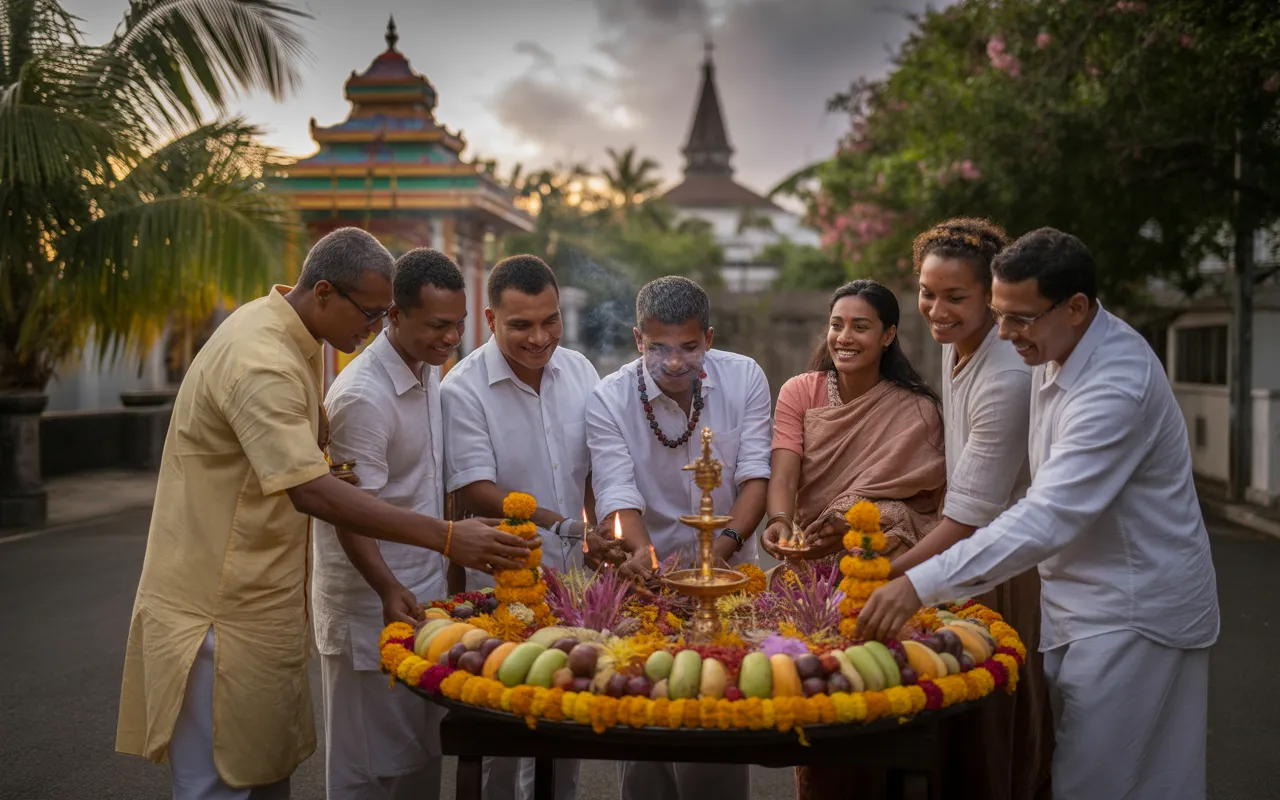
Mauritius is a crossroads of religions.
If you are looking to understand the religion Mauritius To better live there (or prepare for your expatriation), remember the essentials: the island is deeply multi-faith, and this diversity is visible on a daily basis in the public holidays, THE ceremonies, THE places of worship and many social customs. In this article, you will find a recent statistical overview, a guide to major holidays and practical advice on how to respect customs, whether you are a resident, entrepreneur or future expatriate.
Overview of religions in Mauritius (figures and reality on the ground)
The Republic of Mauritius is often cited as an example of religious coexistence In the Indian Ocean: temples, mosques, churches and pagodas sometimes stand side by side just minutes from each other. This diversity is explained by the country's history (colonization, slavery, indentured servitude, migrations).
To rely on solid data, the most reliable source is the Housing and Population Census 2022 published by Statistics Mauritius (Demographic report, published in 2024). The figures below are calculated from the total resident population and declared religious categories.
Distribution of religions (2022 Census) — summary table
| Large religious complex | Size (resident population) | Part (%) | Source / method |
|---|---|---|---|
| Hinduism (as a whole) | 590 263 | 47,87% | Sum of declared Hindu categories / total (2022 Census, Statistics Mauritius) |
| Christianity (as a whole) | 398 212 | 32,29% | Total of listed Christian denominations / total (2022 Census, Statistics Mauritius) |
| Islam (together) | 224 885 | 18,24% | Sum of declared Muslim categories / total (2022 Census, Statistics Mauritius) |
| Other religions (Buddhism, Baha'i, etc.) | 10 600 | 0,86% | Sum of categories "other religions" / total (Census 2022, Statistics Mauritius) |
| Without religion | 7 753 | 0,63% | «No religion» category / total (Census 2022, Statistics Mauritius) |
| Undeclared | 1 384 | 0,11% | Category «Not stated» / total (Census 2022, Statistics Mauritius) |
To view the official publication: Housing and Population Census 2022 – Volume II (Statistics Mauritius).
Key points to remember for everyday life: In Mauritius, religion is not confined to the "private" sphere. It also structures the calendar (days off), certain schedules (e.g., Ramadan) and very visible moments in the public space (processions, pilgrimages, prayers, decorations).
Understanding the major Mauritian religions (and what that means for you)
Hinduism: widely attended festivals and pilgrimages
Hinduism is the primary religion in Mauritius. Celebrations are often family-oriented, but some are also spectacular and public, with large gatherings. Key moments include:
- Maha Shivaratree : major pilgrimage, especially towards Ganga Talao (Great Basin), with worshippers sometimes walking long distances.
- Diwali : «festival of lights» (decorated houses, sharing of sweets).
- Thaipoosam Cavadee Tamil celebration, processions, music, rituals.
- Ganesh Chaturthi : festivities around Ganesh, prayers and offerings.
In practice, these holidays can influence traffic, crowds in certain areas, and the availability of services (government offices, banks, some businesses).
Christianity: Catholicism is very present and there are local traditions
Christianity (and Catholicism in particular) is very well established. The highlights are often Christmas (December 25th) and, depending on the year, All Saints' Day (public holiday in some years). There are many churches, and the celebrations can be very lively (choirs, processions, midnight masses).
Note: Rodrigues Island has a strong Catholic tradition (a recurring piece of information in many summaries, and consistent with the historical presence of the Church).
Islam: Ramadan, Eid and a respectful living environment
The Muslim community is significant in Mauritius. During the Ramadan, Some habits change: schedules, meals, social life in the evening (breaking the fast). The festival of Eid al-Fitr is a national holiday, but its date may depend on lunar observation (so confirmation to watch for).
A good expat reflex: adopt a discreet and respectful attitude (especially in neighborhoods where the practice is very visible) without fearing a "misstep" — Mauritian society is used to diversity.
Buddhism and Sino-Mauritian traditions: temples, Chinese New Year
Chinese traditions and Buddhism are minorities nationally, but very visible culturally, especially during the Chinese New Year (red decorations, family gatherings, public events depending on the location).
Religious holidays and public holidays in Mauritius: what you need to know
In Mauritius, some public holidays are linked to religious festivals, and the exact calendar is officially announced. To verify the most accurate version, consult the official website of the Prime Minister's Office (PMO) or recognized calendars that relay the published dates.
Examples of religious holidays (illustrated with 2026)
As an example (for planning purposes), here are several frequently observed holidays. The dates below are given for 2026 as listed by specialized calendars, to be cross-checked with official announcements: PublicHolidays.mu And OfficeHolidays (Mauritius 2026).
| Holiday / Public Holiday | Religion / tradition | What you will actually see | Practical impact |
|---|---|---|---|
| Thaipoosam Cavadee | Hinduism (Tamil) | Processions, music, crowded temples | Local traffic/crowding |
| Maha Shivaratree | Hinduism | Pilgrimages, procession of the faithful, Grand Bassin | Travel to anticipate |
| Eid al-Fitr | Islam | Prayers, family gatherings | Date sometimes confirmed late (moon) |
| Diwali | Hinduism | Bright decorations, sweets, visits | National festive atmosphere |
| Assumption | Christianity (Catholic) | Religious services | Public holiday according to the official calendar |
| Christmas | Christianity | Decorations, celebrations, meals | Numerous closures |
| Chinese New Year | Chinese traditions | Family festivities, cultural events | National holiday |
Advice : If you are launching a business or planning administrative procedures, build your calendar to include these periods of high demand and closures. Useful resources also exist for expatriates: Expatriation guides – Expat Mauritius.
Customs and “good manners”: avoiding faux pas (temples, mosques, churches)
In a Hindu temple
- Shoes : We very often take our shoes off at the entrance.
- Outfit : Opt for clothing that covers the shoulders and knees, especially during ceremonies.
- Photos: Ask before photographing people, rituals or certain altars.
- Offerings: If you are offering something, keep it simple and follow the local guidelines (flowers, fruit, etc.).
In a mosque
- Outfit : modest and covering; a veil may be required for women in certain places.
- Respect for prayers: Avoid moving around during prayers, speak in a low voice.
- Ramadan: Avoid eating/drinking ostentatiously in certain contexts, out of respect.
In a church
- Silence and discretion: calm attitude during services.
- Outfit : No need to be formal, but remain respectful (avoid beach/very short outfits).
Practical advice for expats: living with religious diversity on a daily basis
Here are some practical tips, particularly useful if you are moving to a new place to work, start a business, or enroll your children in school:
- Anticipating closures: Government offices, banks, and some services may be closed on public holidays. Plan your appointments accordingly.
- Observe before acting: In a new neighborhood, observe the customs (clothing, schedules, noise) during local ceremonies.
- Accept invitations: Diwali, Christmas, Eid… Invitations are often a gateway to quick integration. A small gift (sweets, fruit) is generally appreciated.
- In a company setting: Teams can be very diverse; a shared holiday calendar is a good HR practice.
If your relocation project to Mauritius includes administrative procedures, accommodation, schooling, or an entrepreneurial project, you can start with the website Living in Mauritius: turnkey expatriation and real estate (Expat Mauritius) to understand the support offered and request an assessment.
For further information: reliable sources and official guidelines
- Religious data (2022 Census): Statistics Mauritius – Housing and Population Census 2022 (Volume II).
- Public holidays (institutional reference): Prime Minister's Office (Mauritius).
- Practical calendars (to be cross-checked with the official one): PublicHolidays.mu ; Timeanddate – Mauritius holidays.
- Context of “living together” (further reading): US Department of State – International Religious Freedom (Mauritius).
FAQ – Religion in Mauritius: Frequently Asked Questions
What is the majority religion in Mauritius?
The majority religion in Mauritius is’Hinduism. According to the 2022 census (Statistics Mauritius), all Hindu denominations and categories represent 47,87% of the resident population. The Christianity next comes (32,29%), then the’Islam (18,24%). The remainder corresponds to other religions (less than 1%), people with no religion, and those who did not declare their affiliation. In practice, you will mainly observe this through the calendar of holidays, places of worship, and certain family traditions.
Which religious holidays have the greatest impact on professional life in Mauritius?
Several religious holidays strongly influence business activity: Maha Shivaratree, Diwali, Eid al-Fitr, Christmas and the Chinese New Year These are among the most visible. Government offices and many services close, and some sectors operate at a reduced capacity. Important: the date of some holidays (notably Eid) may depend on the lunar calendar and be confirmed late. The best approach is to check official announcements (PMO) every year and plan ahead for any important matters.
Is it possible to visit temples and mosques in Mauritius if you are not a practicing Muslim?
Yes, it's generally possible, and often well-received if you approach it respectfully. The golden rule: follow the customs of the place. In a temple, shoes are frequently removed, and beachwear should be avoided. In a mosque, modest clothing and discretion during prayer are essential (and a headscarf may be required in some places). Ask permission before taking photos, especially during rituals. If in doubt, observe and let someone from the place guide you.
How should one behave during Ramadan when living in Mauritius?
During Ramadan, the atmosphere is generally peaceful, and social life is often more active in the evenings. As an expat, you don't need to completely change your routine, but certain gestures are appreciated: avoid eating or drinking ostentatiously in places frequented by fasting people, remain discreet near mosques during prayer times, and understand that some schedules may be adjusted. If you are invited to break your fast, accept if you can: it's a convivial and culturally enriching experience.
And now ?
Understanding the religion in Mauritius, Knowing about its festivals and customs saves you time… and avoids many misunderstandings when you settle in. If you are preparing for your expatriation (visas/permits, housing, schooling, banking/insurance, or business plans), you can consult Expat Mauritius and browse the expatriation guides to move forward in a structured way and contact the team for an evaluation of your project.