Mauritius is a country where religion is practiced in the plural.
If you are looking for a clear overview of the religion in Mauritius (religion Mauritius), here's the gist: a well-established religious diversity, official statistics data from the latest available census, and concrete indicators for understanding daily life (places of worship, holidays, practices, coexistence). In 2026, the latest public figures those of Housing and Population Census 2022, published by Statistics Mauritius in May 2024 (This is the most recent reference).
To prepare for your move (housing, administrative procedures, family life), you can also consult Live in Mauritius with Expat Mauritius.
Why is religion so visible in Mauritius?
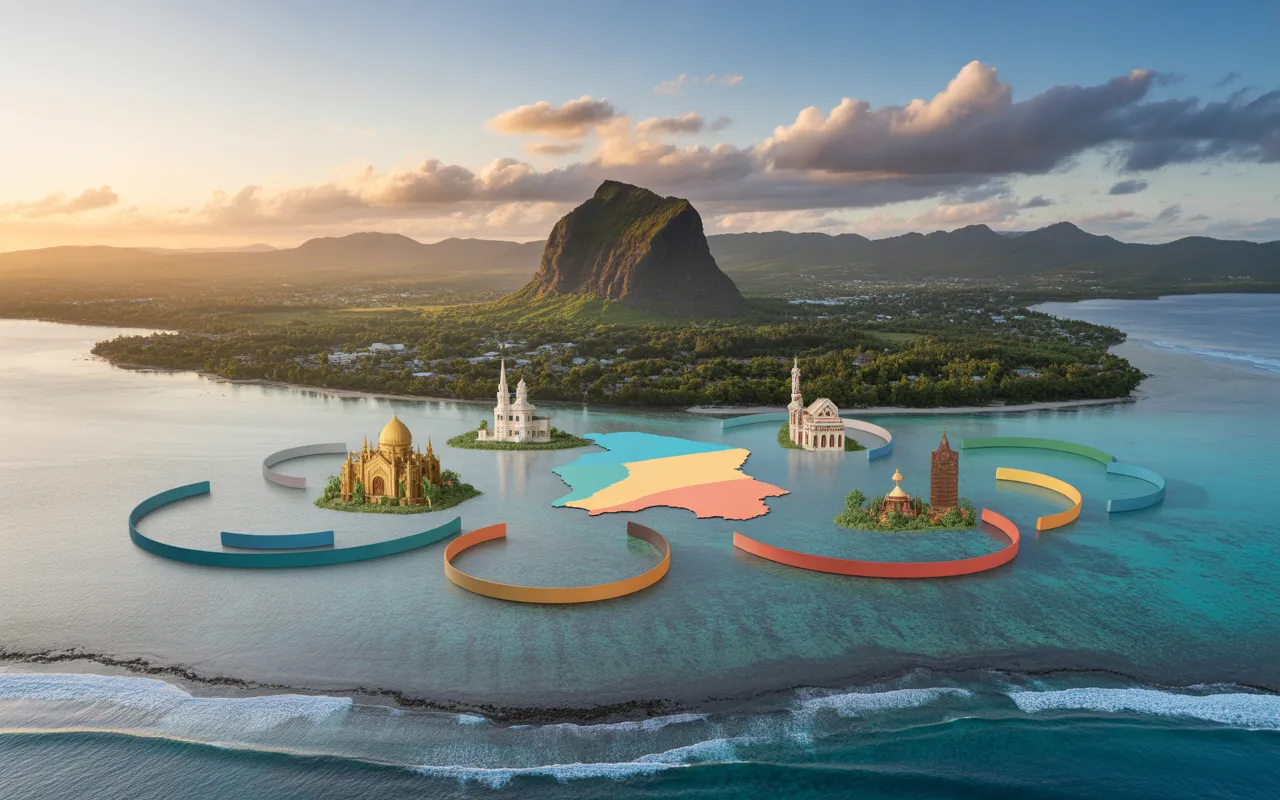
In Mauritius, religion is intimately linked to the archipelago's history: colonization, slavery, indentured servitude, successive migrations, and the creation of a multicultural society. In concrete terms, this translates into:
- a strong presence of Hindu temples, churches, mosques And pagodas throughout the territory; ;
- of the religious holidays which structure the calendar (some are public holidays); ;
- a climate of generally peaceful interreligious coexistence, where celebrations are often known (and sometimes shared) beyond the communities.
Official figures: religion in Mauritius (latest available census)
The latest available national census is the Population Census 2022. The “Religion” tables are published in the report. Housing and Population Census 2022 – Volume II: Demographic and Fertility Characteristics (publication: May 2024). Source : Statistics Mauritius (official PDF).
Important : The published tables exclude the very small resident population of Agalega (approximately 330 people), which explains the total “Republic of Mauritius” to 1 233 097 in the religion tables, instead of 1,233,427 when Agalega is included.
Distribution of religions in Mauritius (2022 Census – Republic of Mauritius)
| Religious group (aggregated) | Population (residents) | Estimated share | Comment |
|---|---|---|---|
| Hinduism | 590 263 | 47,87% | This includes, in particular, the Marathi, Tamil, Telugu, Vedic/Aryan and “Hindu & Other Hindu” groups. |
| Christianity | 398 212 | 32,29% | Predominantly Catholic (307,515), plus other Christian denominations. |
| Islam | 224 885 | 18,24% | Aggregated group “Islam/Muslim & Other Muslim”. |
| Buddhism / Chinese religions (grouped category) | 5 053 | 0,41% | Statistical grouping “Buddhist/Chinese”. |
| Without religion | 7 753 | 0,63% | Declaration “No religion”. |
| Other / not declared | 6 931 | 0,56% | Includes “Other & Not stated”. |
| Total | 1 233 097 | 100% | Published religious paintings (excluding Agalega). |
These figures highlight a key point for 2026: Hinduism is the first religion, followed by Christianity, then of the’Islam. Other affiliations and the absence of religion remain minority cases.
Differences between areas: urban vs rural (useful overview for expats)
The 2022 census also highlights geographical contrasts. Based on the urban/rural categories published in the “religious group” tables (2022 Census):
- Hinduism : approximately 36,9% in urban areas versus 54,9% in rural areas (order of magnitude calculated from the aggregates in table D6).
- Islam : approximately 24,9% in urban areas versus 13,9% in rural areas.
- Christianity : relatively similar proportions, around 35,9% in urban areas and 30,0% in rural areas.
In practice, this can influence the “feeling” on a daily basis (presence of places of worship nearby, atmosphere during certain holidays, schedules and crowds).
Rodrigues: a special case
Rodrigues Island (Republic of Mauritius) has a very different religious structure. In the religion table (2022 Census), we observe in particular 38,220 Catholics on 43 604 inhabitants of Rodrigues, or approximately 87,7% (Order of magnitude calculated from the figures in the table). Source: Statistics Mauritius – Census 2022 (PDF).
Legal framework: freedom of religion in Mauritius
Mauritius has no state religion, and freedom of conscience (including freedom of religion) is constitutionally protected. The constitutional text specifically addresses this freedom. to change religion and to express one's belief in public or in private. Source: Constitute Project – Mauritian Constitution (consolidated version) (see the section “Protection of freedom of conscience”).
Excerpt (faithful summary): The Constitution protects freedom of thought and religion, including the freedom to change one's beliefs and to practice them individually or in community.
Living your religion on a daily basis: what expats need to know
Places of worship: access, codes and best practices
In Mauritius, access to places of worship is generally simple, but a few precautions can help avoid mistakes:
- Outfit : It is advisable to wear clothing that covers the shoulders and legs in temples, mosques and sometimes certain churches during services.
- Shoes : in many Hindu temples, you take off your shoes at the entrance.
- Photos : ask for permission, especially during a ceremony.
- Silence and traffic : during a service, avoid crossing the central space or standing in front of the worshippers.
Neighborhood life and “living together”
Coexistence is visible in everyday life: calls to prayer, church bells, processions, celebratory music, shared meals. To understand this culture of interreligious dialogue, you can consult the Council of Religions (Mauritius) – history and mission, a local organization focused on interreligious harmony.
Religious holidays and public holidays: concrete impact on the organization in 2026
In Mauritius, several festivals linked to major religions are national holidays. This has a direct impact on:
- THE schools (closures),
- THE banks and certain government departments,
- traffic (processions/pilgrimages),
- economic activity (some sectors are operating at a slower pace).
For a practical 2026 calendar (to be checked annually via official announcements), a common source of consultation is: Timeanddate – Holidays and Observances in Mauritius (2026). The website of Prime Minister's Office (PMO) also publishes official press releases and information.
Understanding history (in brief): why this diversity?
Without going into a history lesson, two key points help to understand the Mauritian mosaic:
- The memory of slavery and the construction of a Creole culture: the site of Le Morne Cultural Landscape (UNESCO) is a major symbol of resistance to slavery.
- The indenture system and the migration of contract workers: Aapravasi Ghat (UNESCO) recalls the structuring role of these arrivals in contemporary Mauritian society.
Useful resources to go further
- Official figures (by religion, gender, area, etc.) : Statistics Mauritius – Housing and Population Census 2022 (Volume II, PDF).
- Constitutional framework : Constitution of Mauritius (Freedom of conscience).
- Practical guides to prepare for your expatriation : Expatriation guides – Expat Mauritius.
FAQ – Religion in Mauritius: Frequently Asked Questions
What will be the main religion in Mauritius in 2026?
In 2026, the latest official statistics available These figures come from the 2022 census (published in May 2024). They indicate that the’Hinduism is the first religious group, around 47,87% of the resident population (excluding Agalega in the published tables). The Christianity follows with approximately 32,29%, then the’Islam with approximately 18,24%. The categories “no religion”, “other” and “not declared” remain minority. Source: Statistics Mauritius (Census 2022).
Is there a state religion in Mauritius?
No: Mauritius does not have a state religion. freedom of conscience (including freedom of religion) is protected by the Constitution, which also regulates religious practice in the public sphere and respect for individual rights (for example, in schools). In daily life, this translates into a high visibility of different religions, but also into a logic of coexistence: temples, churches, and mosques often stand side by side within a few kilometers. For a reference, you can consult the constitutional text (section “freedom of conscience”).
How does religion influence work and school in Mauritius?
Religion primarily influences the calendar through... public holidays Traffic is affected by various religious holidays (Hindu, Christian, Muslim, etc.). Government offices, schools, and banks may be closed, and some events (processions, pilgrimages) impact traffic. Practical tip: anticipate peak periods (travel, public services) and check the official dates each year, as some holidays are based on lunar calendars. A 2026 calendar can help with planning, but it should always be verified through official channels.
Can expatriates freely practice their religion in Mauritius?
In the vast majority of cases, yes: religious practice is widely visible and socially accepted, and freedom of conscience is constitutionally protected. You will easily find places of worship, especially in urban areas. The best practices to adopt are primarily cultural: dress appropriately in places of worship, respect for ceremonies, and caution when taking photos. If in doubt, simply ask locally: the welcome is often warm, especially if your approach is respectful.
Where is religious diversity most visible in Mauritius?
Diversity is evident everywhere, but it can be experienced differently depending on the area. For example, the 2022 census data shows urban/rural disparities: Hinduism is proportionally more prevalent in rural areas, while Islam is proportionally more prevalent in urban areas. In large cities, there is also a wide variety of Christian denominations. In Rodrigues, the structure is different, with a strong Catholic majority. These trends can influence your daily life (local festivals, neighborhood life, places of worship).
And now ?
Are you preparing to move to Mauritius (visa/permit, accommodation, schooling, banking/insurance, business creation) and want to avoid cultural and organizational mistakes, especially regarding festivals and local life? Discover the resources and support offered by Expat Mauritius, to move forward with a simple, structured approach tailored to your situation.