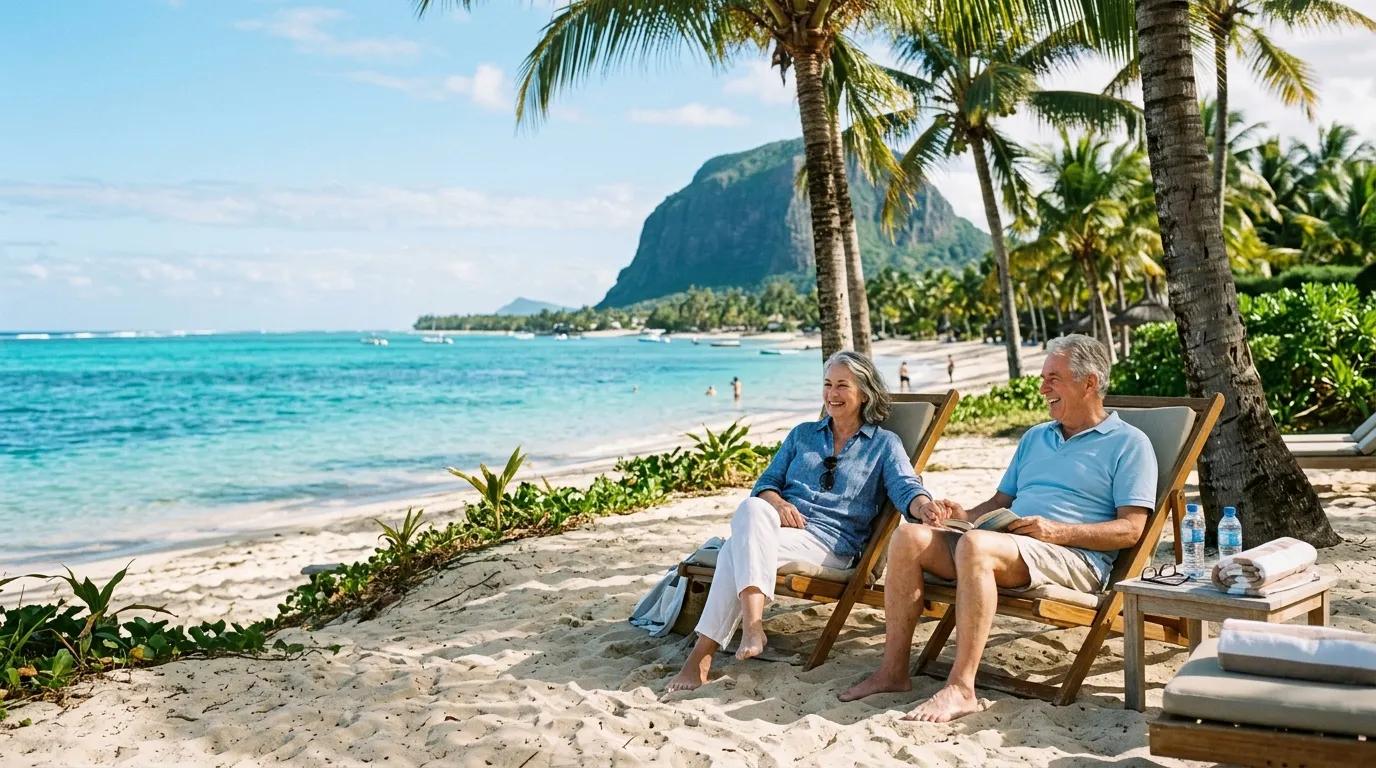
The Retired Non-Citizen Permit governs retirement in Mauritius. For a foreigner aged 50 and over, the official framework allows them to reside on the island with a renewable permit, and then consider permanent residency under certain conditions.passport.govmu.org)
The key points are twofold: proving regular financial resources and respecting the prohibition against working as a local employee. The basic criteria are now specified in Mauritian official texts and websites.mof.govmu.org)
What the Retired Non-Citizen Permit really covers
In practice, this permit is intended for those who wish to live in Mauritius for their retirement, without re-entering the local job market. The official page of Passport and Immigration Office presents the scheme as a residence permit for those over 50, valid for up to 10 years and renewable, while the Immigration Act specifies that the application goes through the EDB before a decision by the Director-General of Immigration.
The key point to remember is simple: a retirement permit is not an automatic right. You must demonstrate fund transfers, present complete supporting documents, and remain within the framework of your retired status. In return, this status opens a clear path to long-term residency, and then to... Permanent Residence Permit if the conditions are met.
Quick summary of the permit
| Key point | Key takeaways | Practical consequence |
|---|---|---|
| Age | The scheme targets foreigners aged 50 or over. | Therefore, the age of the main applicant must be verified before preparing the file. |
| Financial proof | The consolidated EDB text requires a certified bank statement showing either a minimum of USD 18,000 or a guaranteed income of USD 1,500 per month. | The application must demonstrate a regular and credible transfer capacity. |
| Permit duration | The current official pages indicate a 10-year retirement residence permit, renewable. | The project needs to be considered in the medium and long term, not just for a “test” move. |
| Work | The holder may invest, but may not be employed in the activity nor receive a salary or benefits related to that employment.dha.govmu.org) | Retirement remains the logic of the driving licence, even if an asset or a stake can be structured. |
| Permanent Residence | After 3 years of residence as a retiree and with at least USD 54,000 transferred over 3 years, access to the 20-year PRP becomes possible. | A retirement permit can be a real stepping stone to a more stable status. |
| Family | Dependents may include a spouse, parents, and children up to age 24, with a permit that does not exceed that of the primary holder.passport.govmu.org) | A family trip is possible, provided that the files for the beneficiaries are also prepared. |
Note: Some older PDF guides are still circulating with different durations or amounts. The most recent versions published by the Mauritian authorities are the ones that should guide your actual application.
Eligibility requirements to know before applying
The financial criterion is central to the matter. The consolidated text of the EDB Act specifies the required proof in the form of a certified bank statement, with one option at USD 18,000 and another at USD 1,500 per month. The aim is to ensure that retirees can live stably in Mauritius, without relying on the local system.
The procedure also requires physical presence at the time of submission. The official government website specifies that the applicant must be present in Mauritius and appear in person at the OP Unit in Sterling House to submit the application. The application is therefore part of a very concrete administrative process, not simply a matter of sending documents remotely.dha.govmu.org)
If you are also preparing your practical setup, the Expat Mauritius practical guides They can help you plan your accommodation, living budget, and the major steps involved in your arrival. This is useful for avoiding underestimating the additional costs of retiring abroad.
Application procedures: how is the application organized?
- First, prepare your financial documents, your passport and the most important civil status documents, so that the file is consistent from the start.
- Enter Mauritius with the appropriate travel document and visa, as Approval in Principle is not an entry visa. Authorities will then require a medical examination to be carried out locally if the itinerary necessitates it.
- Submit your application via the EDB, in accordance with the mechanism provided by law, then follow the Immigration Office's instructions for further processing.
- Once you have obtained the permit, keep track of your fund transfers and prepare the renewal file now, as compliance is verified over time.
Documents usually requested
- A copy of the passport, accompanied by a recent passport photo, to clearly identify the main applicant.
- A recent character certificate or police extract covering the last ten years, with a more recent version of morality for some renewals.
- Proof of fund transfers to a local Mauritian account, which demonstrates the retiree's financial capacity.
- A birth certificate, as well as a marriage or divorce certificate if the family situation requires it.
- A Mauritian medical certificate and, for renewals, a copy of the current permit and a commitment signed by the applicant.
The official checklist may vary depending on the type of application, the presence of dependents, or a renewal request. Therefore, this list should be considered a starting point, and you should then verify the additional documents required for your application.
Can I work with this permit?
No, not like a typical employee. Current legislation allows the holder to invest in a business, but it prohibits them from being employed in that business, managing it, or receiving a salary or employment-related benefits. In short, the status is compatible with asset investment, not with taking over a local business.
This distinction is important because many future retirees confuse "living in Mauritius" with "working there freely." A retirement permit provides a residency framework, but it does not replace a work permit or a professional employment permit.
Taxation: the concrete impact for a retiree
Taxation depends primarily on your tax residency, not just the type of permit you hold. The page of the Mauritian rule on foreign income It is worth noting that a resident is taxed on their worldwide or remitted income in Mauritius, while a non-resident is only taxed on their Mauritian-sourced income. The same page also specifies that tax residency is determined, in particular, by having resided in Mauritius for 183 days in the current year, or 270 days over the two preceding years.
For the 2025-2026 tax year, the income tax schedule published by the MRA The system displays 0 % up to Rs 500,000 of taxable income, 10 % on the next bracket, and then 20 % beyond that. The system remains self-assessed, meaning you must follow the filing and payment rules applicable to your situation. (mra.mu)
In practice, the tax advantage of retiring in Mauritius doesn't stem from automatic exemption, but from a more transparent set of factors than in many other jurisdictions: source of income, days of residence, residency requirements, potential deductions, and tax treaty, if applicable. It's a genuine optimization tool, but only after an analysis of your personal circumstances.
Family, renewal and transition to the PRP
This status can also work for the family unit. Dependents can include a spouse or common-law partner, parents, and children up to age 24, and their permit cannot exceed the duration of the primary holder's permit. This is a crucial point for families who don't want to separate their retirement plans from their life plans.
At the end of the journey, the Permanent Residence Permit This becomes a serious option. The consolidated text of the Immigration Act states that a retiree who has held a permanent resident permit for at least three years and has transferred $54,000 USD during that period can apply for a 20-year PRP. This transforms the retirement plan into a much more permanent settlement.
Frequently Asked Questions about the Retired Non-Citizen Permit in Mauritius
What are the eligibility requirements and minimum income to demonstrate in order to obtain the Retired Non-Citizen Permit in Mauritius?
The basic requirements are clear: the applicant must be 50 years of age or older and demonstrate sufficient financial resources. The consolidated EDB text requires a certified bank statement showing either a minimum of USD 18,000 or a guaranteed income of USD 1,500 per month. The authorities also require physical presence in Mauritius at the time of application. In practice, this means preparing a comprehensive file that addresses financial, civil, and logistical aspects.
How long does the Retired Non-Citizen Permit last and can it be renewed or converted into permanent residency?
The current official Passport and Immigration Office pages present the retirement permit as a 10-year, renewable document. Importantly, the process can lead to a 20-year PRP if the holder has maintained their retirement permit for three years and transferred at least USD 54,000 during that period. Older documents may contain different wording, so it is essential to follow the most recent official version at the time of application.
Does the Retired Person's Permit allow one to work in Mauritius or is it strictly limited to residence and lifestyle?
The permit is designed for residency, not for local salaried employment. The legislation allows the holder to invest in a business, but prohibits them from being employed in that business, managing it, or receiving a salary or employment benefits. It is therefore a retirement and settlement permit, with a margin for asset investment, but not a general authorization to work.
What are the exact procedures and documents required to apply for a Retired Person's Permit in Mauritius?
The application is processed by the EDB and then by Immigration, with in-person submission in Mauritius. The official checklist includes a passport, a recent photograph, a birth certificate, a recent police or character certificate, proof of funds transfers, a Mauritian medical certificate, and, depending on the case, a marriage or divorce certificate. For renewals, previous permits and proof of compliance must also be provided.
What are the tax implications and tax advantages for a retiree holding a Retired Non-Citizen Permit compared to tax expatriation to other countries?
The tax advantage depends primarily on your actual tax residence. The MRA (Mauritius Revenue Authority) indicates that a resident is taxed on their worldwide or remittance income in Mauritius, while a non-resident is taxed only on Mauritian income. For 2025-2026, the individual tax brackets are 0 %, 10 %, and then 20 %. The main benefit of the Mauritian tax permit, therefore, lies in the clarity of the framework and the possibility of optimizing its structure, not in automatic tax exemption.
And now ?
If your retirement project in Mauritius moves from simple interest to a concrete plan, EXPAT MAURITIUS can help you outline the steps, the timeline, and the supporting documents. You can also review the practical guides to prepare for the installation, then consult the legal notices of the site if you wish to check the editorial framework.