
Heading to Mauritius, without any unpleasant surprises.
If you're looking for how visit Mauritius by organizing your budget, your transport and your formalities, This guide provides you with reliable reference points (official sources when possible), plus concrete advice for traveling with peace of mind, whether you are traveling as a couple, with family or alone.
Essential information to know before visiting Mauritius
Entry requirements: visa, length of stay and mandatory form
For a tourist stay, entry to Mauritius is generally without prior visa, However, the final authorization and the duration granted depend on the immigration officer upon arrival (a principle recalled by the Passport and Immigration Office).
In practice, many travelers obtain an entry stamp allowing them to stay up to 60 days (see in particular the entry information on Travel.State.gov And GOV.UK).
Key point (not to be missed): passengers must complete the Mauritius All-in-one Travel Form (digital form) before arrival. Mauritius Airport also reminds passengers to be wary of fraudulent websites and indicates that the legitimate link is safemauritius.govmu.org : Travel to Mauritius – MRU Airport.
Finally, plan for the essentials: a passport valid beyond your stay, a return/onward ticket, confirmed accommodation, and sufficient funds (see the list of principles on [website address]). Travel Requirements – Passport and Immigration Office).
Currency, payments and exchange rates: the right reflexes
The local currency is the Mauritian rupee (MUR). Bank cards are widely used in hotels, shopping centers and many restaurants, but it is wise to have cash for small shops, markets, snacks and some transport.
To convert accurately, use the indicative rates published by the Bank of Mauritius. As of the date of January 26, 2026, The Bank of Mauritius displays (rates “notes”, for information purposes only): 1 EUR ≈ 52.93 MUR (purchase) / 54.79 MUR (sale) and 1 USD ≈ 44.86 MUR (purchase) / 45.98 MUR (sale). Source: Bank of Mauritius – Consolidated Indicative Exchange Rates.
When to go? Dry season, rainy season, and cyclones
Mauritius is often summarized in two main periods:
- May to October : drier, often milder temperatures (very appreciated for hiking and being active).
- November to April : warmer and more humid.
There summer season in Mauritius (in the meteorological sense) is described as ranging from November 1st to April 30th, and the official cyclone season of November 1st to May 15th, according to the Mauritius Meteorological Services (publication “Summer 2025–2026 Outlook”, dated November 3, 2025).
Field advice: If you are travelling between December and March, keep a “flexible” schedule (alternative activities indoors, buffer day) to absorb a day of heavy rain or swell.
What budget should I plan for when visiting Mauritius?
The budget depends primarily on three factors: accommodation (resort vs apartment), travel (taxi vs car/bus) and excursions (lagoon trips, catamaran, diving…). Rather than inventing a single “price/day”, here is a reliable method with macro data (2023–2024) and actionable benchmarks.
Key figures (2023–2024) to help you understand your position
The Bank of Mauritius publishes the gross tourism earnings (gross tourism receipts). In 2024, The total is shown at 93,574 million (provisional) : Gross Tourism Earnings – December 2024 (BoM). In 2023, The total displayed is 85,993 MUR million : Gross Tourism Earnings – December 2023 (BoM).
Regarding visitor numbers, Statistics Mauritius indicates 1,382,177 tourist arrivals in 2024 (compared to 1,295,410 in 2023): Statistics Mauritius – International Travel and Tourism (Year 2024 Highlights).
Table: “macro” budget (calculated) + exchange rate (26/01/2026)
| Indicator | Value | How to use it within your budget |
|---|---|---|
| Gross tourism receipts (2024) | 93,574 million | Gives an order of magnitude of the overall spending by visitors over the year (useful for “getting a sense of where you stand”, not for predicting your bill down to the cent). |
| Tourist arrivals (2024) | 1 382 177 | Allows you to estimate an average expense by arrival by dividing receipts / arrivals. |
| Estimated average expenditure per arrival (2024) | ≈ 67,700 MUR | Indicative calculation: 93,574 million MUR / 1,382,177 ≈ 67,700 MUR. To be interpreted with caution (spending structure varies greatly depending on profiles). |
| Indicative exchange rate (January 26, 2026) | 1 EUR ≈ 52.93–54.79 MUR; 1 USD ≈ 44.86–45.98 MUR | To convert your expenses (hotel, meals, transport) at the time of booking, please refer to the publications of the Bank of Mauritius. |
What this means in practical terms: if you're aiming for a "simple but comfortable" stay (apartment + car for a few days + mixed restaurants), you can stay below this average; conversely, a resort stay + premium activities + private transfers can significantly exceed it. The most effective approach is to budget by item (accommodation, transport, meals, activities) rather than “per day”.
3 simple ways to reduce the bill without ruining the trip
- Accommodation: Mix 2-3 "wow" nights (seaside) + the rest in a well-located apartment/villa.
- Transportation : bus + Metro Express on the routes served, and car only for exploring (rather than taxi on a daily basis).
- Meal : Alternate between restaurants and local cuisine (snacks, markets): it's often excellent and more affordable.
Getting around Mauritius: transport, prices and tips
Metro Express (light rail): convenient on the Port Louis ↔ Quatre Bornes ↔ Phoenix line
The Metro Express is useful if you are staying/visiting along the route it serves (Port Louis, Rose Hill, Quatre Bornes, etc.). It runs daily, with timetables posted (check before you leave) on the official website: Metro Express – My journey.
The maps MECard exist (Adult, Child, Student…). For example, the Metro Express website indicates a cost of Rs 150 for an Adult MECard including Rs 100 credit (see “Ticket Office”): Metro Express – Ticket Office.
Regarding pricing, an official statement specifies... prices per “internship” applicable from the May 8, 2022 (Fare update): Metro Updated Fares (Press Communiqué – Phase 2B).
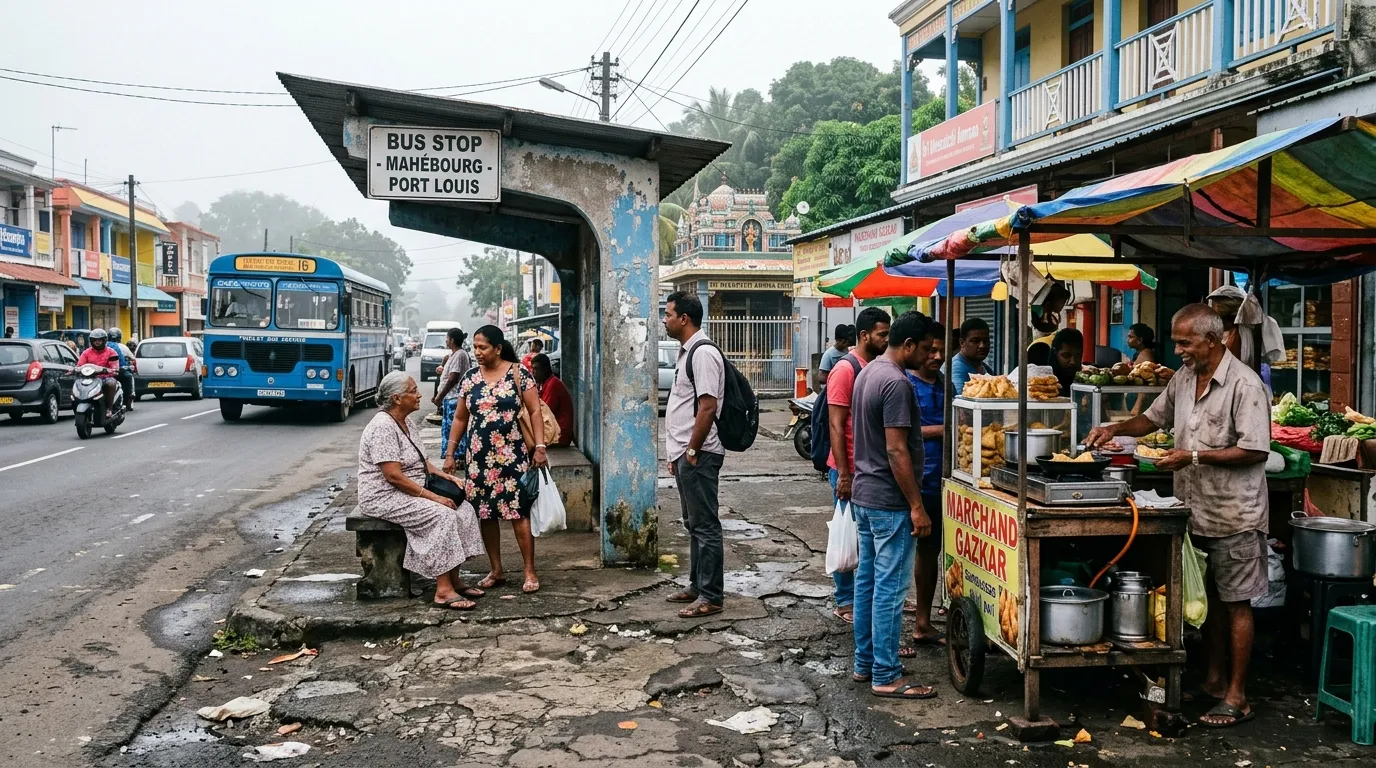
Public buses: the best value for money (and a real “journey within a journey”)
Buses cover the island very well, but require some flexibility (frequencies vary depending on the area and time of day). For fares, the most reliable source is the regulatory document available from the NLTA (National Land Transport Authority): Road Traffic (Bus Fares) (Amendment) Regulations 2022 (entry into force on May 8, 2022).
Table: Official fares (bus) and fares per stage (Metro Express) – useful information
| Transportation | Grid | Adult | Student | Child | Source |
|---|---|---|---|---|---|
| Buses (all routes except those with exceptions) | Stage 1 | Rs 17 | Rs 12 | Rs 8 | NLTA – Regulations 2022 |
| Buses (all routes except those with exceptions) | Stage 2 | Rs 24 | Rs 14 | Rs 12 | NLTA – Regulations 2022 |
| Buses (all routes except those with exceptions) | Stage 3–4 | Rs 30 | Rs 20 | Rs 15 | NLTA – Regulations 2022 |
| Buses (all routes except those with exceptions) | Stage 5–6 | Rs 35 | Rs 20 | Rs 16 | NLTA – Regulations 2022 |
| Buses (all routes except those with exceptions) | Over 30 internships | Rs 47 | Rs 24 | Rs 21 | NLTA – Regulations 2022 |
| Metro Express | Stage 1 | Rs 35 | Rs 17 | Rs 15 | Metro Express – Press Release (05/06/2022) |
| Metro Express | Stage 5 | Rs 55 | Rs 30 | Rs 27 | Metro Express – Press Release (05/06/2022) |
Tip: To help you plan your bus journeys, the NLTA also provides a timetable guide and useful documents (see the “Bus Timetable” page): NLTA – Bus Timetable.
Taxis, transfers and car rental: which to choose?
- Taxi / transfers: Very convenient for evenings out, airport transfers, or if you don't want to drive on the left. Ask for a price before getting in, especially for routes other than "standard" ones.
- Car rental: Ideal for exploring freely (wild south, viewpoints, hikes). Driving is... left : take 30 minutes to “recalibrate” (roundabouts, priorities) and avoid driving at night if you do not know the area.
- Winning combination: 2–3 days by car for exploration + the rest by bus/Metro + a few targeted taxis.
Where to stay when visiting Mauritius (according to your style)
- North (Grand Baie and surrounding areas) : lively atmosphere, restaurants, outings, accessible beaches, convenient base.
- West (Flic-en-Flac, Tamarin) : sunsets, surfing (depending on spots), good balance between beaches and activities.
- South / Southwest : more “nature”, cliffs, hikes, viewpoints (Black River Gorges National Park), ideal if you are travelling by car.
- East (Belle Mare and surrounding area) : large beaches, often more “resort-like”, relaxation and lagoon.
If this is your first time, a simple route is to do 2 bases (e.g., North + South/West) rather than changing hotels every two days.
Route ideas for discovering Mauritius
5 days (first visit)
- Day 1: Arrival, nearby beach, market/local food
- Day 2: Port Louis + Aapravasi Ghat (if you like history) + sunset
- Day 3: Lagoon excursion (catamaran/islets depending on weather)
- Day 4: Wild south + viewpoints + waterfall (depending on access)
- Day 5: Beach + souvenir shopping + departure
7 days (the correct format)
- Add a "nature" day: Black River Gorges (easy or more challenging hike)
- Add a "local produce" day: tea (Bois Chéri / scenic routes) + rum (if a visit is possible)
10 days (without running)
- 2 bases (North + West/South) to limit travel
- A full day of "slow" relaxation (spa, beach, reading)
- 1 "ocean" activity (diving, guided snorkeling) + 1 "land" activity (hiking, waterfall, garden)
Practical tips for a peaceful stay
Upon arrival: anticipate the immigration process
Complete the digital form (QR code) before departure and keep a copy readily available. Mauritius Airport specifies that the form must be completed for all passengers, including minors, and that the legitimate link is safemauritius.govmu.org. Source : MRU Airport – Travel to Mauritius.
Respect for the lagoon: beautiful, but fragile
Avoid walking on the corals, use a “reef friendly” sunscreen when you can, and choose tour operators who explain the basic rules (distance from wildlife, no feeding).
Daily budgeting: your “surprise-proof kit”
- Withdraw a small amount in MUR upon arrival (quick spending) and then compare banks/ATMs.
- Leave some room for: last-minute taxi, changing weather, spontaneous activity.
- Follow the rates via the Bank of Mauritius rather than approximate conversions.
FAQ – Visiting Mauritius
What is the daily budget for visiting Mauritius?
There's no single reliable "daily budget," as it all depends on accommodation (resort vs. apartment), transportation (taxis vs. car/bus), and excursions. To give you a general idea, a macro benchmark is that in 2024, the Bank of Mauritius projected MUR 93,574 million in gross tourism receipts, while Statistics Mauritius forecasted 1,382,177 arrivals, or approximately MUR 67,700 per arrival (order of magnitude). The most effective approach is to budget by category (accommodation, transportation, meals, activities) and adjust it according to your personal style.
Do you need to rent a car to visit Mauritius?
It's not mandatory, but it's often the most flexible option if you want to explore the south, see multiple viewpoints, and combine beaches with hikes. Without a car, you can easily combine buses (official fares are regulated), the Metro Express on the route it serves, and a few select taxis. If you do drive, remember that driving is on the left: take the time to get used to it and avoid traveling at night if you're not comfortable.
How to get from the airport to your hotel in Mauritius?
Upon arrival, you generally have three options: a pre-booked transfer (hotel or service provider), a taxi, or car rental directly at the airport. To avoid stress after a long flight, a pre-booked transfer is often the simplest, especially if you are staying further away (north or west). If you take a taxi, ask for the price before setting off. In all cases, remember to complete the Mauritius All-in-one Travel Form (QR code) before departure; it is recommended by the airport to expedite security checks.
Can you pay in euros when visiting Mauritius?
In some hotels and tourist areas, the euro may occasionally be accepted, but this isn't ideal: change given and the exchange rate applied may be less favorable. The safest option is to pay in rupees (MUR) or by card when possible. For accurate conversions, refer to the indicative exchange rates of the Bank of Mauritius: as of January 26, 2026, 1 EUR was worth approximately 52.93–54.79 MUR (based on buy/sell notes). Use these benchmarks to estimate your expenses and compare rates.
How many days should I plan to properly visit Mauritius?
A first glimpse can be had in 5 days, but 7 days is often the best compromise to enjoy the lagoon and also discover the interior (nature, viewpoints, culture). With 10 days, you can travel at a relaxed pace, by establishing two bases (for example, north then west/south) and including one truly leisurely day. If you are traveling during the rainy season (November to April), plan a flexible itinerary: the weather may require postponing a sea excursion to the following day.
And now ?
Are you coming to Mauritius for a holiday… and feeling that the island could become your life project (settling down, investing, starting a business)? EXPAT MAURITIUS supports individuals and entrepreneurs with local expertise and comprehensive support. Start on the homepage to discover our approach and request an assessment: Living in Mauritius: turnkey expatriation and real estate, Then explore the dedicated resources: Expatriation guides – Expat Mauritius.