The Mauritian lagoon is best experienced from the water.
If you are looking for the best water sports in Mauritius, The real question is not just “what to do?”, but How much does it cost? And how to do it safely (weather, swell, authorized service providers, equipment, suitable areas).
In this guide, you will find a clear overview of water sports and excursions (from snorkeling to catamaran sailing, including diving, kitesurfing, and parasailing), with examples of published tariffs (2025–2026) and safety reflexes adapted to Mauritius.
Understanding the terrain: lagoon vs. open sea
In Mauritius, many activities are practiced in the lagoon (area protected by the coral reef). The water is generally calmer here, ideal for:
- snorkeling (fins-mask-snorkel),
- paddle, kayak,
- family outings“ (glass bottom boat, islets).
There high sea and the passes (or more exposed areas) are more concerned with:
- there Scuba diving on some sites,
- there big game fishing,
- THE kitesurf depending on the season and wind direction,
- Whale watching (often offshore).
As a result, on the same day, one spot can be “perfect” and another dangerous. That's why, in Mauritius, today's marine weather It matters more than the calendar.
The best water sports to do in Mauritius
Snorkeling (fins, mask and snorkel): the best "wow" / budget ratio“
Snorkeling is often the easiest way to discover tropical fish and coral, especially in sheltered areas of the lagoon. In practice:
- Choose areas where entry into the water is easy (beach, gentle slope),
- Avoid walking on the coral (it is fragile and sharp).,
- ideally wear a UV-resistant t-shirt (sun protection + friction).
Glass-bottom boat: perfect for children or non-swimmers
The glass-bottom boat allows you to observe the reef without necessarily swimming, and sometimes offers a swimming/snorkeling stop. It's a good option if you're traveling with:
- children,
- people who are not very comfortable in the water,
- a group with different skill levels.
Catamaran trip (Île aux Cerfs, East coast, etc.)
A catamaran day trip is a classic: sailing in the lagoon, swimming, lunch/BBQ, sometimes a stop on a small island or beach. To avoid any unpleasant surprises:
- ask what is included (meals, drinks, snorkeling equipment),
- check the navigation zone (lagoon vs further offshore),
- Please review the cancellation policy in case of adverse weather.
Scuba diving: introductory dives, explorations, training courses
Scuba diving is very accessible in Mauritius, including for beginners via a Scuba baptism / Discover Scuba. For safety:
- Never dive if you are sick (cold/sinus problems).,
- follow the instructions“no fly”(no plane right after),
- Choose a center that clearly explains the briefing, equipment, and procedures.
For prevention, organizations like DAN (Divers Alert Network) publish useful resources on risks and best practices in diving.
Kitesurfing: Le Morne and the windy spots
Kitesurfing is one of the leading sports in Mauritius, with renowned spots (e.g., Le Morne) and schools offering group/private lessons. Safety precautions:
- Don't rent without a real skill level: the wind and current can quickly put you in difficulty.,
- choose a school with safety boat and insurance included.,
- Please respect swimming areas and navigation corridors.
Paddleboarding & kayaking: easy, zen, but not “risk-free”
On a calm lagoon, stand-up paddleboarding and kayaking are accessible to almost everyone. Points to check:
- buoyancy aid vest (especially for children),
- wind direction (the return trip can be much harder than the outward journey),
- Avoid going out if the sea is “very rough” or in case of a swell warning.
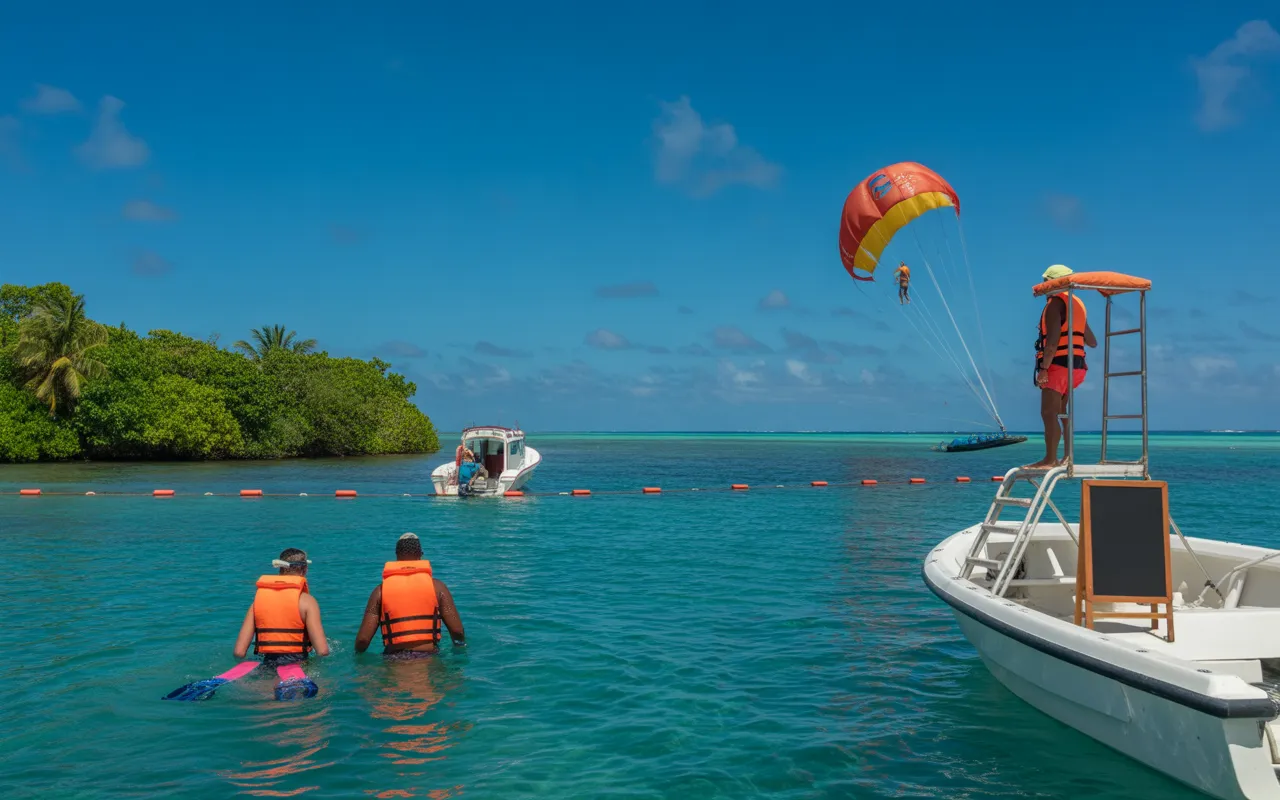
Parasailing: guaranteed panoramic views, provided you choose the right weather window.
Parasailing is generally practiced from a boat. Key points:
- Adjustable harness + clear briefing,
- Minimum weight/age as per operator,
- Activity postponed if wind is too strong (this is normal).
Jet skiing, tube riding, wakeboarding: fun, but strict rules
These activities are more "mechanical" and require a structured environment: a dedicated area, supervision, a high-vis vest, and safety distances. Tip: avoid crowded areas during peak hours, and pay close attention to the briefing (stop, fall, distances, signals).
Dolphins & whales: a memorable, but supervised experience
In Mauritius, whale watching is one of the most popular activities. To stay within the bounds of ethics and regulations:
- favor operators who clearly display their license and their practices,
- Refuse any "hunting" approach, pursuit, encirclement, or launching into the water in unclean conditions.,
- Keep in mind that local regulations govern the activity: the Tourism Authority references in particular to texts related to “Dolphin and Whale Watching”.
Prices for water sports in Mauritius: what you really need to budget for
Prices vary mainly depending on: the coast (North/East/West/South), the season, the duration, the level (beginner/experienced), privatization, and what is included (meals, transfers, equipment, insurance).
Method Rather than announcing a risky “average”, the table below includes published prices (online sources of providers/organizations consulted recently) to give you a concrete order of magnitude. Prices may change: always check when booking.
Examples of published rates (2025–2026): water sports in Mauritius
| Activity | Format / duration | published price | What this includes (according to the source) |
|---|---|---|---|
| Catamaran Île aux Cerfs | Shared day trip | 3,400 Rs / adult | Meals + drinks |
| Beginner diving (Discover Scuba) | Session + dive (center) | 3,300 Rs | Introductory session (pool) + sea dive |
| Kitesurfing (group lessons) | 2 hours | 4,500 MUR / person (season 01/07/2025 → 30/06/2026) | Equipment + insurance + safety boat (advertised) |
| Blue Bay (glass bottom boat) | Approx. 1 hour 15 minutes | €18 / adult | Excursion + snorkeling option (as described) |
| Parasailing (e.g., Belle Mare / Île aux Cerfs) | Flight (duration varies depending on the operator) | €52 (solo) / €71 (double) at Belle Mare; €54 at Trou d'Eau Douce / Île aux Cerfs | Equipment + supervision (depending on the operator) |
Budget advice : for activities displayed in euros, you can ask for the price in Mauritian rupees (Rs/MUR) when paying, as the exchange rate and conditions (taxes, transfers, options) change depending on the providers.
Maritime safety in Mauritius: rules to know (and apply)
1) Check the official bulletins (cyclone, heavy swells, heavy rain)
In Mauritius, conditions can change quickly: a "calm" sea in the morning can become dangerous with an approaching swell. A simple precaution:
- Check the alerts and bulletins of the Mauritius Meteorological Services,
- in case of a warning heavy swells, Avoid swimming, sea outings and exposed beaches (MMS publishes precautionary recommendations).
Regarding the risk of cyclones, the authorities remind us of the usual period from November 1st to May 15th, and the importance of following official communications. You can find preparedness advice on the government website: Be ready for cyclones (NDRRMC).
2) Understanding the flags and swimming areas
When an area is supervised, the flags provide an immediate indication of the risk level (swimming allowed, caution, prohibited). While the signage may vary from beach to beach, remember the essentials:
- Green : favorable conditions,
- YELLOW : caution (current, waves, visibility…),
- red Swimming prohibited.
3) Never underestimate the swell and currents
Two common mistakes made by travelers:
- confusing “good weather” and “safe sea”,
- relying solely on the lagoon without looking at the pass / the ocean.
In the event of a rough sea warning, official bulletins may explicitly advise against all outings at sea for recreational boaters, fishermen, and the general public. Take these messages seriously: they also apply to tourist water sports.
4) Security checklist before paying (10 points)
- Does the service provider clearly explain the program and the weather conditions for cancellation?
- Are life jackets available and mandatory when necessary?
- Briefing: procedures, areas, duration, signals?
- Reasonable number of people (boat, group, skill level)?
- Equipment in good condition (masks, fins, regulators, harnesses)?
- Qualified supervision (instructor, skipper, etc.)?
- Is there a first aid kit/oxygen supply for diving (if applicable)?
- Insurance: included or not, and what are the exclusions?
- Is the area suitable for your level (beginner vs. advanced)?
- We're not pushing you to "go anyway" if you don't feel it.
Practical advice (comfort + safety)
What to put in your bag
- Water-resistant sunscreen + UV-protective t-shirt (less sunburn, easier on a boat).
- Water shoes (rocks, sea urchins, corals).
- Waterproof bag / waterproof pouch.
- Anti-nausea if you are sensitive (catamaran / open sea).
- A light layer: the wind + sea spray cools quickly at sea.
Best times: consider each activity individually.“
Rather than looking for a single “best month”, think in terms of usage:
- kitesurf : depends a lot on the winds (and the spot),
- catamaran / snorkeling : favor days with calm seas,
- all activity at sea : during cyclone season (November 1 → May 15), maintain more flexibility and follow the bulletins.
FAQ – Water sports in Mauritius (prices, safety, tips)
What budget should I plan for a catamaran day trip to Île aux Cerfs?
For the most common "catamaran day trip" offers, the price depends mainly on the format (shared vs. private) and what is included (meals, drinks, transfers). For example, a shared trip advertised as including meals and drinks at 3,400 Rs per adult on an offer published online. Always check if the departure is from Mahébourg/Trou d'Eau Douce, if snorkeling equipment is provided, and the policy for rescheduling in case of rough seas.
Is scuba diving in Mauritius accessible to beginners?
Yes, through supervised "baptism"/initiation formats (often called Discover Scuba). For example, a center advertises an initiation including a session + sea dive at 3,300 Rs. Accessibility depends primarily on your comfort in the water and your health (sinuses, breathing). Ask questions at the center, follow the briefing, and don't hesitate to cancel if you don't feel confident: a good provider always prioritizes safety.
How can you tell if the sea is dangerous (swell) before going out on a boat?
The most reliable method is to consult the official bulletins. The Mauritius Meteorological Services publishes "Heavy Swell Warning Bulletins" and advises precautions to be taken; some notices mention "very rough" seas and explicitly advise against going out to sea for fishermen, boaters, and the general public. In practice, if a heavy swell is forecast, postpone catamaran trips, big-game fishing, snorkeling in exposed areas, and towed water sports. Even the lagoon can be affected depending on the channels.
Is it legal to swim with dolphins or see whales in Mauritius?
Activities involving cetaceans are regulated and must be carried out with authorized operators. Tourism Authority A page of legislation is available, including texts related to dolphin and whale watching. In all cases, refuse risky practices (chasing, encircling, forced entry into the water, lack of briefing). From a safety and ethical standpoint, prioritize respectful observation from a distance and choose providers who are transparent about their permits and rules.
And now ?
If you're preparing to move abroad, planning a long-term vacation, or embarking on a life in the sun, enjoy these water sports… while calmly organizing everything else. For a structured expatriation (visas/permits, housing, schools, banking/insurance, starting a business), discover Expat Mauritius (assistance in Mauritius) and browse the expatriation guides. You can also quickly access contact information via the homepage.