Mauritius has a rich history.
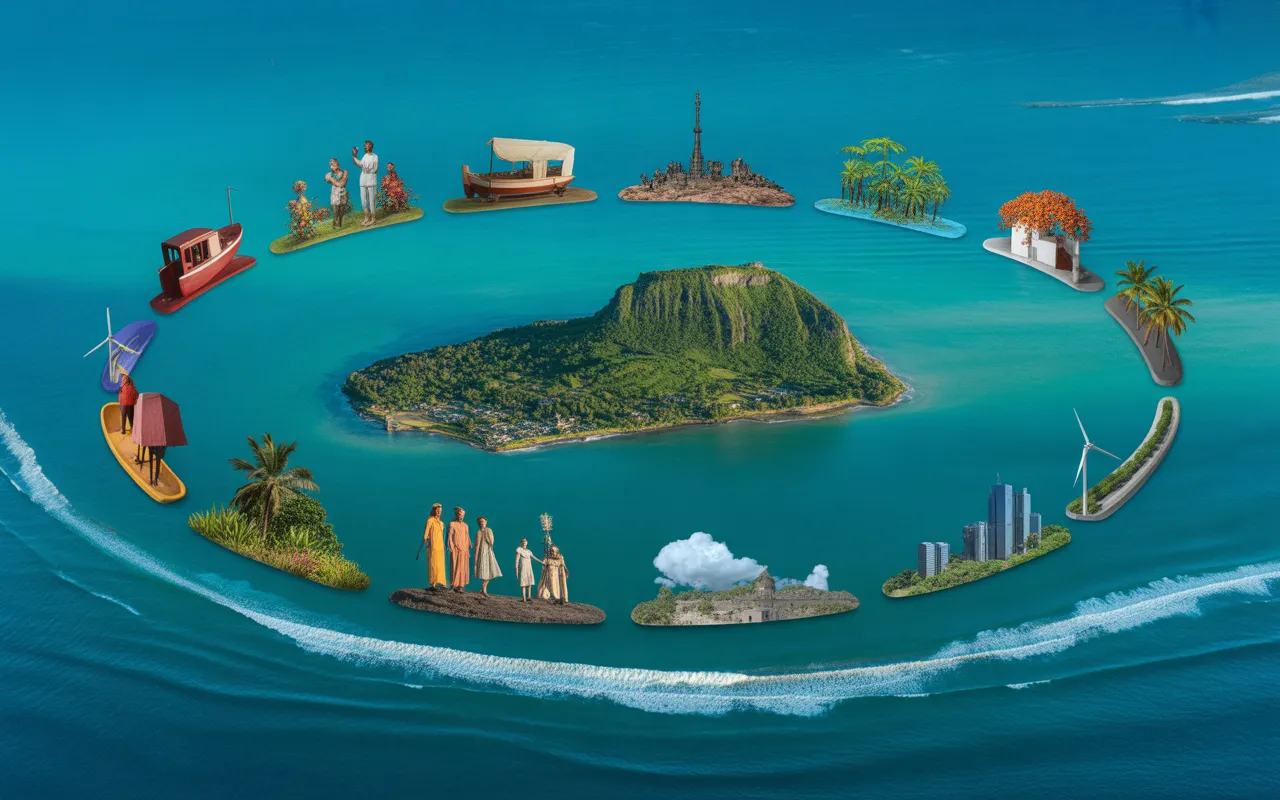
If you are looking to understand the history of Mauritius (often sought after as history of Mauritius), the simplest approach is to follow a clear chronology: a long-uninhabited island, then successive colonial periods (Dutch, French, British), the abolition of slavery, the arrival of indentured laborers, independence, and finally the construction of a multicultural nation.govmu.org)
To further develop your plans for living there, you can also consult:
Step 1 — A long-uninhabited island, spotted on the routes of the Indian Ocean
Before any permanent human settlement, Mauritius is described as long unknown and uninhabited, probably visited by Arab sailors in the Middle Ages. On maps around 1500, it appears with an Arabic name (often transcribed Dina Arobi). (govmu.org)
This point is essential: Mauritian history, unlike that of many territories, begins with successive arrivals (navigators, colonists, workers, traders) who, over the centuries, would form a very diverse society.govmu.org)
Step 2 — The Portuguese: passages, mapping, and the birth of the Mascarene Islands
At the beginning of the 16the In the 19th century, Portuguese navigators visited the island several times. The Mauritian government mentions that a Portuguese sailor (Domingo Fernandes Pereira) was the first European to land there. around 1511 and that the island appears on maps under the name Cirne. (govmu.org)
Another notable legacy: the name «"Mascarene Islands"» (Mauritius, Rodrigues, Réunion) is associated with Don Pedro Mascarenhas. The Portuguese, however, did not establish a permanent settlement.govmu.org)
Chronological markers (quick reading chart)
| Period / date | Key event | Why is it still visible today? |
|---|---|---|
| Around 1511 | Portuguese passages; the island appears as Cirne on maps | The mapping of the archipelago begins; the first steps towards maritime routes. |
| 1598–1710 | Dutch period: the island is named "Mauritius"« | Introductions of species and crops (including sugarcane) (govmu.org) |
| 1715–1810 | French period: "Isle de France", development of Port-Louis | Strong influences on language, culture, and institutions (govmu.org) |
| 1810–1968 | British period: abolition of slavery (1835), economic transformations | Political and administrative framework; demographic shift (indentured labor)govmu.org) |
| March 12, 1968 | Independence | Birth of the modern Mauritian state (cia.gov) |
| March 12, 1992 | Mauritius becomes a republic | Institutional consolidation; same date as the national holiday (cia.gov) |
Step 3 — The Dutch (1598–1710): the name «Mauritius» and the first settlements
In 1598, A Dutch squadron led by Admiral Wybrand Van Warwyck landed at Grand Port and named the island «Mauritius», in honor of Prince Maurice of Nassau. (govmu.org)
The Mauritian Government recalls that the first attempt at settlement was established in 1638, but the colony remained fragile and the Dutch eventually left the island in 1710. (govmu.org)
A sustainable agricultural legacy
The Dutch period is notably associated with the introduction of the sugar cane (as well as domestic animals and deer), elements that will influence the island's economy in the long term.govmu.org)
Step 4 — The dodo: a global symbol of extinction and an ecological lesson
It is impossible to talk about Mauritian history without mentioning the dodo, The flightless bird has become an emblem of Mauritius. According to the Mauritian government, human pressure and the introduction of species (rats, pigs, monkeys) have accelerated its decline, and The last dodo was reportedly killed in 1681.. (govmu.org)
Beyond the anecdote, it's a lesson that remains relevant today: on an island, ecosystems can be extremely sensitive to rapid changes (biological introductions, deforestation, overexploitation).govmu.org)
Step 5 — The French (1715–1810): Isle de France and the rise of Port Louis
In September 1715, Guillaume Dufresne D'Arsel takes possession of the island for France, which renames it «"Isle de France"». A more concrete occupation is put in place from 1721, Then the island developed significantly under Mahé de Labourdonnais, with Port Louis as its naval base and construction center.govmu.org)
The official text also highlights the role of Isle de France during the Napoleonic Wars: the island served as a base for privateers until the British expedition of 1810.govmu.org)
Step 6 — The British conquest (1810) and the Treaty of Paris (1814)
After clashes in 1810, the British finally landed in large numbers and the French administration capitulated. By the Treaty of Paris of 1814, Isle de France, once again renamed "Mauritius", was definitively ceded to Great Britain.govmu.org)
A striking (and rare) point is the continuity: the act of surrender, according to the Government of Mauritius, guarantees respect for the language, of the customs, of the laws and traditions of the inhabitants. This helps to understand why culture and the French language remain so present in Mauritius, despite a long British period.govmu.org)
Stage 7 — 1835: Abolition of slavery and social shift
During the British period (1810–1968), the abolition of slavery in 1835 is one of the major turning points. The Mauritian government indicates that compensation is being paid to the planters (mentioned as two million pounds sterling (based on this source) and focuses particularly on the demographic and socio-economic effects: the plantation system must recruit a new workforce.govmu.org)
This step explains part of the social structure and memories in Mauritius, and why certain heritage sites carry a strong symbolic weight (slavery, marronage, indentured servitude).govmu.org)
Step 8 — Indentured Labor: The arrival of nearly half a million contract workers
After abolition, Mauritius became a historical laboratory for "free" contract labor. UNESCO recalls that in 1834, The British government chose Mauritius for "the great experiment" aimed at replacing slavery with indentured labor, and that between 1834 and 1920, almost half a million Contract workers arrive mainly from India (as well as other regions), via the website of the’Aapravasi Ghat in Port Louis.whc.unesco.org)
«"The place where the modern diaspora of contract workers began."whc.unesco.org)
For further information, the official UNESCO dossier is an excellent reference: Aapravasi Ghat (UNESCO). (whc.unesco.org)
Why this is a key milestone in the history of Mauritius
- Demographic transformation Migrations linked to indentured servitude have a lasting impact on the population and cultural practices.whc.unesco.org)
- Economy Sugarcane is consolidated as a main export.govmu.org)
- Heritage The Aapravasi Ghat is a World Heritage Site in 2006. (unesco.org)
Stage 9 — Le Morne: Maroonage, memory of slavery and world heritage
Le Morne, in the southwest of the island, is one of the most significant places in Mauritian history. UNESCO describes Le Morne as a refuge for... runaway slaves (maroons) in the 18the and at the beginning of the 19the century, which became a symbol of resistance to slavery.whc.unesco.org)
The site is listed as a World Heritage Site in 2008 (with a boundary change in 2011 indicated on the UNESCO fact sheet).whc.unesco.org)
A reliable resource to consult: Le Morne Cultural Landscape (UNESCO). (whc.unesco.org)
Stage 10 — 1968 then 1992: the modern state, a plural society and a diversified economy
The British period ends with the’independence on March 12, 1968. Maurice then becomes a republic, March 12, 1992 (The same date is celebrated as a national holiday.)cia.gov)
A multicultural (and multilingual) society with encryption
CIA data (2011 estimates for languages/religions, and 2023 for population) provide useful benchmarks: Mauritius has approximately 1,309,448 inhabitants (2023), with a strong presence of Creole as the language of everyday use, and a cultural mosaic (Indo-Mauritians, Creoles, Sino-Mauritians, Franco-Mauritians).cia.gov)
An island economy that has managed to change scale
Mauritius is often cited as an example of economic diversification in the Indian Ocean. To illustrate the orders of magnitude, the IMF indicates a GDP per capita (current USD) estimated at 11,188 $ in 2023 And 11,883 $ in 2024 (with projections beyond).imf.org)
Why knowing the history of Mauritius is a concrete help when settling in
Understanding Mauritius's history isn't just "cultural": it's practical. It sheds light on:
- Languages in everyday life : a country where Creole is widely spoken, where French is very present, and where English is central to the institutions.cia.gov)
- Heritage references Aapravasi Ghat (indentured servitude) and Le Morne (maroon communities) are two keys to understanding the country today.whc.unesco.org)
- Religious and cultural diversity : a calendar of festivals and traditions stemming from several heritages (Indian, African, European, Chinese).cia.gov)
If your goal is to transform this understanding into a concrete project, you can browse the practical guides to expatriation or return to the page Living in Mauritius for an overview of the installation steps.govmu.org)
FAQ — Frequently asked questions about the history of Mauritius
Why was Mauritius also called "Isle de France"?
The name "Isle de France" dates back to the period when the island was a French colony. The Government of Mauritius states that in September 1715, Guillaume Dufresne D'Arsel took possession of the island for France and renamed it accordingly. This name remained in use until the British conquest (1810) and the cession confirmed by the Treaty of Paris (1814). Remembering this name is useful because many archives, maps, and historical buildings in Port Louis and Pamplemousses refer to this French period.govmu.org)
What is the difference between independence (1968) and the republic (1992) in Mauritius?
Independence marks the end of British sovereignty: Mauritius became an independent state on March 12, 1968. The republic corresponds to a later institutional development: on March 12, 1992, Mauritius became a republic (with a president as head of state), and the same date is associated with the national holiday "Independence and Republic Day". In practice, these two milestones help to situate the progressive construction of contemporary institutions.cia.gov)
What is Aapravasi Ghat and why is it a major site?
The Aapravasi Ghat, in Port Louis, is the former immigration depot linked to the arrival of indentured laborers in the 19th century.e century. According to UNESCO, Mauritius was chosen in 1834 for "the great experiment" aimed at replacing slavery with contract labor, and between 1834 and 1920 nearly half a million workers, mainly from India, passed through this location. The site was inscribed on the World Heritage List in 2006, as it bears witness to a major migration and a labor system that permanently transformed Mauritian society.whc.unesco.org)
Why is Le Morne associated with slavery and resistance?
Le Morne (southwest of Mauritius) is described by UNESCO as a place of refuge for runaway slaves (maroons) in the 18th century.e and at the beginning of the 19the century. Oral traditions have made it a symbol of the struggle for freedom, the suffering and sacrifice linked to slavery. Inscribed on the World Heritage List in 2008, Le Morne is today an essential landmark for understanding Mauritian collective memory and the place of slavery in the island's history.whc.unesco.org)
What languages are spoken in Mauritius, and where does this mix come from?
The Mauritian linguistic landscape is explained by the historical accumulation of periods and migrations. The CIA (2011 estimates) indicates a strong predominance of Creole as the language of everyday use, but also the presence of Bhojpuri, French, and English (very institutional, although a minority language in daily practice). Official sources also emphasize that the capitulation of 1810 was accompanied by guarantees of respect for languages and customs, which helps to understand the cultural continuity observed today.cia.gov)
And now ?
Understanding the history of Mauritius helps us better understand the country today: its diversity, its cultural landmarks, its heritage sites, and its social balance. If you are planning to move there (alone, with your family, or to start a business), you can begin with the expatriation guides, then discover the support offered on Expat Mauritius to structure your arrival project in Mauritius.cia.gov)