Buying in Mauritius is not just about the price displayed.
Between PDS, IRS, and RES, the right choice depends primarily on the type of property, the level of services, your budget, and your residency objective; in all three cases, the EDB regulates purchases by non-citizens, and an investment exceeding USD 375,000 can grant residency to the owner and their family. (edbmauritius.org)
Since December 13, 2024, a practical point has changed for purchases under these schemes: the non-citizen buyer must now pay 85 % of the price in Mauritian rupees to the developer, with the remaining 15 % payable in foreign currency or Mauritian rupees. (edbmauritius.org)
Understanding the real estate purchase framework for a non-citizen
In Mauritius, property purchases by non-citizens do not follow a single universal rule. The general principle is simple: except in specific cases, prior authorization is required, and the administration requests basic documents such as a site plan, an appraisal report, and an indication of the source of funds. For certain approved residential projects, however, the EDB (Environmental Development Board) is the key point of contact for the application.dha.govmu.org)
In practice, the PDS, IRS, and RES programs remain the best-known frameworks for purchasing residential property in an authorized project. The EDB also indicates that foreigners can acquire property in existing IRS projects, while the PDS was designed to facilitate the development and purchase of luxury residences by non-citizens. (edbmauritius.org)
PDS, IRS and RES: a quick comparison
Comparative table of the three devices
| Device | Program logic | Assets concerned | Residence and key point | Key points to remember |
|---|---|---|---|---|
| PDS | A program designed for high-end residences with services, common areas and a commercial or leisure component. | Luxury villas, apartments, penthouses and, in some cases, serviced plots of land. | There is no minimum purchase price under the scheme, but a residency permit is granted for properties exceeding USD 375,000; the permit remains valid as long as the property is owned. (edbmauritius.org) | The PDS (Property Development Scheme) is often the most flexible option for a long-term property purchase with a life goal in Mauritius. (edbmauritius.org) |
| IRS | Purchasing framework within already approved integrated projects, often oriented towards lifestyle and premium residential environment. | Residences located in existing IRS projects. | The residency threshold remains at USD 375,000 for the purchaser and their dependents, according to EDB rules. (edbmauritius.org) | Interesting if you are targeting an existing project with a resort or integrated set logic. (edbmauritius.org) |
| RES | Approved residential program, more classic in its real estate complex logic than the PDS. | Residential properties in approved RES projects. | The residency threshold also remains at USD 375,000 for the purchaser and their dependents. | Useful if the property in question belongs to an already structured and authorized RES project. (edbmauritius.org) |
Key points to remember: If your priority is project flexibility, services, and clarity when buying a home, the PDS (Property Development Scheme) is often the most logical starting point. If you are buying in an existing or established project, the IRS (Integrated Residential Scheme) or RES (Real Estate Scheme) may be perfectly suited. (edbmauritius.org)
Which system should you choose based on your project?
Choose the PDS for a prestigious purchase with a residence
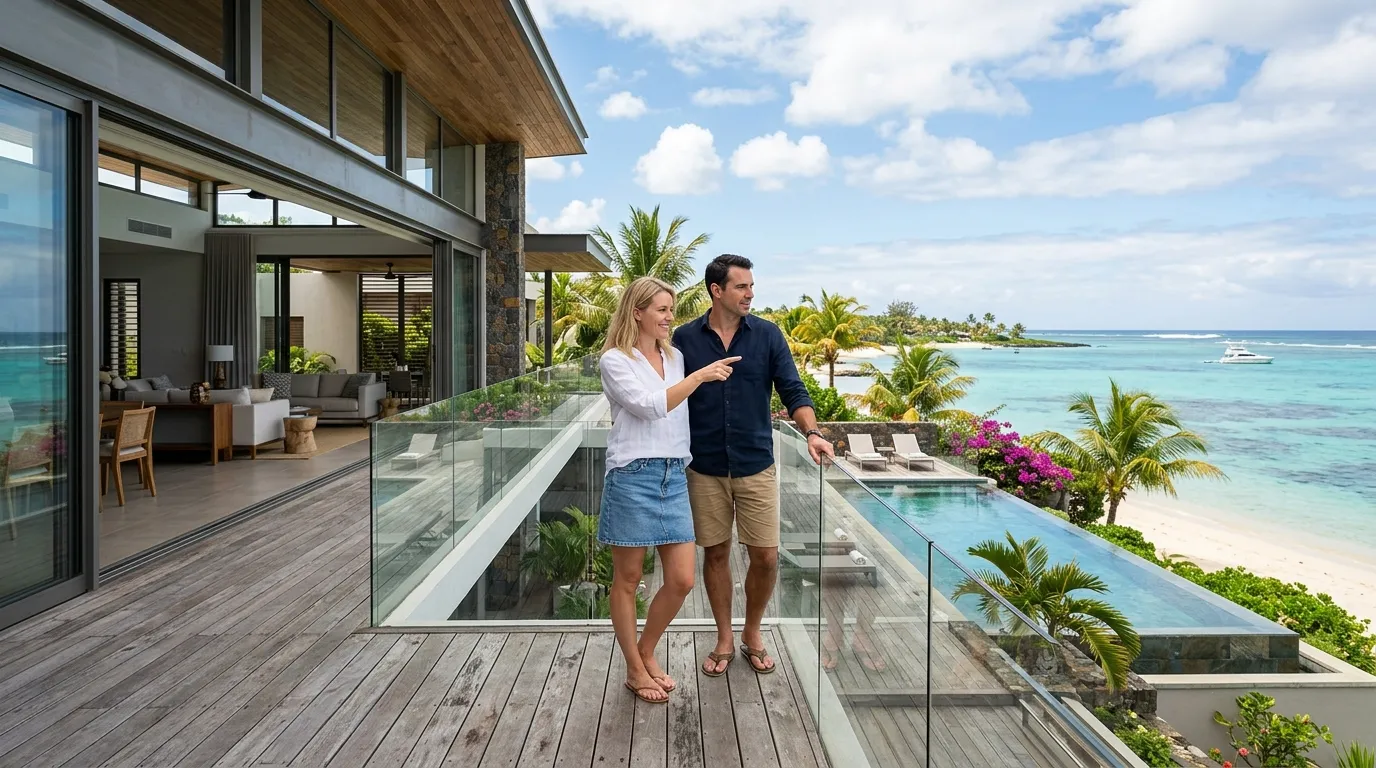
The PDS (Property Development Scheme) is generally the best choice if you are looking for a luxury villa or apartment with a more comprehensive residential environment: high-quality amenities, leisure spaces, services, and day-to-day management. The EDB (Mauritius Development Board) also specifies that the PDS can include serviced plots, that the project must have at least six residential units, and that there is no minimum purchase price under this scheme. (edbmauritius.org)
Choose the IRS if you are aiming for an already existing integrated system.
The IRS (Integrated Residential Scheme) is relevant when targeting a residential program that has already been approved and is integrated into a resort-type environment or large real estate development. The advantages often lie in the project's maturity, the clarity of the common areas, and the established purchasing framework. For the residence, the threshold remains USD 375,000, with the same benefit for dependents. (edbmauritius.org)
Choose RES if you are looking for a more traditional approved residential project.
The RES scheme is suitable when the property in question is part of an authorized residential development, without necessarily having the "resort" feel of an IRS scheme. Here again, the decisive factor is less the acronym than the quality of the project, its approval status, and compliance with the residency threshold. For many buyers, the difference therefore lies primarily in the type of development, its level of luxury, and its location.
Points to consider before signing
The first point to verify is the exact status of the project: whether it is approved under the correct scheme and whether it can accommodate a non-citizen buyer. The second is the payment method, as Regulation 85/15, which came into effect on December 13, 2024, has a direct impact on financing and bank flows. (edbmauritius.org)
The third point, often underestimated, concerns the timeframe and sequence of formalities: file validation, signing of the deed, registration, and then possibly a residency application. The EDB also reminds us that a non-citizen can buy an apartment in a G+2 type condominium with prior approval, provided the price is at least 6 million MUR. This is a useful point to consider if you are comparing the PDS, IRS, and RES schemes to a more “standard” apartment purchase.migration.govmu.org)
The steps to take, in order
- Verify that the property is located within an authorized project and identify the applicable scheme.
- Confirm the actual budget, incorporating the payment rule of 85 % in MUR and 15 % in foreign currency or MUR. (edbmauritius.org)
- Prepare the documents for the file requested by the administration, including the site plan, the evaluation and proof of the origin of the funds.
- Have the deed drawn up and registered in the correct order with the notary, then check that the purchase is properly recorded.
- If you are aiming for residency, prepare the corresponding application as soon as you reach the threshold of USD 375,000. (edbmauritius.org)
To prepare the other building blocks of your project — installation, banking, schools, insurance or visa — the Expat Mauritius practical guides can also help you structure your steps.
FAQs about PDS, IRS and RES programs
What are the differences between PDS, IRS and RES for the purchase of a property in Mauritius?
The PDS is geared towards upscale residences with services, common areas, and sometimes serviced lots, while the IRS and RES schemes are used to purchase units in existing approved projects. In terms of the residence itself, all three schemes share the $375,000 threshold for the owner and, depending on the rules, their dependents. In practice, the PDS is often seen as the most flexible for a high-end, turnkey purchase. (edbmauritius.org)
What is the minimum investment amount to purchase property under the PDS, IRS or RES and obtain a residency permit?
The residency threshold indicated by the EDB is USD 375,000 or the equivalent in a freely convertible currency. For the PDS (Property Development Scheme), a distinction must be made between the purchase price of the property and access to the permit: the EDB specifies that there is no minimum purchase price under the scheme, but that the residency permit is required for properties exceeding USD 375,000. (edbmauritius.org)
Can a non-citizen obtain a residence permit by purchasing property through the PDS in Mauritius?
Yes, subject to meeting the investment threshold and scheme conditions. The EDB indicates that a non-citizen who purchases property under the PDS for more than USD 375,000 can obtain a residence permit as long as they retain ownership of the property. The spouse and children under 24 can also be included, and permit holders are exempt from work permits to invest and work in Mauritius. (edbmauritius.org)
What types of real estate are eligible under the PDS, IRS and RES in Mauritius?
The PDS covers villas, apartments, penthouses, and, in some cases, serviced plots within an authorized project. For the IRS and RES, the EDB distinguishes between residential properties in existing approved projects, with an acquisition process governed by the program's framework. If your search is for an apartment, you should also check whether the property falls under a G+2 scheme or another authorized arrangement. (edbmauritius.org)
What administrative procedures are required to invest in real estate in Mauritius through these schemes?
First, it's necessary to verify that the property and the project are properly authorized. Then, the required documentation must be prepared by the authorities: a site plan, an evaluation report, and proof of funding. Next comes the signing of the deed, registration, and finally, a residency application if the investment threshold is met. If the property doesn't fall within an approved scheme, prior authorization becomes mandatory.
And now ?
If you're still hesitating between PDS, IRS, and RES, the most effective approach is to start with your actual objective: primary residence, rental income, wealth purchase, or family settlement. To move forward with confidence, begin with the Expat Mauritius homepage And, if you want to check the site's editorial framework, also consult the legal notices.